
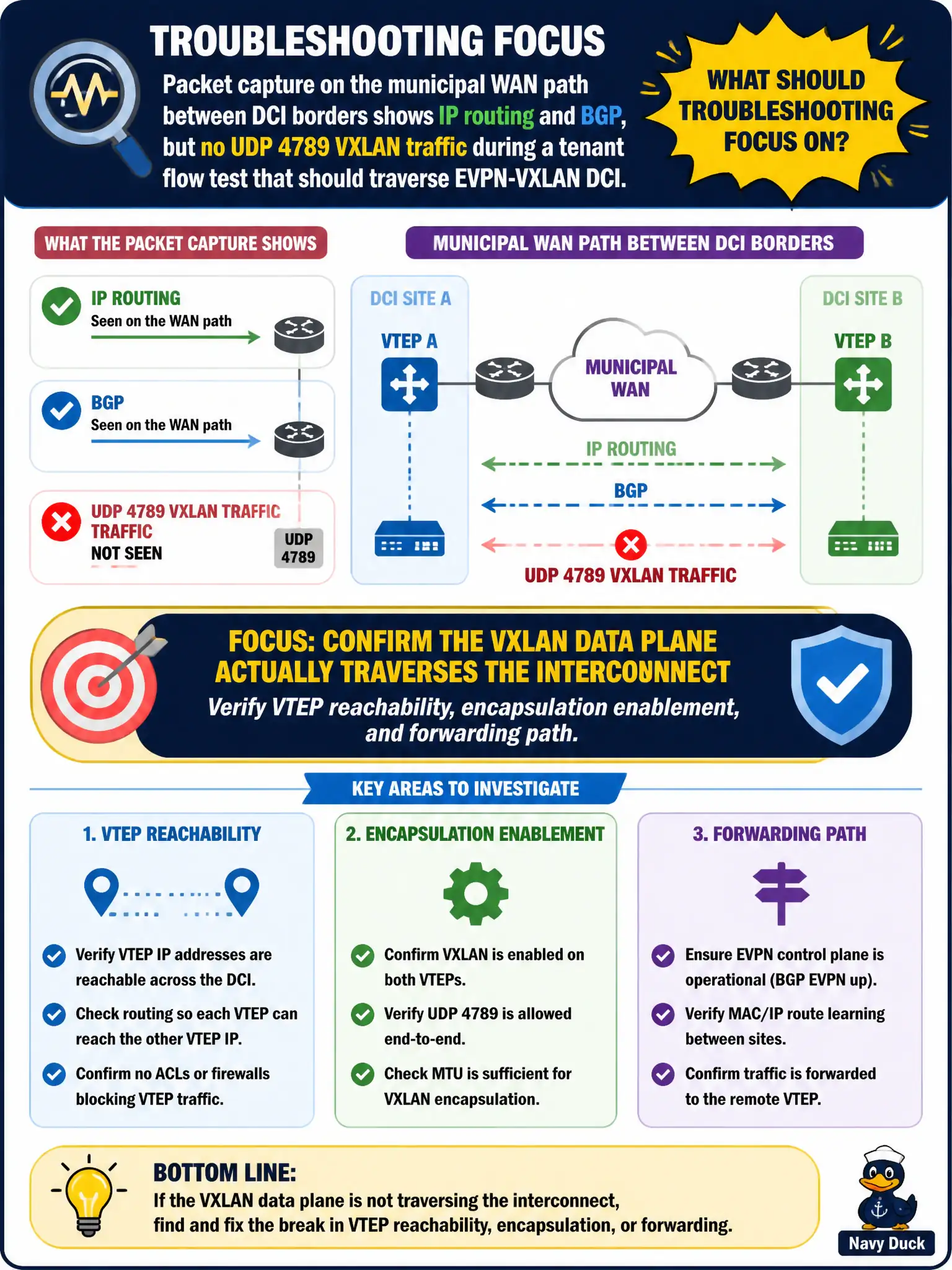
Packet capture on the municipal WAN path between DCI borders shows IP routing and BGP, but no UDP 4789 VXLAN traffic during a tenant flow test that should traverse EVPN-VXLAN DCI. What should troubleshooting focus on?
Select an answer to reveal the explanation.
Short Explanation
If the WAN sniff shows zero VXLAN UDP, the overlay trucks are not on that road—even if BGP looks pretty. Verify VTEPs can reach each other, encapsulation is on, and traffic is really steered into the DCI overlay. Control plane green lights are not a data-plane proof.
Full Explanation
When packet capture on the municipal WAN path between DCI borders shows IP routing and BGP but no UDP 4789 VXLAN traffic during a tenant flow test that should traverse EVPN-VXLAN DCI, troubleshooting should focus on confirming the VXLAN data plane actually traverses the interconnect—VTEP reachability, encapsulation enablement, and forwarding path. Control-plane evidence without VXLAN packets means traffic is hairpinning locally, bypassing the DCI, failing encapsulation, or being filtered before the WAN tap. Assuming EVPN Type-2 advertisements alone guarantee VXLAN packets on the WAN without further checks skips data-plane validation. Replacing BGP with RIPv2 on the underlay because VXLAN supposedly cannot ride BGP-routed IP networks is an unfounded protocol swap; VXLAN routinely rides IP underlays with BGP. Disabling all VNIs so the capture shows native Ethernet instead of UDP 4789 destroys the overlay rather than diagnosing it. Exam caveat: absence of UDP 4789 on a supposed DCI flow is a data-plane path problem until proven otherwise. Operational check: generate a known tenant flow that must cross sites, verify local and remote VTEP IPs, check filters for UDP 4789, confirm the correct VNI is active, and recapture on the WAN; if still empty, traceroute the forwarding path to find where the civic flow leaves the intended DCI encapsulation path.