
During a large civic VM evacuation, the stitch gateway CPU spikes while MAC/IP routes churn across the DCI. What should the ops team monitor and plan for?
Select an answer to reveal the explanation.
Short Explanation
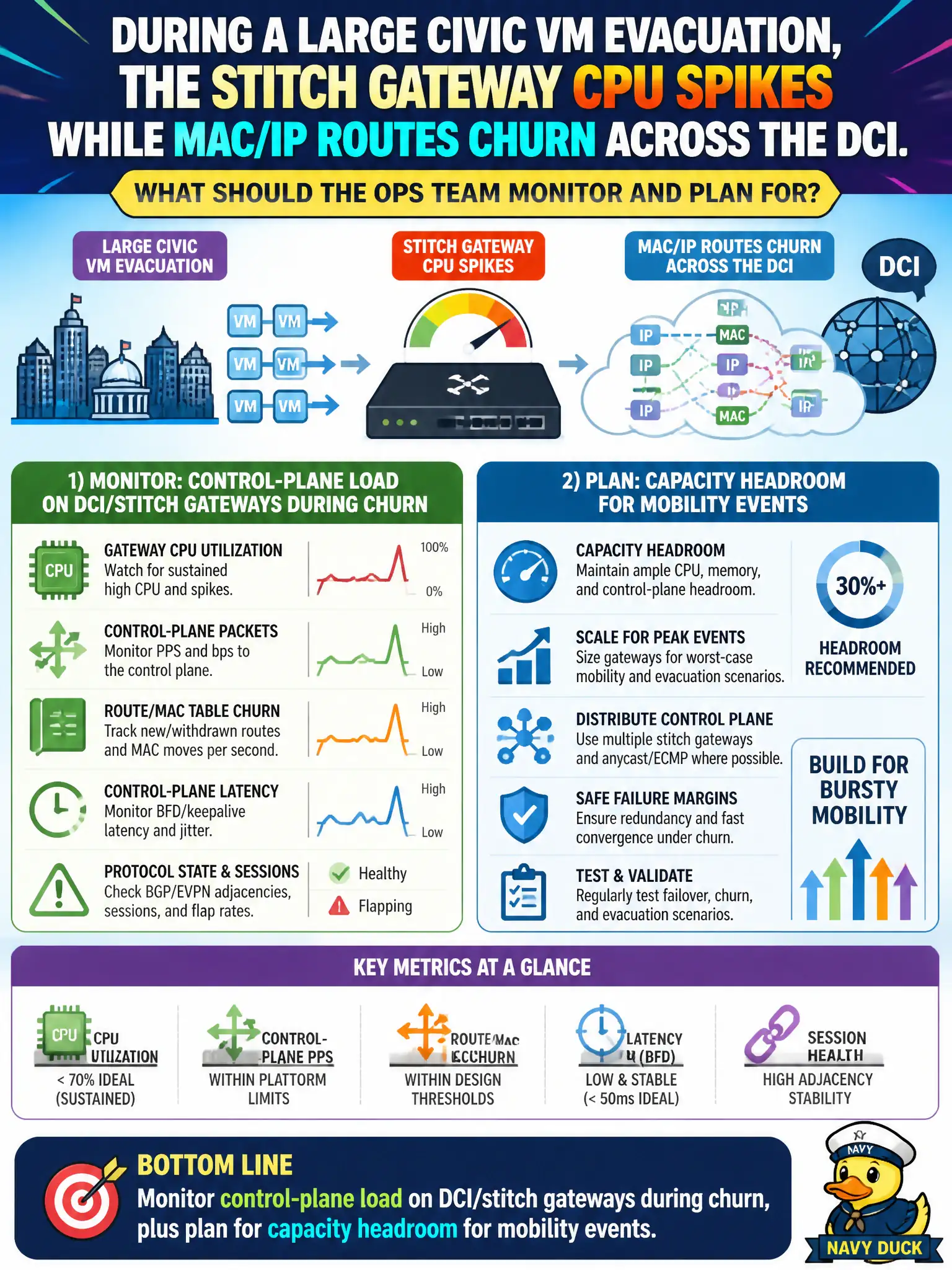
Mass MAC moves make the stitch gateway the busy dispatcher—CPU and BGP EVPN churn climb together. Watch control-plane load and keep spare capacity for migration days. Hoping CRCs on access ports tell that story will miss the spike.
Full Explanation
During a large civic VM evacuation, when the stitch gateway CPU spikes while MAC/IP routes churn across the DCI, the ops team should monitor and plan for control-plane load on DCI/stitch gateways during churn, plus capacity headroom for mobility events. Mass MAC mobility generates EVPN updates, FIB churn, and encapsulation work concentrated on stitch PEs; cities that evacuate racks without capacity planning discover the interconnect control plane is the bottleneck. Watching only access-port CRC counters because stitch CPU is supposedly unrelated to MAC moves ignores the control-plane cost of multi-site mobility. Disabling MAC mobility so the stitch gateway never processes route updates breaks legitimate VM moves and freezes stale locations. Pinning every VM to one site permanently so EVPN never withdraws or re-advertises MACs may be a business constraint for some apps, but it is not a universal substitute for sizing stitch gateways to handle planned evacuations. Exam caveat: mobility events are stitch capacity events—design headroom and dual gateways, do not “fix” load by disabling mobility. Operational check: before a municipal evacuation drill, baseline stitch CPU and EVPN update rates; during the drill, watch RE/CPU, queue drops, and route churn; if thresholds trip, add stitch capacity or stage moves in waves, and update the evacuation playbook with measured limits.