
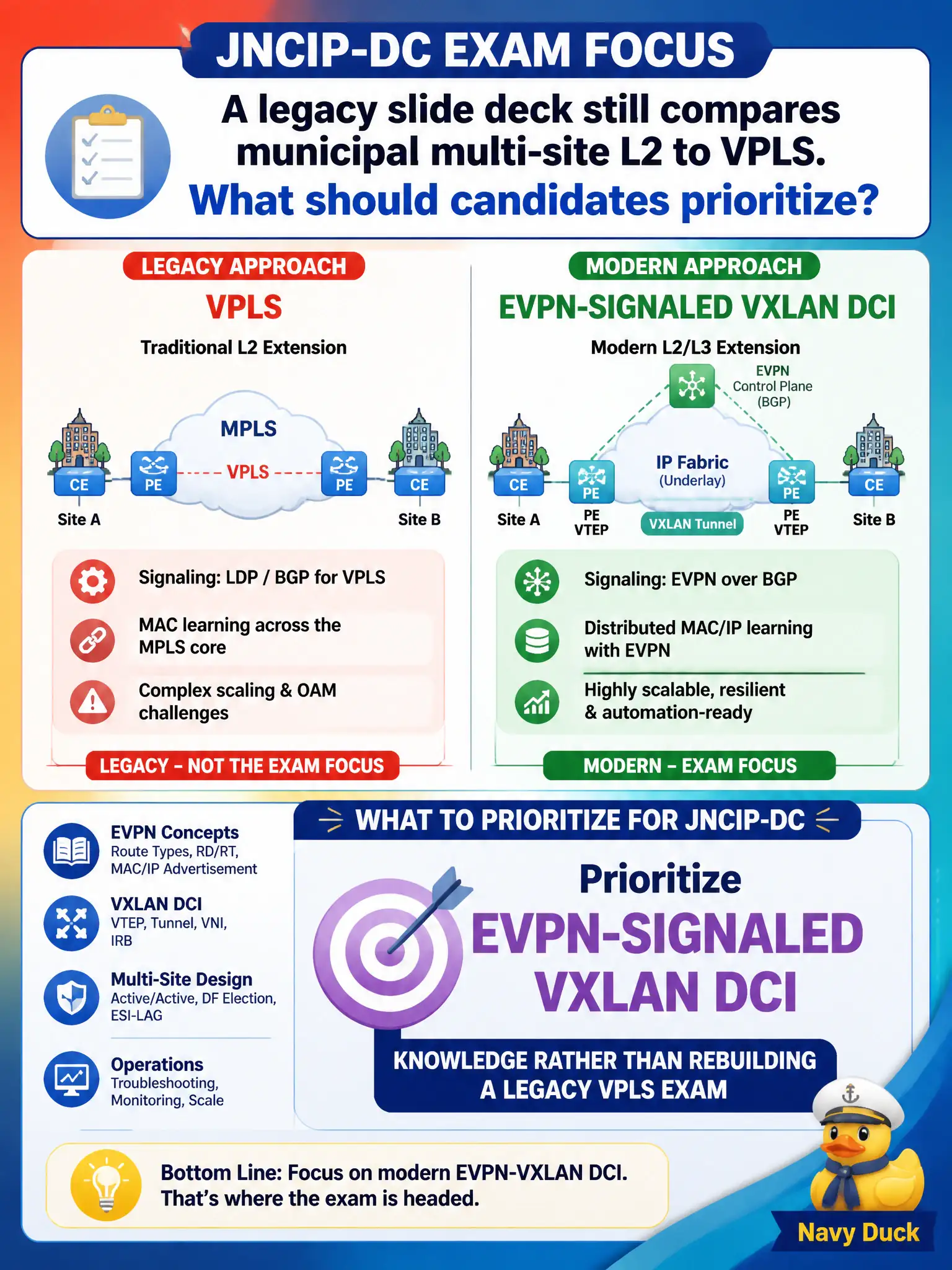
A legacy slide deck still compares municipal multi-site L2 to VPLS. For JNCIP-DC exam focus, what should candidates prioritize?
Select an answer to reveal the explanation.
Short Explanation
VPLS is the old chapter; EVPN-VXLAN DCI is the one this cert wants on the test. Know the contrast at a high level, then spend study time on EVPN signaling and VXLAN between sites. Do not turn practice into a VPLS nostalgia quiz.
Full Explanation
When a legacy slide deck still compares municipal multi-site L2 to VPLS, JNCIP-DC candidates should prioritize EVPN-signaled VXLAN DCI knowledge rather than rebuilding a legacy VPLS exam. Current blueprint interconnect objectives center on EVPN control plane with VXLAN data plane between data centers, including route types, RT policy, and VTEP underlay needs for civic multi-site fabrics. Rebuilding a full VPLS configuration exam because VPLS allegedly replaced EVPN-VXLAN DCI in JN0-683 reverses the actual technology direction and wastes study time. Treating VPLS pseudowire details as the primary interconnect objective over EVPN similarly mis-weights the exam. Ignoring EVPN Type routes to study only spanning-tree multi-site designs anchors learning on stretched VLAN/STP patterns that EVPN-VXLAN DCI is meant to supersede for scalable overlays. Exam caveat: study EVPN-VXLAN DCI deeply; use VPLS only as historical contrast unless a specific objective still names it. Operational check: align the city’s interconnect lab and study checklist to EVPN session bring-up, Type-2/Type-5 exchange, RT mapping, and VXLAN capture between borders; archive VPLS slides as legacy reference so new engineers are not examined on the wrong primary technology.