
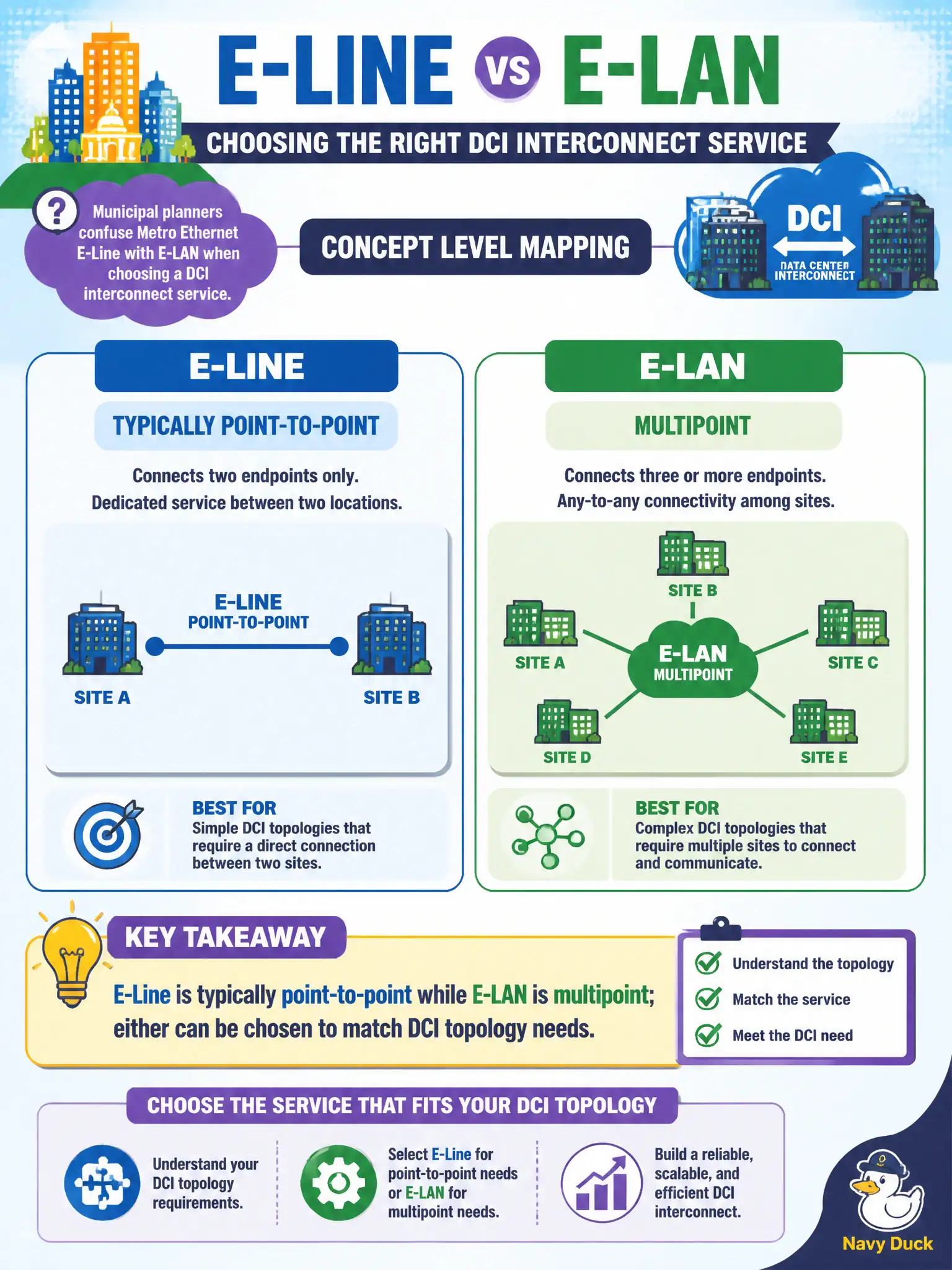
Municipal planners confuse Metro Ethernet E-Line with E-LAN when choosing a DCI interconnect service. Which mapping is correct at the concept level?
Select an answer to reveal the explanation.
Short Explanation
E-Line is usually a point-to-point wire; E-LAN is a multipoint party line. Map the Metro Ethernet service shape to how many DC sites need to meet, then choose.
Full Explanation
At the concept level, Metro Ethernet E-Line is typically a point-to-point service while E-LAN is multipoint; either may be chosen to match municipal DCI topology needs (two halls versus many). They are not identical multipoint services with no design difference. E-LAN is not always Layer-3 only, and E-Line is not always encrypted Internet transit. E-Line does not require Apstra blueprints, and E-LAN does not require Contrail as the DCI control plane. Exam caveat: the carrier service type constrains topology, but EVPN overlay choices (L2 stretch versus L3) still sit on top—E-LAN does not automatically make unsafe L2 stretch a good idea. Operational check: match a two-site city DCI to E-Line or a multipoint regional design to E-LAN as appropriate, verify the handoff encapsulation and MTU, and then apply the EVPN stretch model that the applications require. Map E-Line versus E-LAN to site count first, then choose EVPN stretch independently based on application adjacency needs. Map E-Line versus E-LAN to site count first, then choose EVPN stretch independently based on application adjacency needs. Map E-Line versus E-LAN to site count first, then choose EVPN stretch independently based on application adjacency needs.