
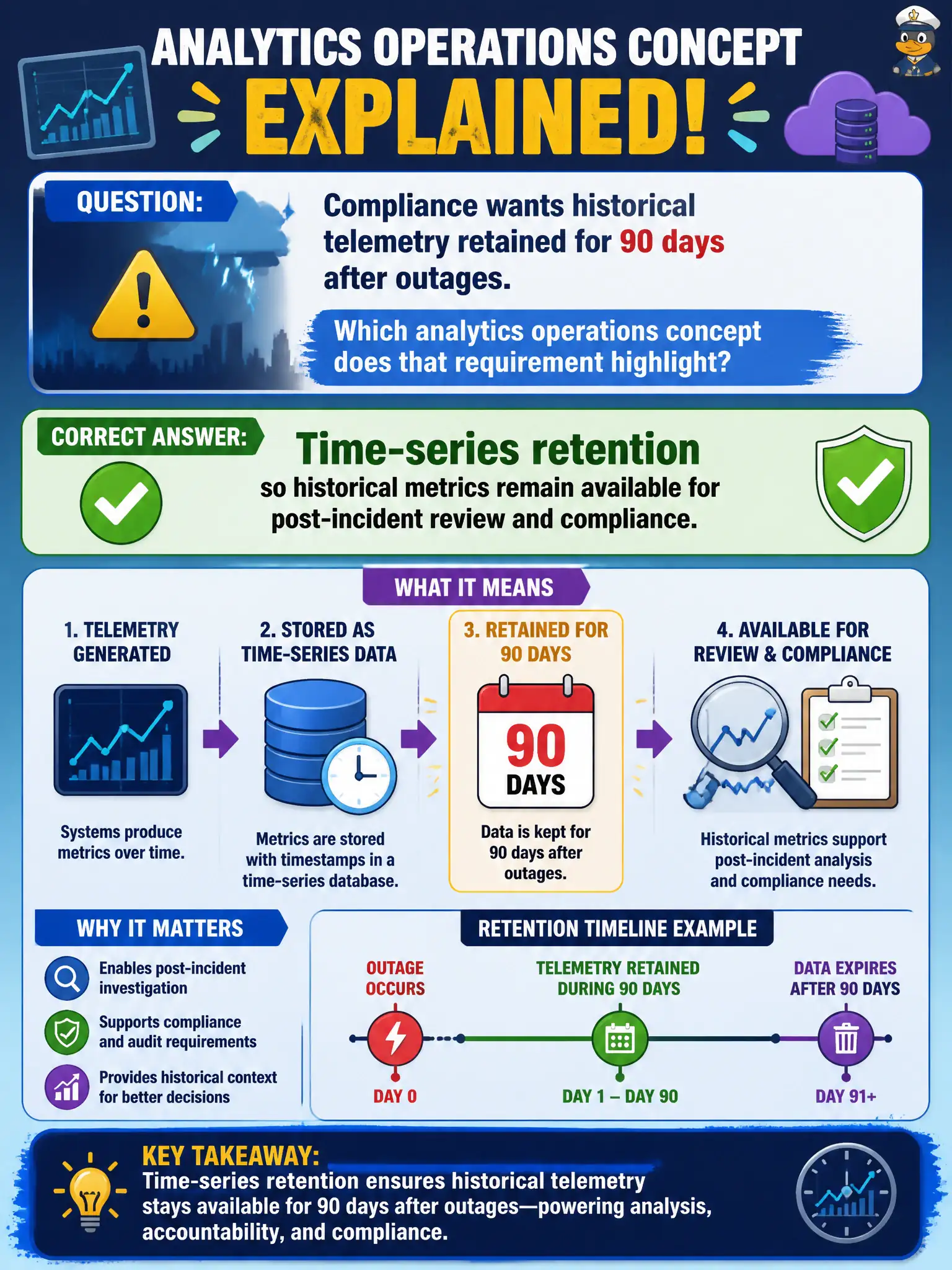
Compliance wants historical telemetry retained for 90 days after outages. Which analytics operations concept does that requirement highlight?
Select an answer to reveal the explanation.
Short Explanation
Ninety days of telemetry is the flight recorder for the fabric—when something breaks, you rewind the tape. Compliance is asking for that recorder to keep spinning, not for sticky notes or a five-second memory. Wipe-at-end-of-shift policies make postmortems guesswork.
Full Explanation
Time-series retention keeps historical metrics available for post-incident review and compliance—highlighted by a 90-day telemetry retention requirement after outages. Deleting all metrics each shift destroys forensics. Keeping only the latest five-second sample fails historical review. Sticky notes on spines are not durable analytics storage. Exam caveat: Retention is a storage and lifecycle policy decision tied to civic compliance needs. Operational check: Query a metric from 60+ days ago on the collector and confirm it is still retrievable. In civic data-center operations, record the expected CLI or collector evidence for this concept so the next on-call engineer can validate fabric behavior without re-deriving the design under incident pressure. In civic data-center operations, record the expected CLI or collector evidence for this concept so the next on-call engineer can validate fabric behavior without re-deriving the design under incident pressure. In civic data-center operations, record the expected CLI or collector evidence for this concept so the next on-call engineer can validate fabric behavior without re-deriving the design under incident pressure. In civic data-center operations, record the expected CLI or collector evidence for this concept so the next on-call engineer can validate fabric behavior without re-deriving the design under incident pressure.