
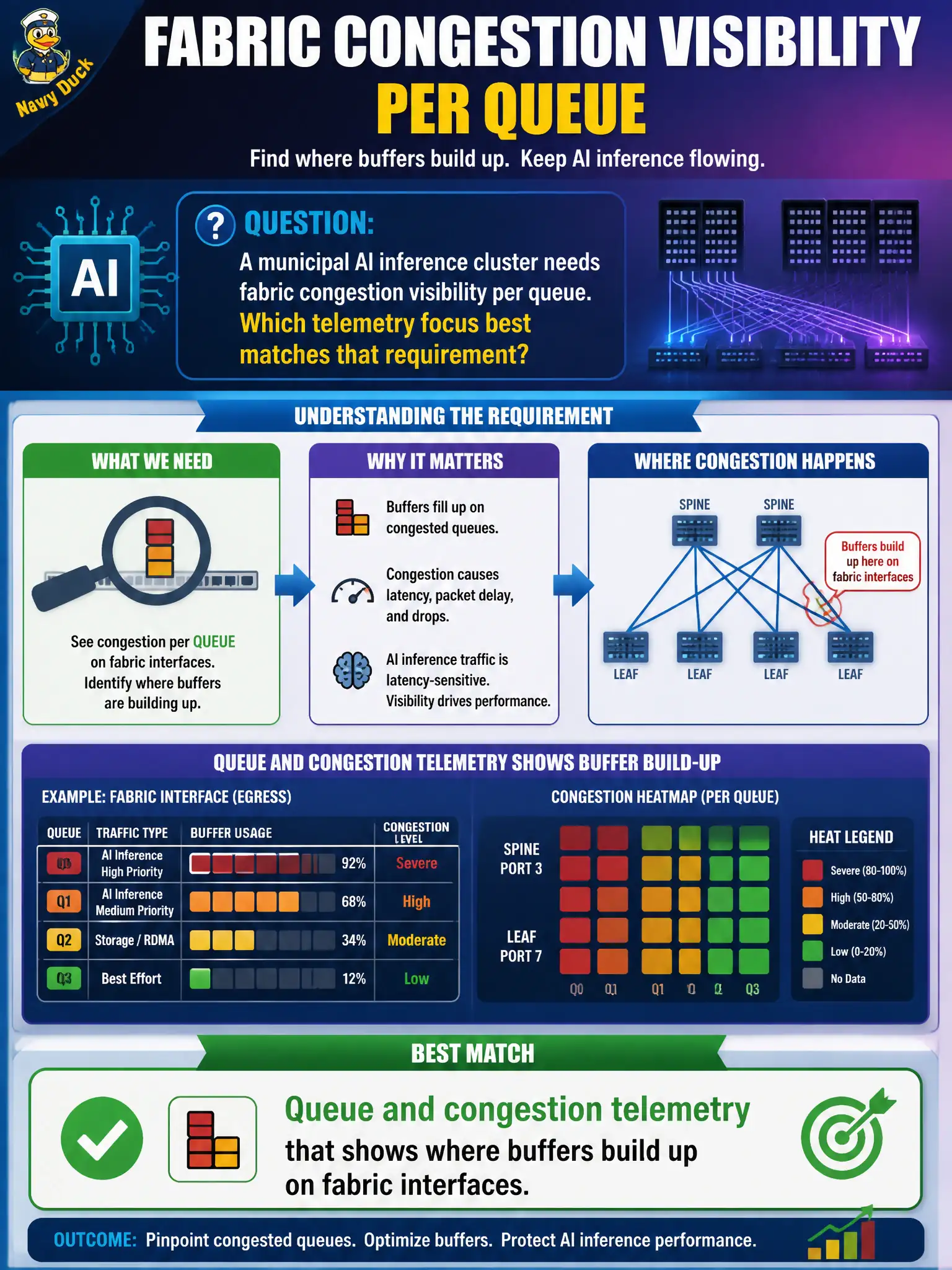
A municipal AI inference cluster needs fabric congestion visibility per queue. Which telemetry focus best matches that requirement?
Select an answer to reveal the explanation.
Short Explanation
AI east-west bursts pile up in switch queues like cars at a too-short on-ramp. Per-queue congestion telemetry shows which ramps are jammed before jobs time out. Empty RU placeholders and lunch lines will not explain fabric drops.
Full Explanation
Queue and congestion telemetry shows where buffers build on fabric interfaces—matching a municipal AI inference cluster’s need for per-queue congestion visibility. Empty rack-unit placeholders are not congestion telemetry. Cafeteria wait times are unrelated. Disabling queue counters removes the required signal. Exam caveat: East-west AI bursts often show first as queue pressure, not as a simple link-down. Operational check: Identify top congested queues during a job burst and map them to the exact leaf/spine interfaces. In civic data-center operations, record the expected CLI or collector evidence for this concept so the next on-call engineer can validate fabric behavior without re-deriving the design under incident pressure. In civic data-center operations, record the expected CLI or collector evidence for this concept so the next on-call engineer can validate fabric behavior without re-deriving the design under incident pressure. In civic data-center operations, record the expected CLI or collector evidence for this concept so the next on-call engineer can validate fabric behavior without re-deriving the design under incident pressure. In civic data-center operations, record the expected CLI or collector evidence for this concept so the next on-call engineer can validate fabric behavior without re-deriving the design under incident pressure.