
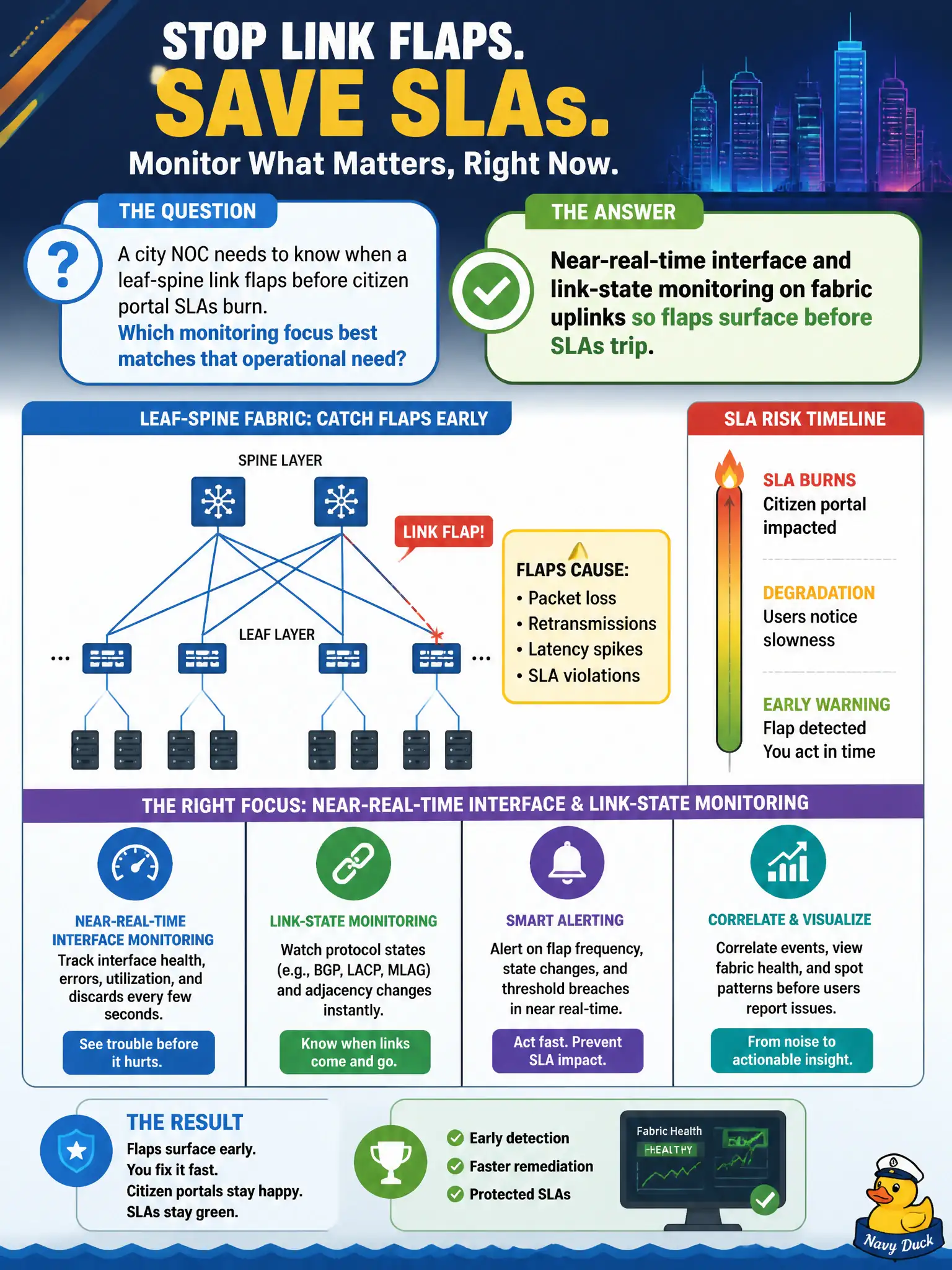
A city NOC needs to know when a leaf-spine link flaps before citizen portal SLAs burn. Which monitoring focus best matches that operational need?
Select an answer to reveal the explanation.
Short Explanation
Citizen portals die when the fabric link flaps—not when next year's license spreadsheet updates. Watch the leaf-spine link state like a bridge sensor that beeps the second a cable goes dark. If you only stare at DNS from a laptop, you miss the actual road that just collapsed.
Full Explanation
Near-real-time interface and link-state monitoring on leaf-spine uplinks surfaces flaps before citizen portal SLAs burn—fabric health visibility that annual spreadsheets cannot provide. Annual capacity sheets without live interface feeds miss active flaps. License expiry calendars do not detect link failure. Helpdesk DNS latency checks do not observe fabric uplink state. Exam caveat: Alerting thresholds should prioritize critical leaf-spine links that carry municipal east-west and north-south traffic. Operational check: Flap a lab uplink and confirm the NOC alert fires with interface identity before any synthetic SLA probe fails. In civic data-center operations, record the expected CLI or collector evidence for this concept so the next on-call engineer can validate fabric behavior without re-deriving the design under incident pressure. In civic data-center operations, record the expected CLI or collector evidence for this concept so the next on-call engineer can validate fabric behavior without re-deriving the design under incident pressure. In civic data-center operations, record the expected CLI or collector evidence for this concept so the next on-call engineer can validate fabric behavior without re-deriving the design under incident pressure.