
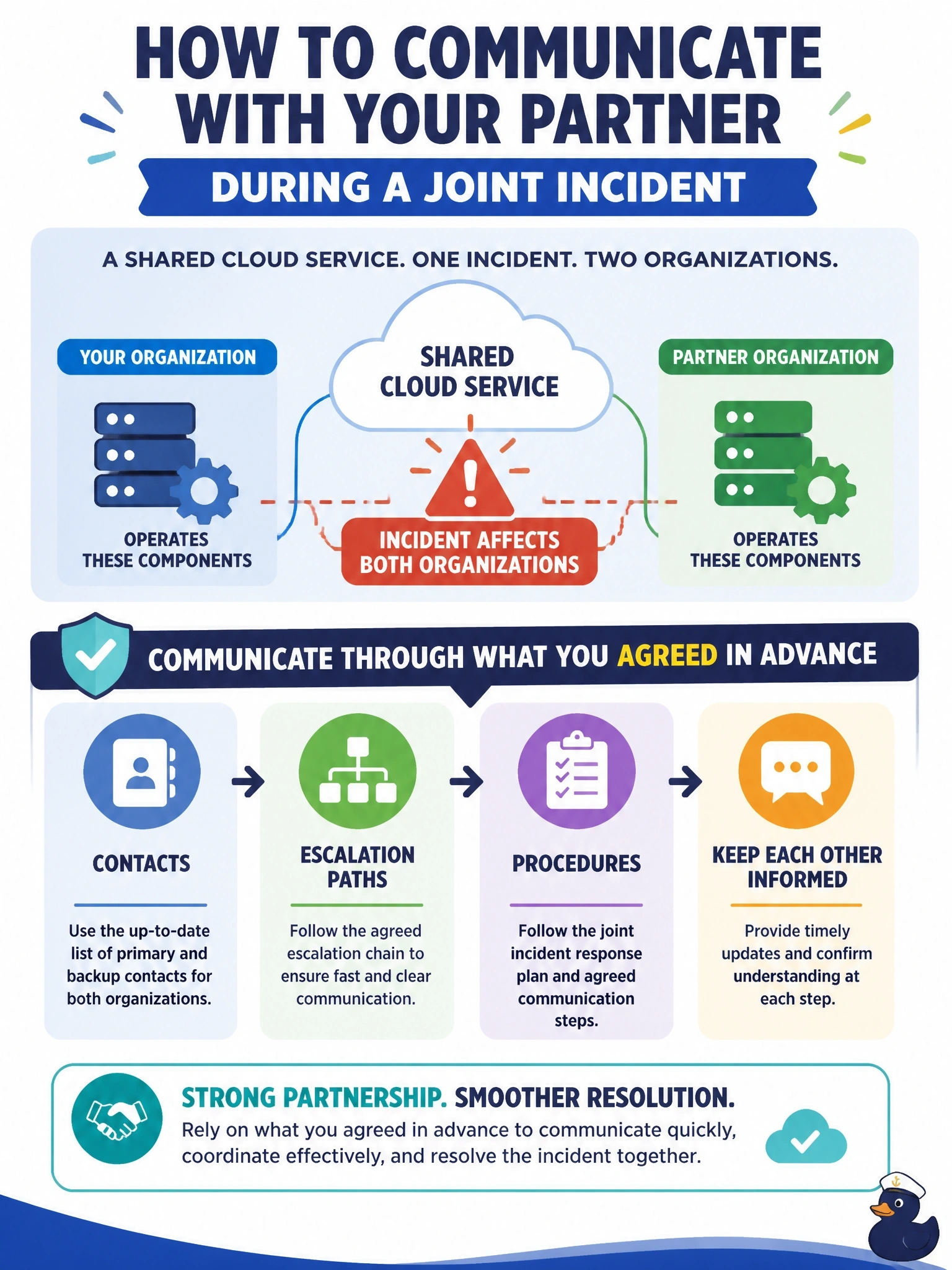
A company jointly delivers a cloud service with a partner, and each organization operates different components. An incident now affects both organizations. How should communication with the partner be handled?
Select an answer to reveal the explanation.
Short Explanation
When two teams share the field, you agree the signals before kickoff, not mid-play. A joint plan with named contacts and escalation paths means the right people hear the right things fast. The trap is relying on who you happen to know, or broadcasting it to the world.
Full Explanation
When services are delivered jointly, incidents frequently cross organizational boundaries, and effective response depends on coordination that was established beforehand. Partner agreements should define security incident contacts and backups on both sides, escalation paths, secure channels, notification timeframes, information-sharing rules and who communicates externally. A joint incident response plan, exercised periodically, turns those terms into working procedures. Relying on personal relationships may be quick, but it bypasses authorized decision-makers, can leak sensitive information to the wrong people, and fails when those individuals are unavailable or have moved on. Learning of an incident through public social media means the partner has no time to respond, contain its part of the service or coordinate messaging. Regulators receive notifications where the law requires them, but they do not act as intermediaries between companies during an incident; coordination is the responsibility of the parties themselves. Exam caveat: the outline lists partners alongside vendors, customers, regulators and other stakeholders, and the common thread is planned, authorized communication through agreed channels. Operational check: confirm the partner agreement names current incident contacts and channels on both sides, that the contacts are verified periodically, and that the joint plan has been exercised in a tabletop scenario.