
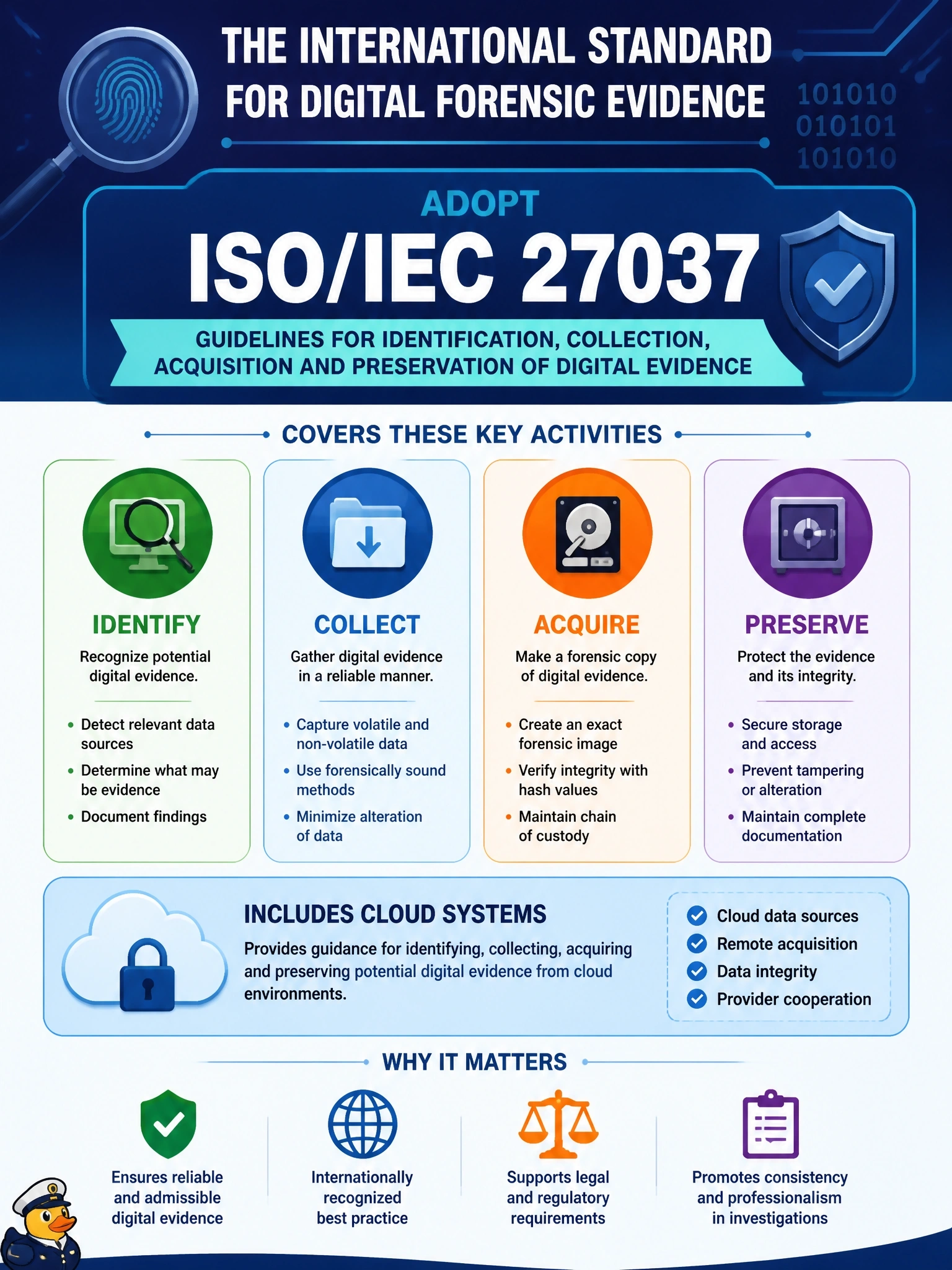
A forensic team wants an international standard that provides guidelines for identifying, collecting, acquiring and preserving potential digital evidence, including from cloud systems. Which standard should it adopt for these activities?
Select an answer to reveal the explanation.
Short Explanation
Think of the forensic family as a relay team: 27037 runs the first leg, finding, collecting, acquiring and preserving the evidence. Analysis and interpretation come later in 27042, and 27041 checks your methods are fit for purpose. The trap is grabbing a family member who runs a different leg.
Full Explanation
ISO/IEC 27037 provides guidelines for the specific activities in handling digital evidence: identification, collection, acquisition and preservation of potential digital evidence. It is the reference for the first phase of an investigation. ISO/IEC 27041 provides guidance on assuring the suitability and adequacy of incident investigative methods, ensuring that tools and processes are validated and fit for purpose; it concerns assurance of methods rather than the evidence-handling steps themselves. ISO/IEC 27042 provides guidelines for the analysis and interpretation of digital evidence, covering how examiners draw conclusions and report them, which comes after acquisition and preservation. ISO/IEC 27050 addresses electronic discovery, the identification, preservation, collection, processing, review and production of electronically stored information for legal proceedings; it overlaps in vocabulary but is aimed at the eDiscovery process rather than forensic evidence handling. Exam caveat: ISO/IEC 27043 sets out overall incident investigation principles and processes, and the 2026 outline cites 27037, 27041, 27042 and 27043 together, so expect questions that ask which part of the investigation each covers. Operational check: confirm that the team's evidence-handling procedures map each collection and preservation step to ISO/IEC 27037 guidance and that analysis procedures reference ISO/IEC 27042.