
A cloud provider wants each hypervisor host to prove that it booted untampered firmware, boot loader and kernel before the orchestrator is allowed to schedule tenant workloads onto it. Which mechanism provides this assurance?
Select an answer to reveal the explanation.
Short Explanation
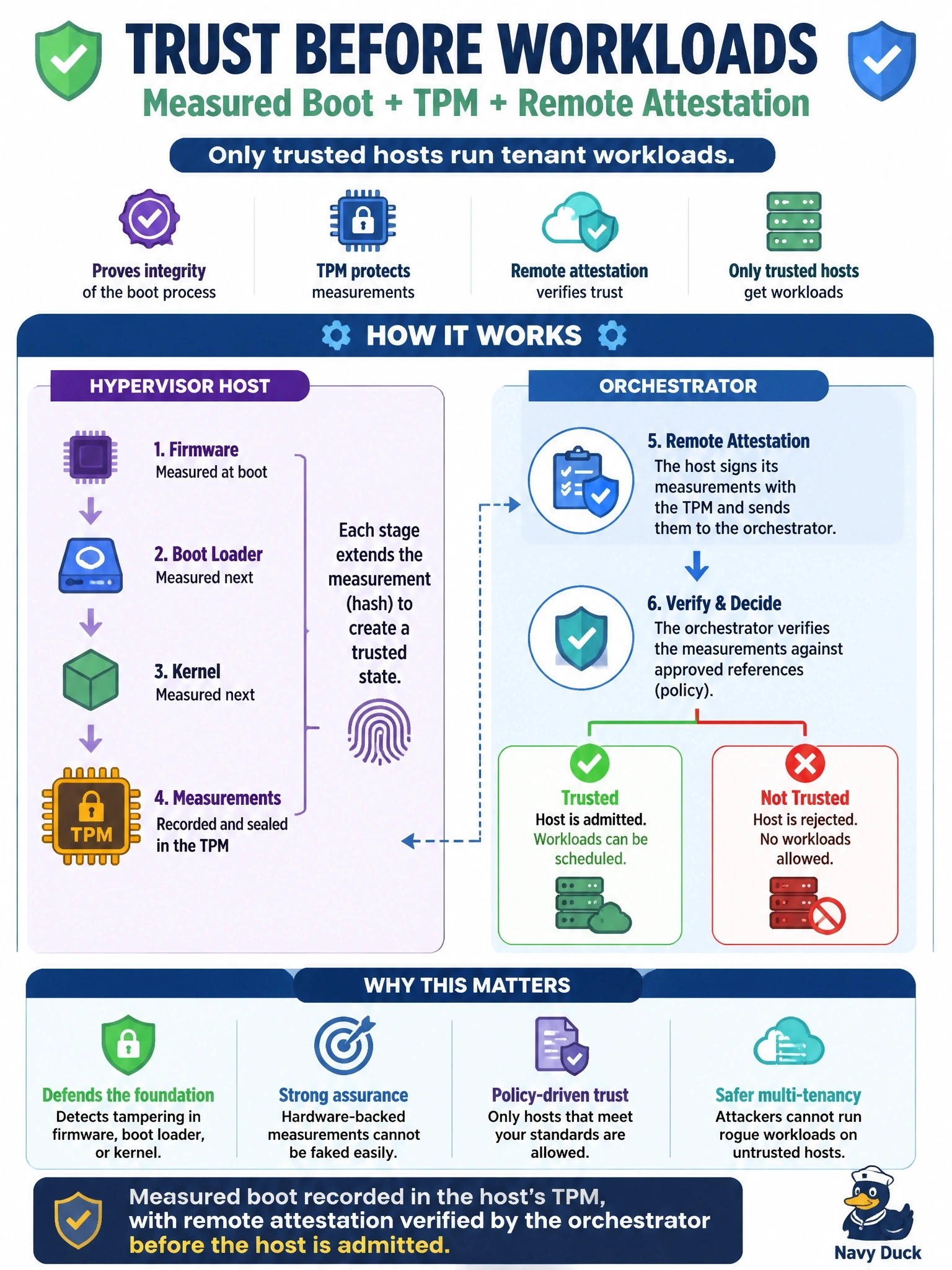
You want the host to show its receipts before it gets any tenants. Measured boot logs every component into the TPM as it loads, and attestation lets the orchestrator check those receipts against known-good values. The trap is a control that starts after the kernel, when a rootkit's already in charge.
Full Explanation
Measured boot hashes each component in the startup chain, firmware, boot loader, kernel and early drivers, and extends those hashes into the platform configuration registers of the host's Trusted Platform Module before the component executes. Remote attestation then has the TPM sign a quote of those register values with a key that never leaves the chip. The orchestrator, or an attestation service it trusts, compares the quote with known-good reference measurements and admits the host to the pool only if they match. A host intrusion detection agent starts after the kernel, so a compromised boot loader or kernel can hide from it or disable it, and it provides no hardware-rooted proof. An HSM is a central key management appliance; it does not observe a host's boot process, and encrypting a boot volume does not prove that the code that ran was authentic. A weekly package comparison is a configuration management control that inspects software state long after boot, cannot detect firmware tampering, and relies on the possibly compromised operating system to report honestly. Exam caveat: the TPM is the hardware root of trust for a single host, which is why it appears with HSMs in the outline's hardware security requirements. Operational check: alter a test host's boot loader and confirm that attestation fails and that the orchestrator refuses to schedule workloads on it.