
Engineers at a SaaS company edit infrastructure templates and application configuration directly in production, leaving no record of who changed what, and they cannot roll back reliably when a change fails. Which practice should be introduced?
Select an answer to reveal the explanation.
Short Explanation
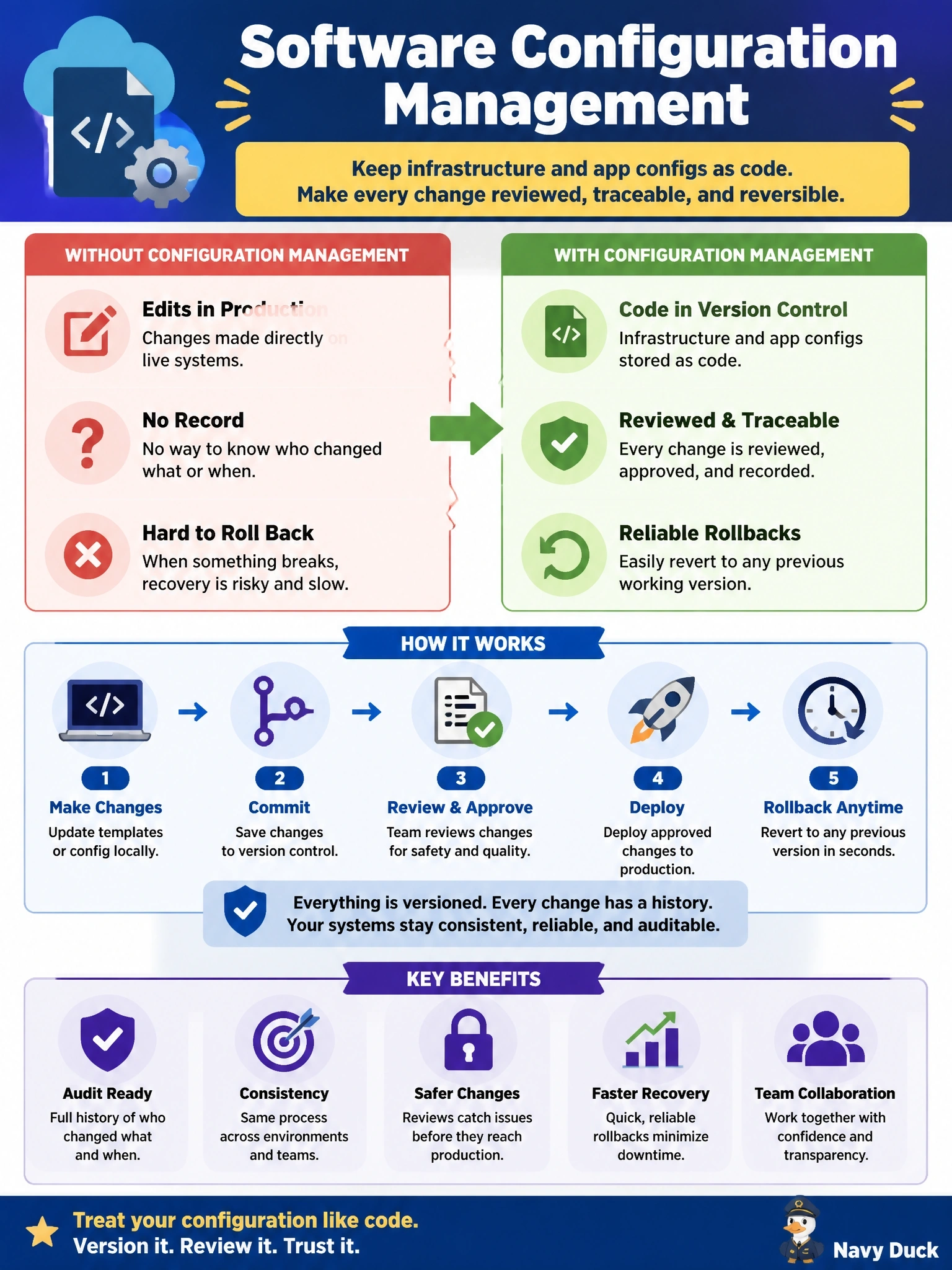
If nobody wrote down the recipe, you can't cook the same dish twice or figure out who added the extra salt. Putting code and templates under version control with reviewed changes gives you history, accountability and a clean way back. Snapshots and weekly scans just tell you something changed, not who did it or why.
Full Explanation
Software configuration management controls changes to code and configuration items throughout their life. For cloud applications that includes infrastructure templates as well as application code: every item is stored in a version control system, changes go through review and approval, each commit records who made it and why, released versions are tagged, and deployments are made from the repository through a pipeline rather than by hand in production. The result is traceability, reproducibility and reliable rollback to a known-good version. Nightly snapshots of virtual machines can restore a prior state, but they capture whole systems at a point in time, lose changes made during the day, record nothing about who changed what, and do not cover managed services that are configured through templates rather than machines. Concentrating changes in one engineer creates a single point of failure and removes separation of duties, while still leaving no reviewable history. A weekly vulnerability scan may notice some drift after the fact, but it neither prevents uncontrolled changes nor provides attribution or rollback. Exam caveat: the 2026 outline drops infrastructure as code strategy as a separate operations bullet, but versioning templates remains part of software configuration management in the SDLC. Operational check: confirm production changes can only be applied by the pipeline from the main branch, and that each deployment links to an approved, reviewed commit.