
A penetration test finds that a management API for a company's cloud workloads is reachable from the internet and accepts requests authenticated only by a static key embedded in a mobile app. How should this finding be categorized, and what is the most appropriate treatment?
Select an answer to reveal the explanation.
Short Explanation
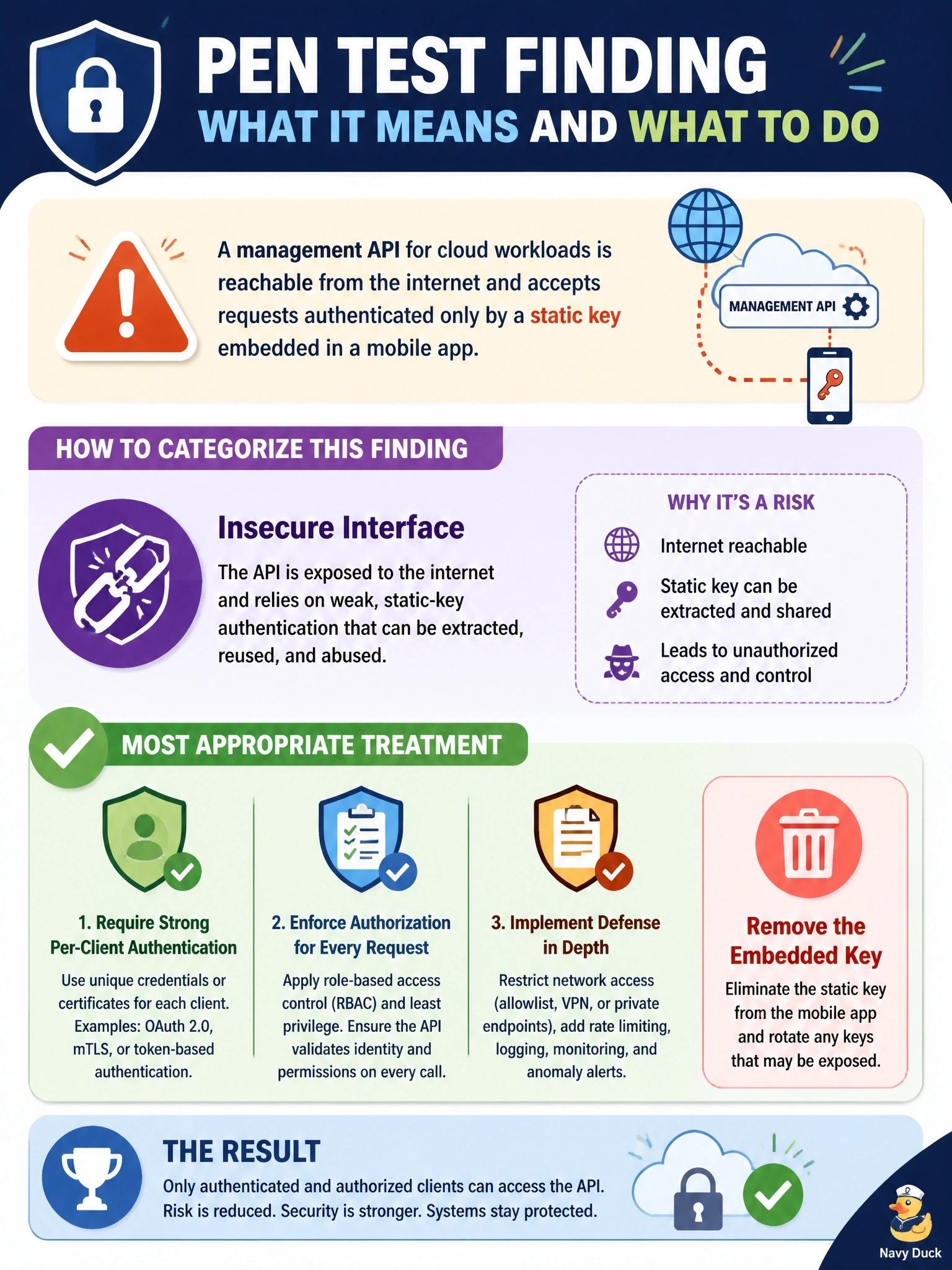
A static key baked into a mobile app is a house key taped under the doormat; anyone who unpacks the app finds it. That's the classic insecure interfaces and APIs weakness, so you fix the front door with real per-client authentication and authorization. Don't let the other choices pull you toward unrelated threats.
Full Explanation
Insecure interfaces and APIs are consistently ranked among the most significant cloud vulnerabilities by the CSA because cloud services are managed and consumed through them. A management API exposed to the internet that trusts a single static key embedded in a distributed mobile application has effectively public credentials, since application binaries can be decompiled and the key extracted. Treatment replaces the shared secret with strong authentication per client or user, such as OAuth flows with short-lived tokens, enforces authorization on every operation, restricts the API's exposure through a gateway, rotates and revokes the compromised key, and adds logging and rate limiting. A content delivery network absorbs volumetric traffic, but the finding concerns authentication, and attackers using the extracted key would pass through a CDN as legitimate clients. Data remanence concerns residual data on media after deletion; crypto-shredding addresses decommissioning, not unauthorized API calls today. Hypervisor escape is a virtualization isolation threat; dedicated hosts do nothing about an API that accepts anyone holding a public key. Exam caveat: secrets distributed in client code should always be treated as disclosed. Operational check: confirm the old key is revoked, and retest the API to verify that calls without valid per-client tokens are rejected.