
A health research group will let external analysts query aggregate statistics produced from a cloud-hosted patient data set and the models trained on it. The requirement is that results must not reveal whether any single individual's record is in the data, even to an analyst with outside knowledge. Which technique best meets this requirement?
Select an answer to reveal the explanation.
Short Explanation
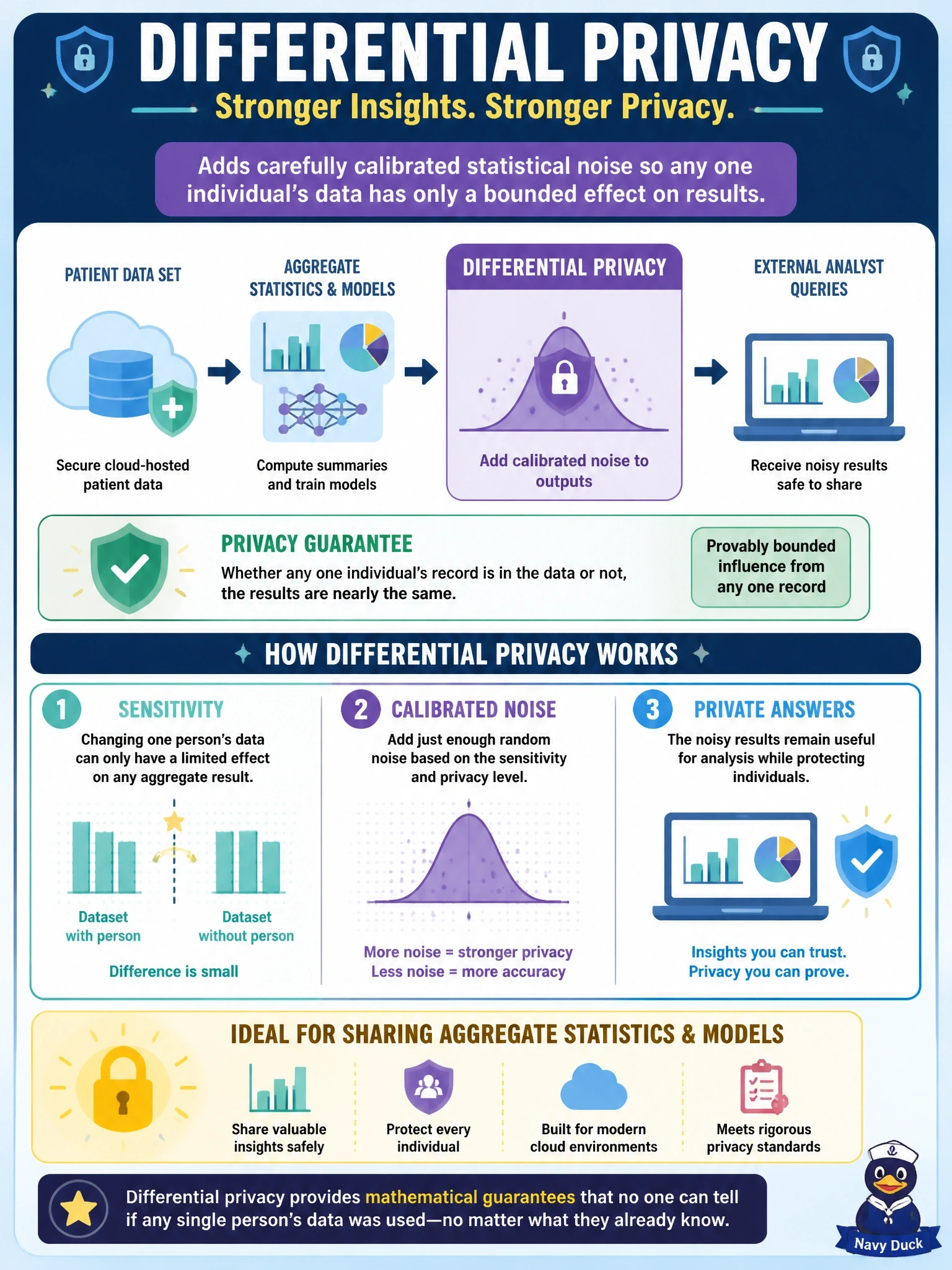
Think of it like adding a little static to the radio: the song still comes through, but you can't pick out one voice in the crowd. That's differential privacy, and it's the only option here that holds up even when the analyst already knows a lot about someone. Pseudonyms and masking just relabel the records.
Full Explanation
Differential privacy gives a mathematical guarantee that the output of an analysis is almost the same whether or not any single individual's record is included. It works by adding carefully calibrated random noise to query results or to the training process, governed by a privacy budget that limits cumulative leakage across queries. Because the guarantee holds regardless of what auxiliary information an attacker possesses, it directly meets the requirement. Pseudonymization replaces identifiers with codes but leaves each record's attributes intact; an analyst with outside knowledge can single out or re-identify individuals through combinations of attributes, and aggregate queries can still reveal membership through differencing. Encryption with keys held in an HSM protects data at rest and in transit, yet analysts receive decrypted results, so it has no effect on what those results disclose. Masking hides part of an identifier in displayed output, which limits casual exposure but does nothing to stop inference from aggregate statistics. Exam caveat: differential privacy trades accuracy for privacy; a smaller privacy budget means more noise and less precise answers. Operational check: confirm the query interface tracks and enforces the privacy budget per analyst and refuses queries once it is spent.