
A company is migrating legacy file shares to cloud storage. The files carry no classification labels, and their metadata, such as owners, dates and folder names, is known to be unreliable. Which discovery method should be used to find sensitive content?
Select an answer to reveal the explanation.
Short Explanation
If there are no labels and the metadata lies, the only honest witness left is the content itself. You open the files and look for the patterns that matter. The trap answers lean on information the scenario already told you is missing or wrong.
Full Explanation
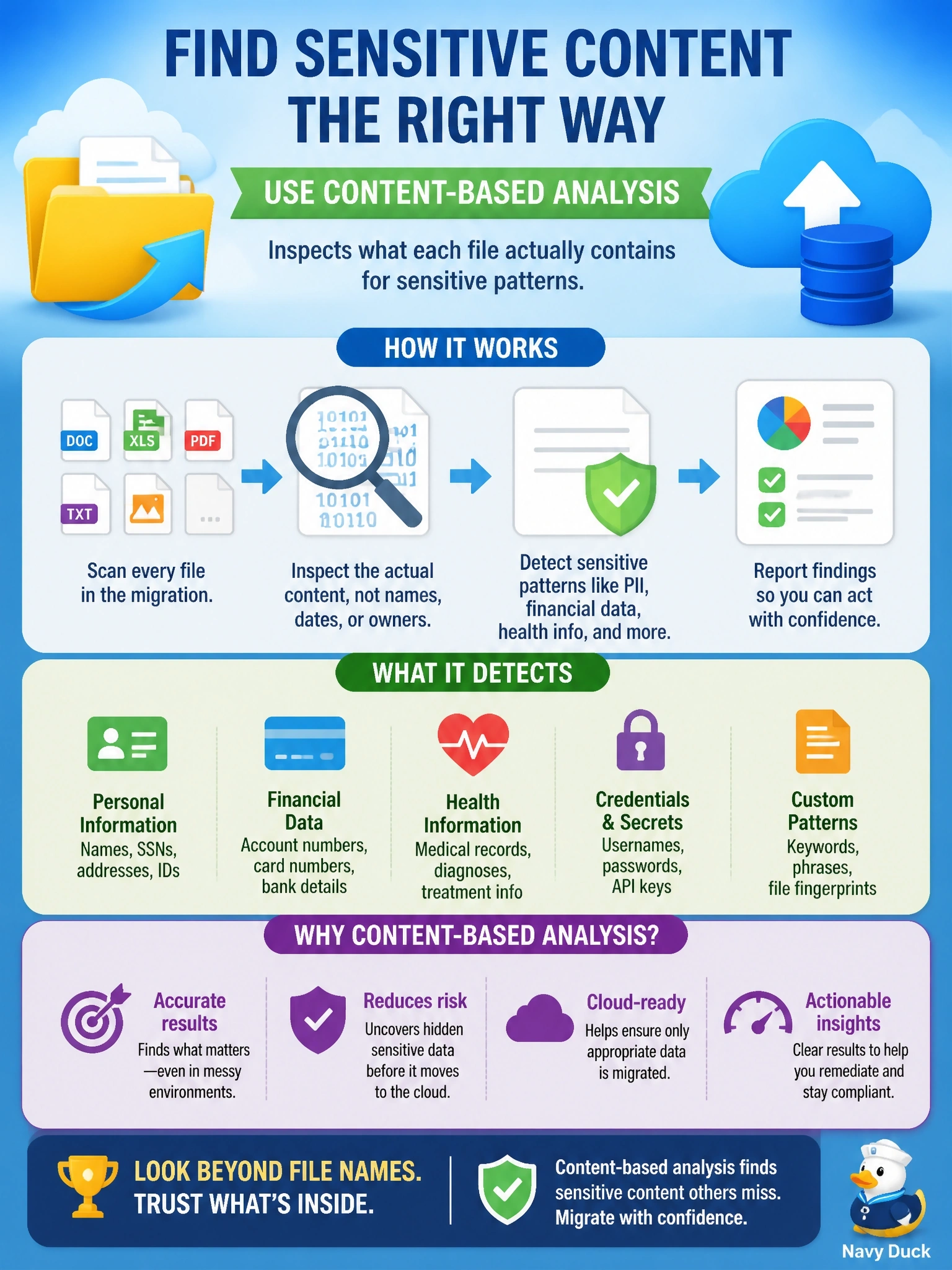
Data discovery generally uses three approaches. Label-based discovery reads classification markings that were applied earlier, which is fast and reliable when labeling is consistent. Metadata-based discovery uses attributes such as owner, creation date, file type and location to infer sensitivity, which helps when metadata is accurate. Content-based analysis inspects the data itself, using pattern matching, keywords, fingerprints and classifiers, which is slower but does not depend on anyone having labeled or organized the data correctly. The scenario removes the first two options: the files have no labels, so label-based discovery finds nothing, and the metadata is unreliable, so inferences from owners, dates and folders would misclassify files. Access frequency is not a recognized method for determining sensitivity; heavily used files may be mundane and rarely opened files may be highly sensitive. Content-based analysis is therefore the method that can actually locate sensitive data before migration. Exam caveat: content analysis has false positives, and large data sets may need sampling, prioritization and tuning. Operational check: run content discovery on a pilot share, review results with data owners and apply labels during migration so future discovery can rely on them.