
An analytics team wants a data set derived from EU customer records that falls outside the scope of GDPR, because no individual can be identified from it by any means reasonably likely to be used. Which technique meets this goal?
Select an answer to reveal the explanation.
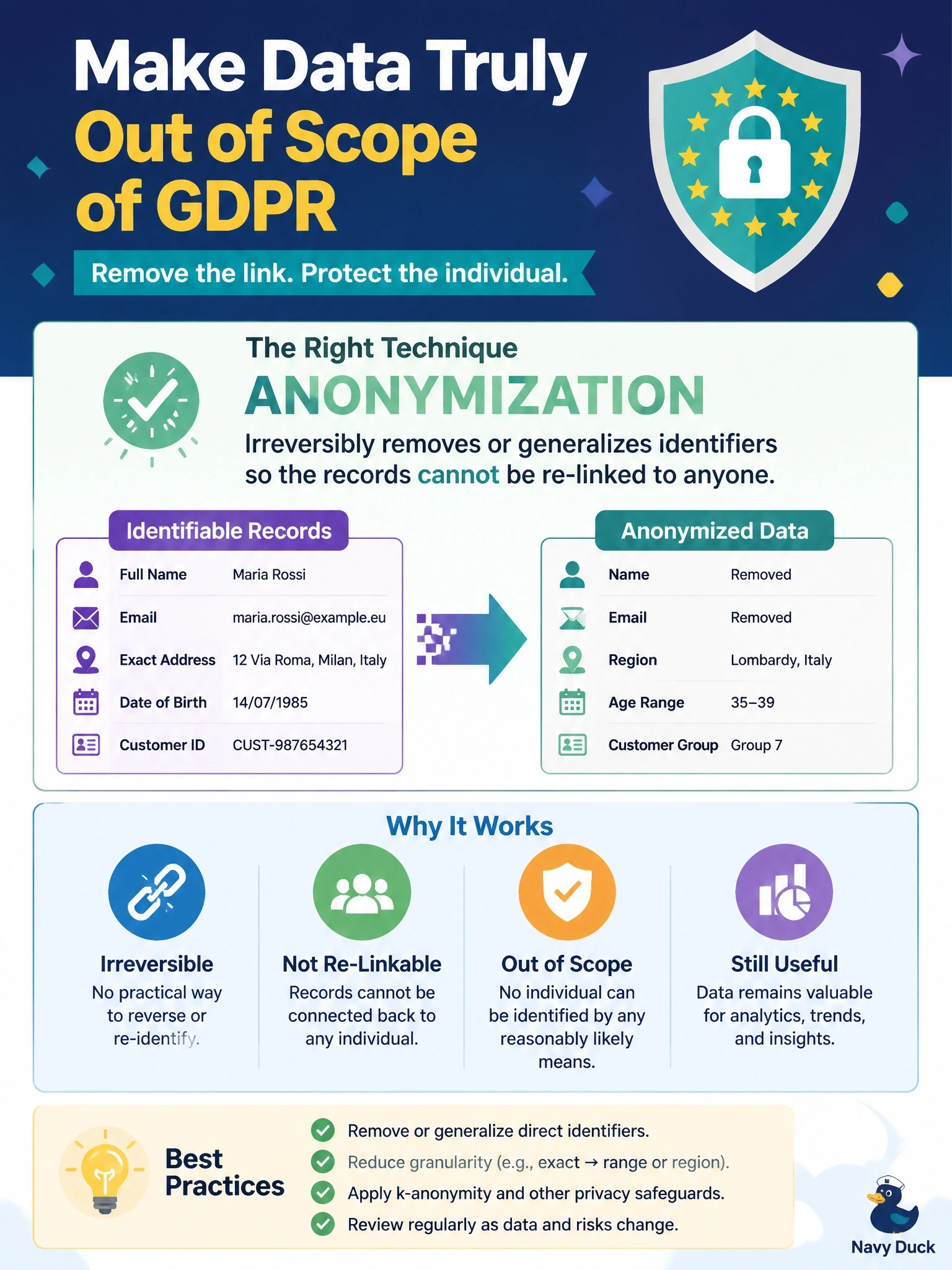
Short Explanation
If there's any key, table or vault that can turn the data back into a person, it's still personal data. Only true anonymization, where you can't go back, takes it out of GDPR's reach. The trap is pseudonymization, which GDPR explicitly still treats as personal data.
Full Explanation
GDPR applies to personal data, meaning information relating to an identified or identifiable natural person. Data that has been anonymized so that individuals are no longer identifiable, taking into account all means reasonably likely to be used, is outside the regulation's scope. Anonymization achieves this by irreversibly removing direct identifiers and generalizing, aggregating or perturbing quasi-identifiers so that records cannot be re-linked, alone or combined with other available data. Pseudonymization replaces identifiers with codes while additional information, such as a key table, allows re-identification; GDPR explicitly treats pseudonymized data as personal data, though it recognizes pseudonymization as a useful safeguard. Tokenization with a queryable vault is reversible by design, so the organization can map tokens back to individuals and the data remains personal. Encryption is likewise reversible for whoever holds the key, and the data remains personal data in the hands of the organization that can decrypt it, regardless of who custodies the key. Exam caveat: anonymization must be assessed against linkage and inference risk, since poorly anonymized data sets have been re-identified. Operational check: perform a documented re-identification risk assessment before releasing the data set as anonymous.