
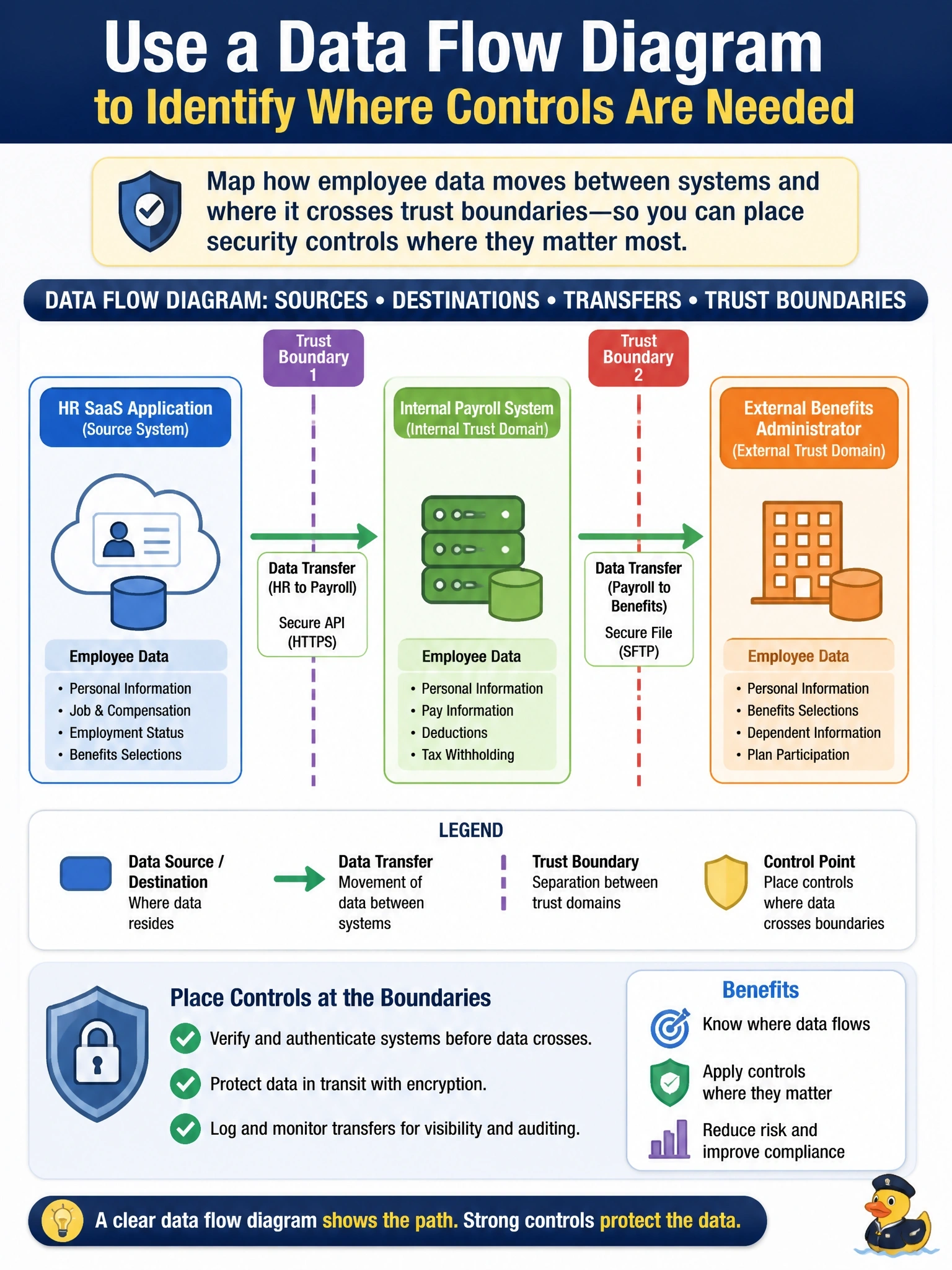
An organization plans to connect its HR SaaS application to an internal payroll system and to an external benefits administrator. During design review, nobody can say where employee data moves between these parties or where it crosses from one trust domain into another. What should the security architect produce to identify where controls are needed?
Select an answer to reveal the explanation.
Short Explanation
You can't put guards on bridges you haven't drawn on the map. A data flow diagram shows you every hop and every trust boundary, so you know exactly where encryption, authentication and DLP have to go. The trap is picking something useful but different, like classification or a BIA, that doesn't tell you where the data travels.
Full Explanation
Data flows are a core cloud data concept because cloud integrations move data between services, tenants and third parties that each sit in different trust domains. A data flow diagram identifies data sources, processing steps, storage locations, transfer paths and the trust boundaries where data passes from one party's control to another's. Those crossings are precisely where controls belong: authentication and authorization of each connection, encryption in transit, input validation, logging and contractual protections with the external administrator. A classification policy tells the team how sensitive HR records are, which informs control strength, but it does not reveal the paths or boundaries data will cross. A penetration test probes exposed interfaces for vulnerabilities and, for a SaaS service, also needs provider permission; it finds weaknesses but not the integration's data movements. A business impact analysis supports continuity planning by ranking systems and setting recovery objectives, which is a different question from where data flows. Exam caveat: data flow diagrams should be maintained as integrations change, not drawn once. Operational check: walk each flow on the diagram and confirm every boundary crossing has an owner, an encryption method and an access control.