
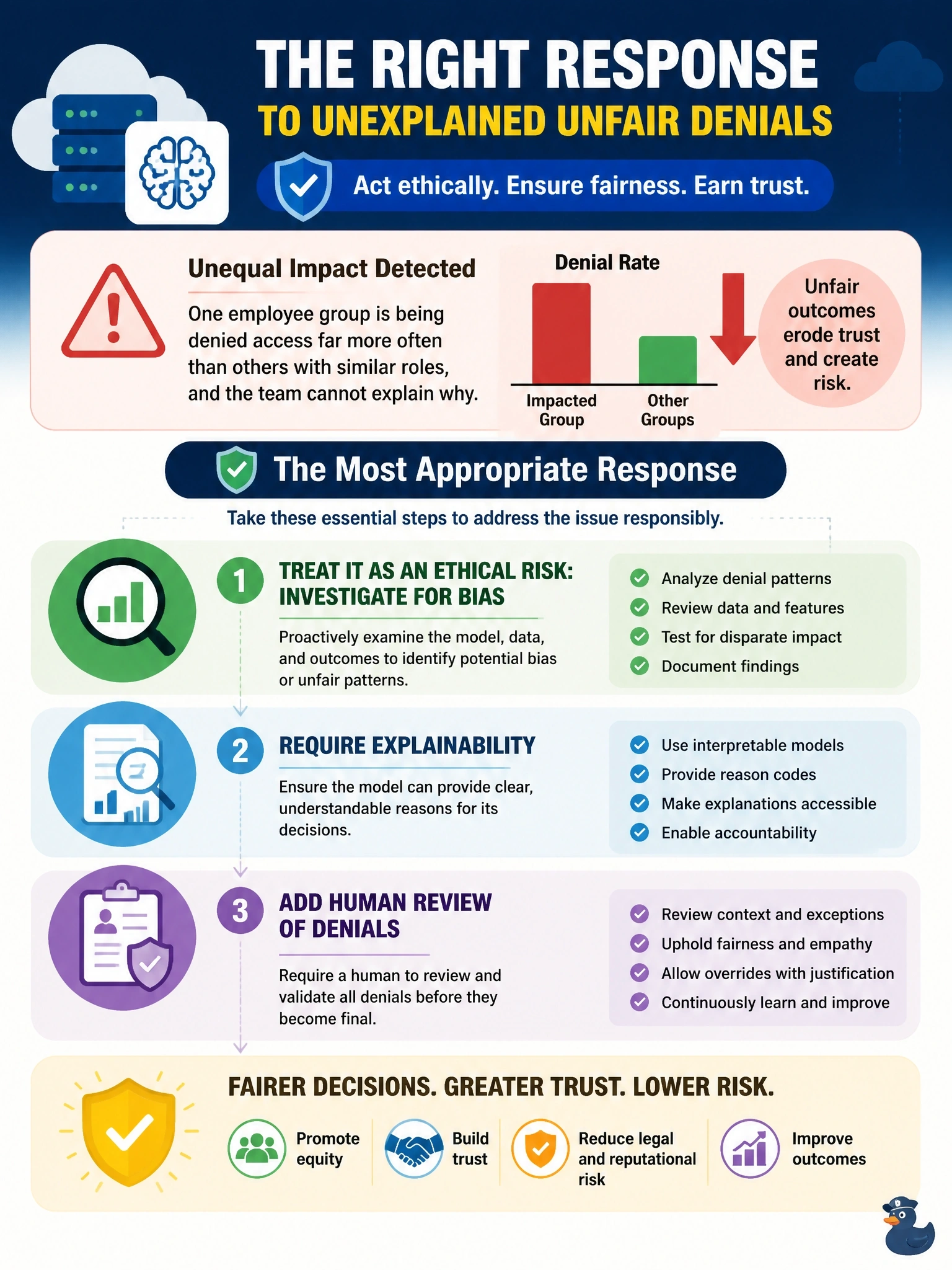
A cloud-hosted machine learning model that recommends whether to approve access requests denies one employee group far more often than others with similar roles, and the team cannot explain why. What is the most appropriate response?
Select an answer to reveal the explanation.
Short Explanation
If a referee keeps calling fouls on one team only, you review the tape before the next game. Unexplained, uneven outcomes from a model are a bias problem you investigate, explain and put a human in front of. The trap is assuming a machine can't be unfair.
Full Explanation
Ethical concerns in AI include bias, fairness, transparency, explainability and accountability for automated decisions. A model that denies one group of employees much more often than comparable peers, with no explanation, may have learned bias from historical data, proxy features or flawed labels. The appropriate response is to investigate for bias using fairness testing across groups, examine the features driving decisions, require explainability sufficient to justify outcomes, and add human review of adverse decisions while the issue is resolved. Accountability stays with the organization deploying the model. Retraining on more data from the same source is likely to reproduce the same bias, because the problem may lie in that source. Accepting outcomes as objective because a model produced them is the automation bias the ethics objective warns against; models encode the patterns and flaws of their training data. Hiding decision reasons reduces transparency, prevents affected people from contesting errors and makes the bias harder to find. Exam caveat: the 2026 outline lists ethical concerns and regulatory requirements separately under AI and ML; bias can also create legal exposure under anti-discrimination and AI regulation. Operational check: compare approval rates by group on recent decisions, document the findings and track remediation through the model governance process.