
A financial services firm wants assurance about a large public cloud provider's security controls before signing a contract. The provider states that it does not permit individual customers to conduct on-site audits of its data centers. What is the most appropriate way to verify the provider against the firm's criteria?
Select an answer to reveal the explanation.
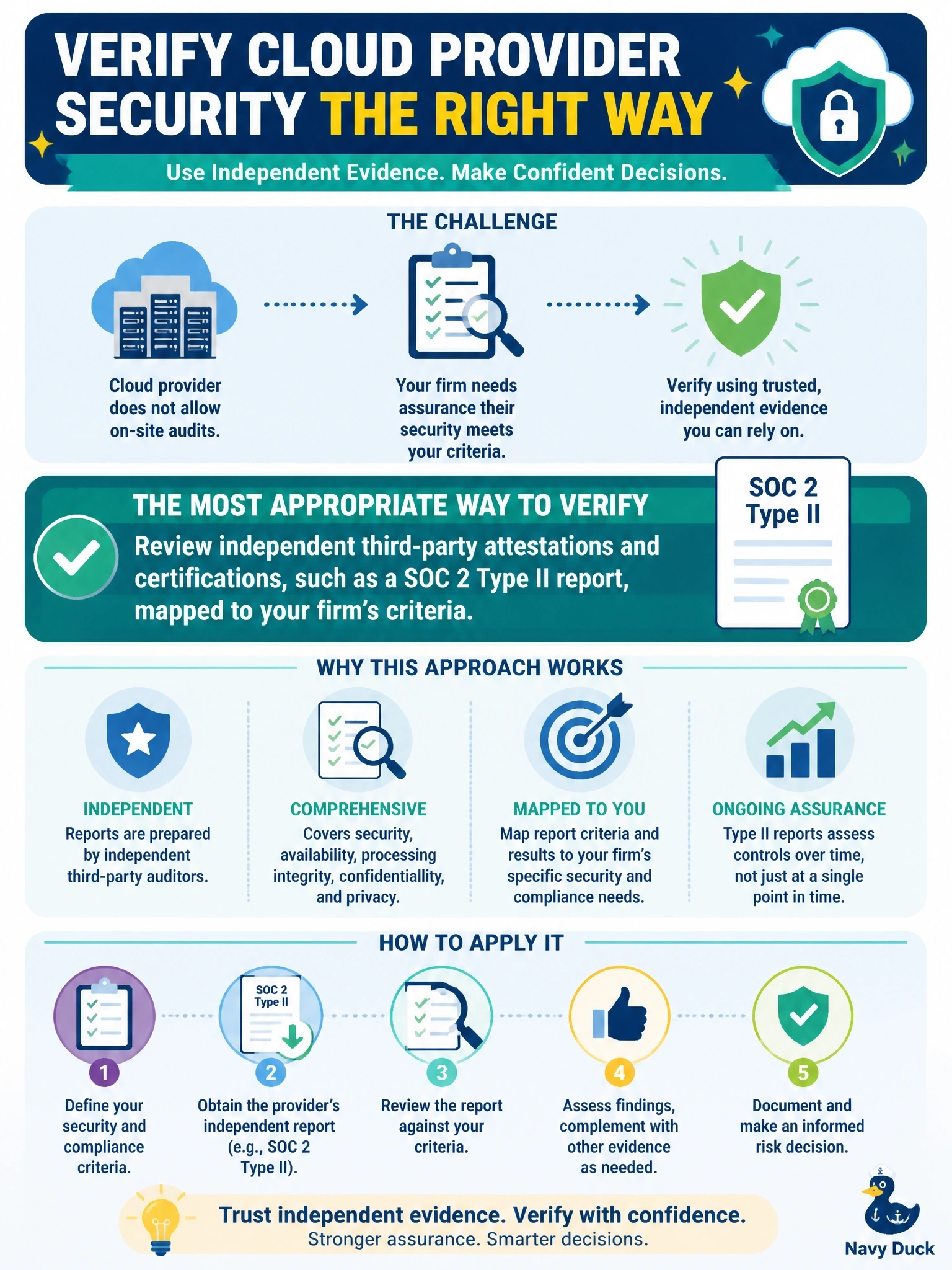
Short Explanation
You can't inspect every factory that makes your car parts, so you trust independent safety inspectors whose reports you can read. For big providers, third-party attestations are that inspector's report. The trap is testing their infrastructure without permission, which is an attack, not an audit.
Full Explanation
Large public providers serve too many customers to permit individual on-site audits, so customers verify them against their own criteria using independent third-party evidence. Typical evidence includes SOC 2 Type II reports, which test the operating effectiveness of controls over a period, ISO/IEC 27001 certification with its scope and statement of applicability, CSA STAR attestations and sector-specific authorizations. The firm maps its requirements to the controls these documents cover, reviews exceptions, scope and complementary user entity controls, and addresses gaps through contract terms or compensating controls. Accepting a whitepaper relies on unaudited marketing material written by the party being evaluated, which provides no independent assurance. Refusing to contract unless an on-site audit is granted is an unrealistic stance with hyperscale providers and does not help the firm make a risk-based decision. An unannounced penetration test against the provider's infrastructure is unauthorized testing; it likely violates the terms of service and law, and it could harm other tenants. Exam caveat: regulated sectors may negotiate additional audit rights, sometimes pooled among customers, so the contract should still preserve whatever access regulators require. Operational check: confirm each report covers the services and regions the firm will use and that its period is current.