
A proposed cloud design places a single perimeter firewall in front of every workload and relies on it as the only security control, with flat internal networks, default host configurations and no encryption between tiers. Which secure design principle should the security architect apply?
Select an answer to reveal the explanation.
Short Explanation
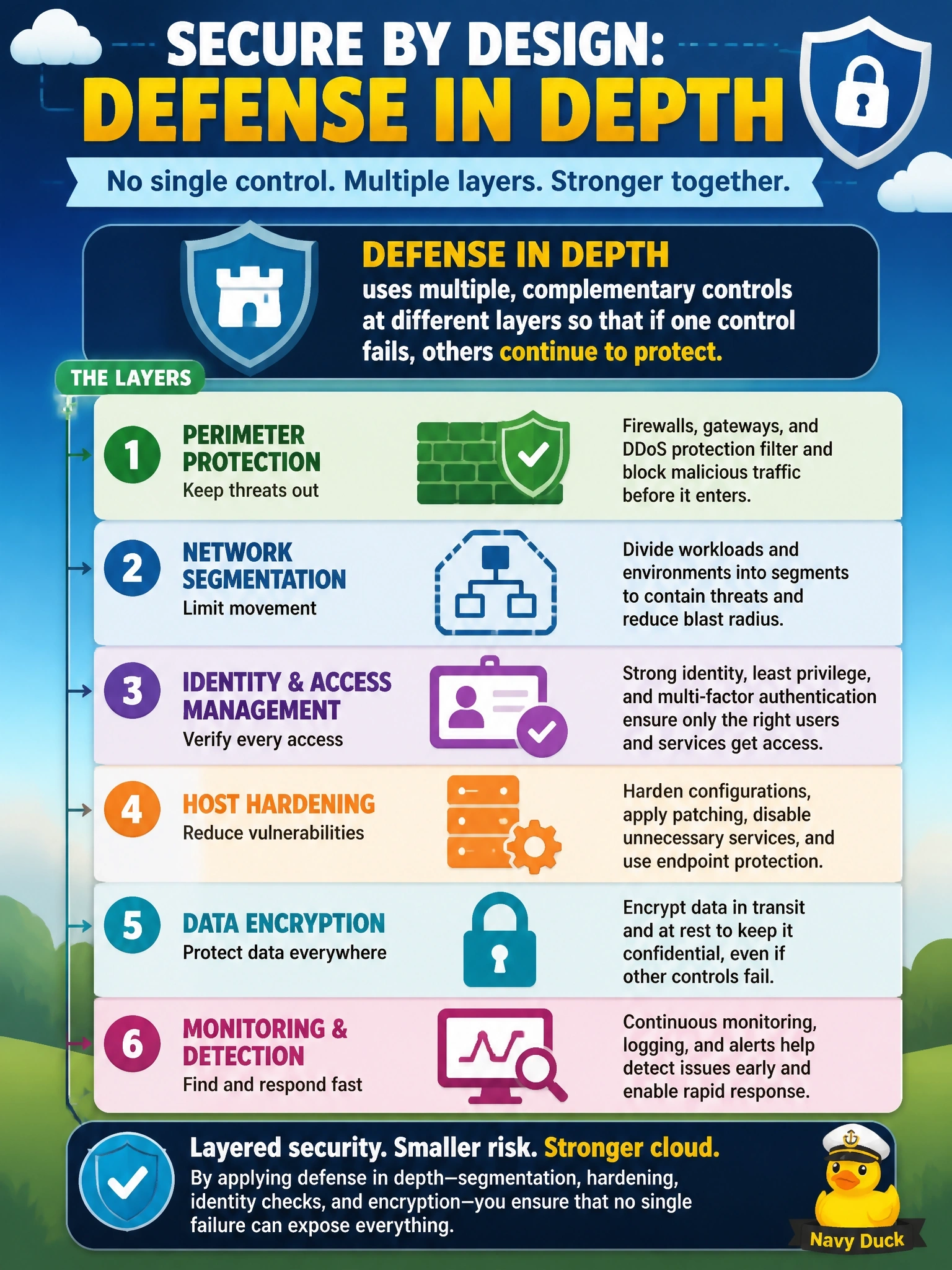
A castle with one wall and nothing behind it falls the moment the wall's breached. Defense in depth adds the moat, the inner keep and the guards, so you're not betting everything on one barrier. The trap is a second identical firewall, which is just the same wall twice.
Full Explanation
Defense in depth layers independent controls so that the failure or bypass of any one does not expose the whole environment. A single perimeter firewall in front of flat internal networks means that one misconfiguration, one exploited workload or one compromised credential gives an attacker access to everything. Applying the principle means segmenting networks so workloads are isolated from each other, hardening hosts against a baseline, enforcing identity-based access checks, encrypting traffic between tiers and monitoring each layer. This is also secure by design, which the 2026 outline adds to cloud design patterns: security built into the architecture rather than bolted on at the edge. A higher-throughput firewall improves capacity but keeps the same single point of control and failure. A second identical firewall in series adds redundancy of one control type; a flaw or misconfiguration common to both devices defeats them together, and nothing protects workloads once traffic is inside. Allowing traffic only from the corporate office breaks the customer-facing purpose of most workloads and still leaves the inside flat and unprotected. Exam caveat: layering does not mean duplicating; each layer should address a different failure mode. Operational check: trace one request end to end and list every independent control it crosses.