
A company is leaving a public IaaS provider and must sanitize its data on the provider's multi-tenant storage. It cannot access the physical drives, and the provider will not remove or destroy shared media for one customer. Which sanitization method is most appropriate?
Select an answer to reveal the explanation.
Short Explanation
If you can't burn the paper because it's in someone else's filing room, you burn the only key that can read it. That's crypto-shredding. The trap is overwriting from your tenant, which can't reach every copy, block or replica the provider keeps.
Full Explanation
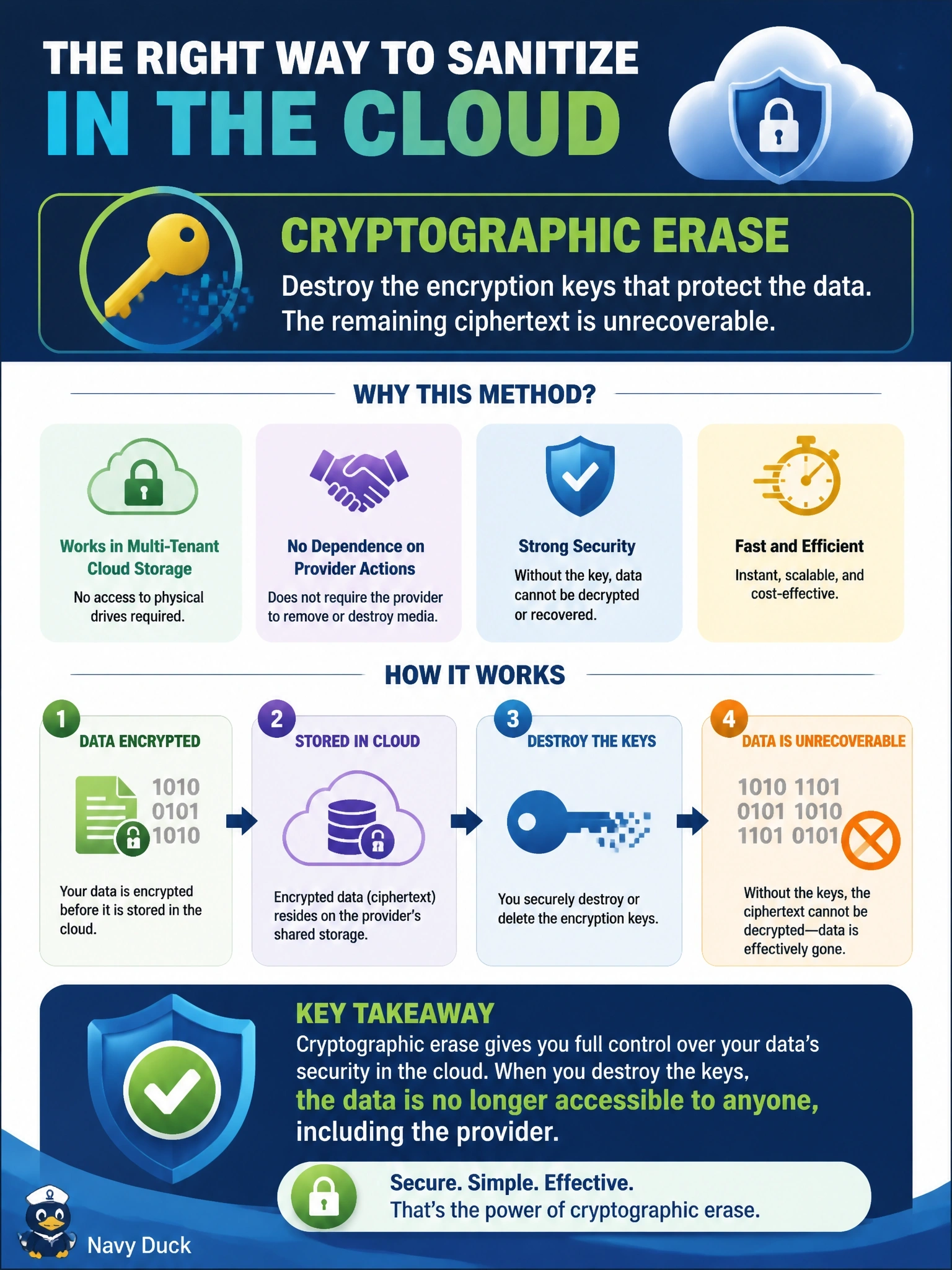
Cryptographic erase, often called crypto-shredding, sanitizes data by destroying the encryption keys that protect it. If all copies of the data, including replicas, snapshots and backups, are encrypted under keys the customer controls, deleting those keys leaves only ciphertext that cannot be recovered. In multi-tenant cloud storage, where the customer has no physical access and the media holds other tenants' data, it is the practical sanitization method. Degaussing requires physical access to magnetic media and would destroy other tenants' data, and it is ineffective on solid-state drives. Overwriting from inside the tenant writes only to the logical blocks the customer currently sees; it cannot reach replicas, snapshots, reallocated blocks or wear-leveled flash cells, so residual copies may remain. Physical destruction is not available to one tenant on shared media and would affect other customers. Exam caveat: crypto-shredding only works if encryption was in place for the data's whole life and the keys were never exported or copied elsewhere, so it must be planned at onboarding, not at exit. Operational check: confirm all volumes, object storage, snapshots and backups used customer-managed keys, then schedule key destruction and keep the key service's deletion record as evidence.