
A government contractor encrypts archives that must stay confidential for thirty years using today's public-key algorithms. A risk review notes that a future cryptographically relevant quantum computer could break those algorithms. What should the organization do now?
Select an answer to reveal the explanation.
Short Explanation
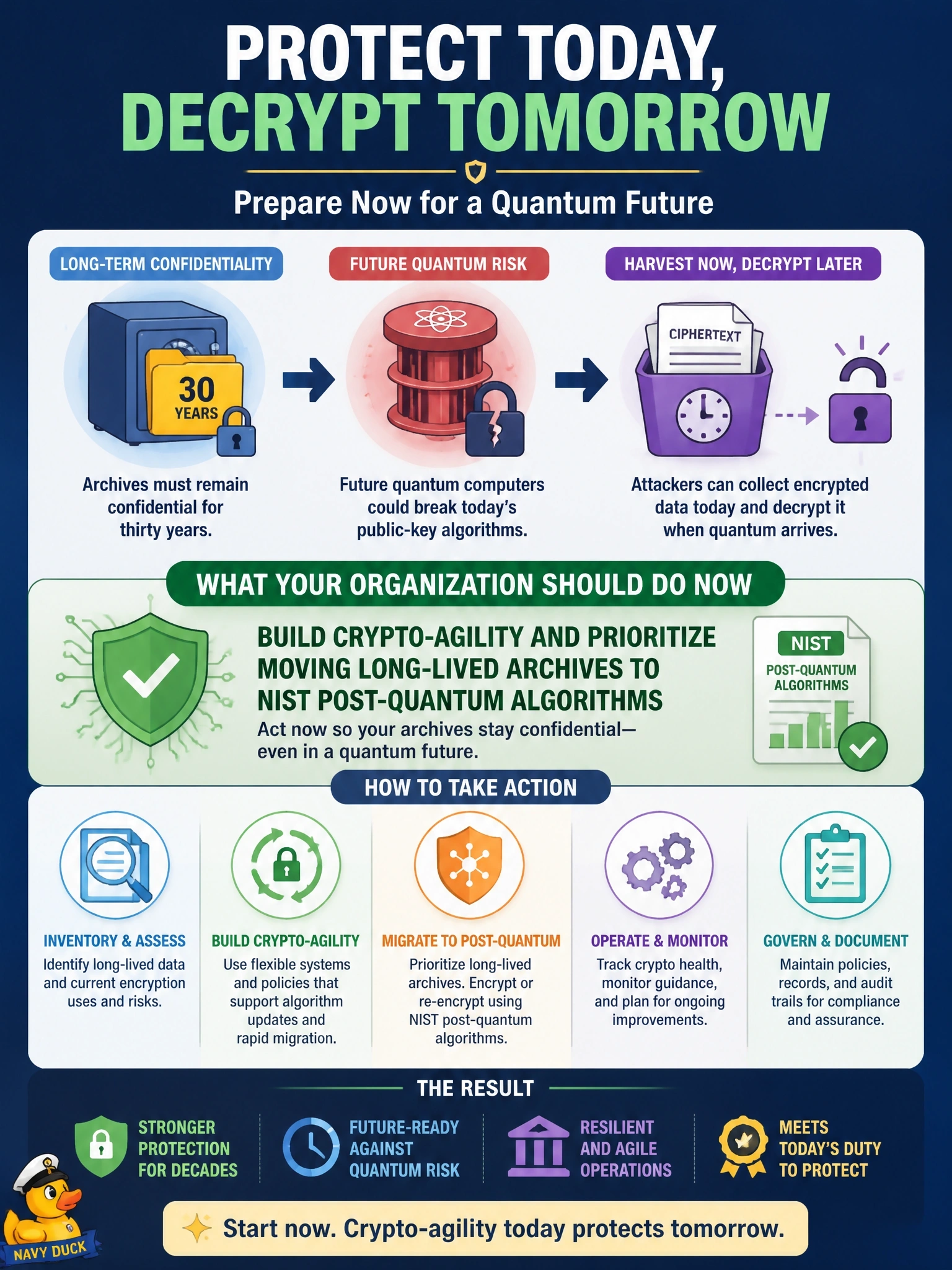
A thief who can't open your safe today can still steal it and wait for better tools. That's harvest now, decrypt later, and it's why long-lived secrets need post-quantum protection now. The trap is waiting until the quantum computer shows up, when the stolen copies are already out the door.
Full Explanation
Large-scale quantum computers running Shor's algorithm would break widely used public-key algorithms such as RSA and elliptic curve cryptography. Adversaries can capture encrypted data today and decrypt it once such a machine exists, a pattern called harvest now, decrypt later. Data that must stay confidential for decades is therefore at risk now, not later. The sound response is crypto-agility, the ability to replace algorithms without redesigning systems, combined with an inventory of cryptographic use and prioritized migration of long-lived data to the post-quantum algorithms NIST has standardized. Doubling RSA key lengths does not solve the problem, because Shor's algorithm breaks RSA efficiently at any practical size. Deferring until a demonstration ignores that captured ciphertext cannot be re-protected after the fact. Relying on TLS misses the point twice: archives at rest are not protected by transport encryption, and TLS key exchange that uses classical public-key methods is itself vulnerable to harvested captures. Exam caveat: symmetric algorithms are far less affected, with longer keys such as 256-bit AES regarded as adequate, so the urgent work is in key establishment and signatures. Operational check: produce a cryptographic inventory that identifies every system protecting data with a confidentiality lifetime beyond ten years.