
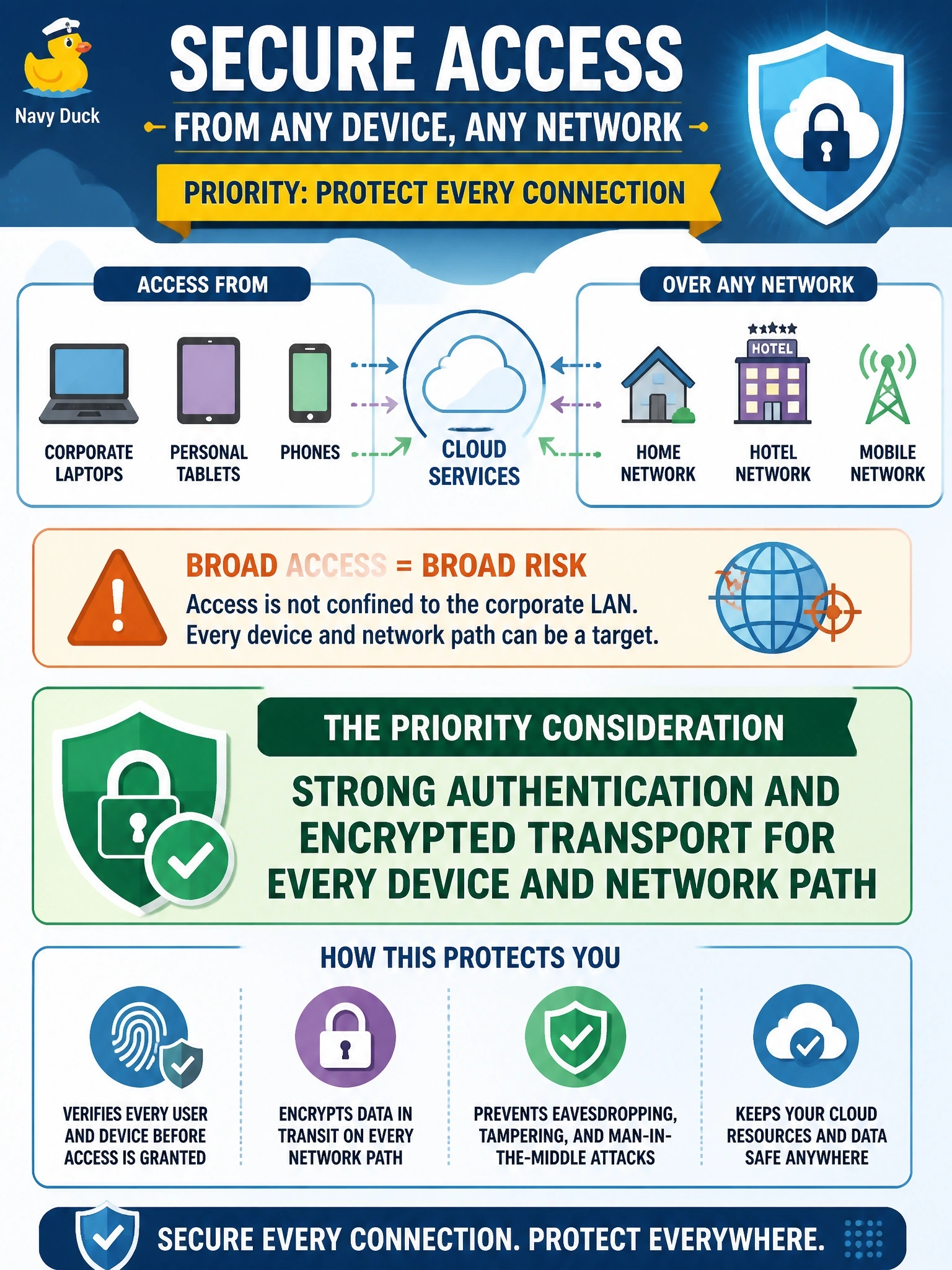
A firm's staff reach its cloud services from corporate laptops, personal tablets and phones over home, hotel and mobile networks. The security manager wants to address the risk that arises most directly from this broad network access. Which consideration should take priority?
Select an answer to reveal the explanation.
Short Explanation
When your front door opens onto every street in town, you check IDs harder and lock the hallway. Broad network access means users arrive from anywhere on any device, so identity and encrypted connections matter most. The trap is worrying about the provider's internals or billing instead of your own access paths.
Full Explanation
NIST SP 800-145 describes broad network access as capabilities available over the network and accessed through standard mechanisms that promote use by heterogeneous thin or thick client platforms, such as phones, tablets, laptops and workstations. The security consequence is a wider attack surface on the customer side: unmanaged or lightly managed endpoints, untrusted networks and many more paths to the service. The priority controls are strong authentication, such as multifactor authentication, together with encrypted transport and, where possible, device posture checks before access is granted. Segmenting the provider's internal network is a provider responsibility and is not what broad access exposes; users reach the service interface, not the provider's switching fabric. Per-device capacity limits address resource consumption rather than the confidentiality and integrity risks of many access paths. Per-device metering is a billing matter tied to measured service, not a security response to broad access. Exam caveat: broad network access does not mean public exposure is required; private connectivity options still deliver the characteristic. Operational check: review sign-in logs for the share of sessions without multifactor authentication or from unmanaged devices, and confirm conditional access policy covers every client platform in use.