
A hospital wants proof that its responders can actually perform the technical recovery steps for its patient records system, but the business owner has ruled out any interruption to clinical operations. Which type of test BEST meets both requirements?
Select an answer to reveal the explanation.
Short Explanation
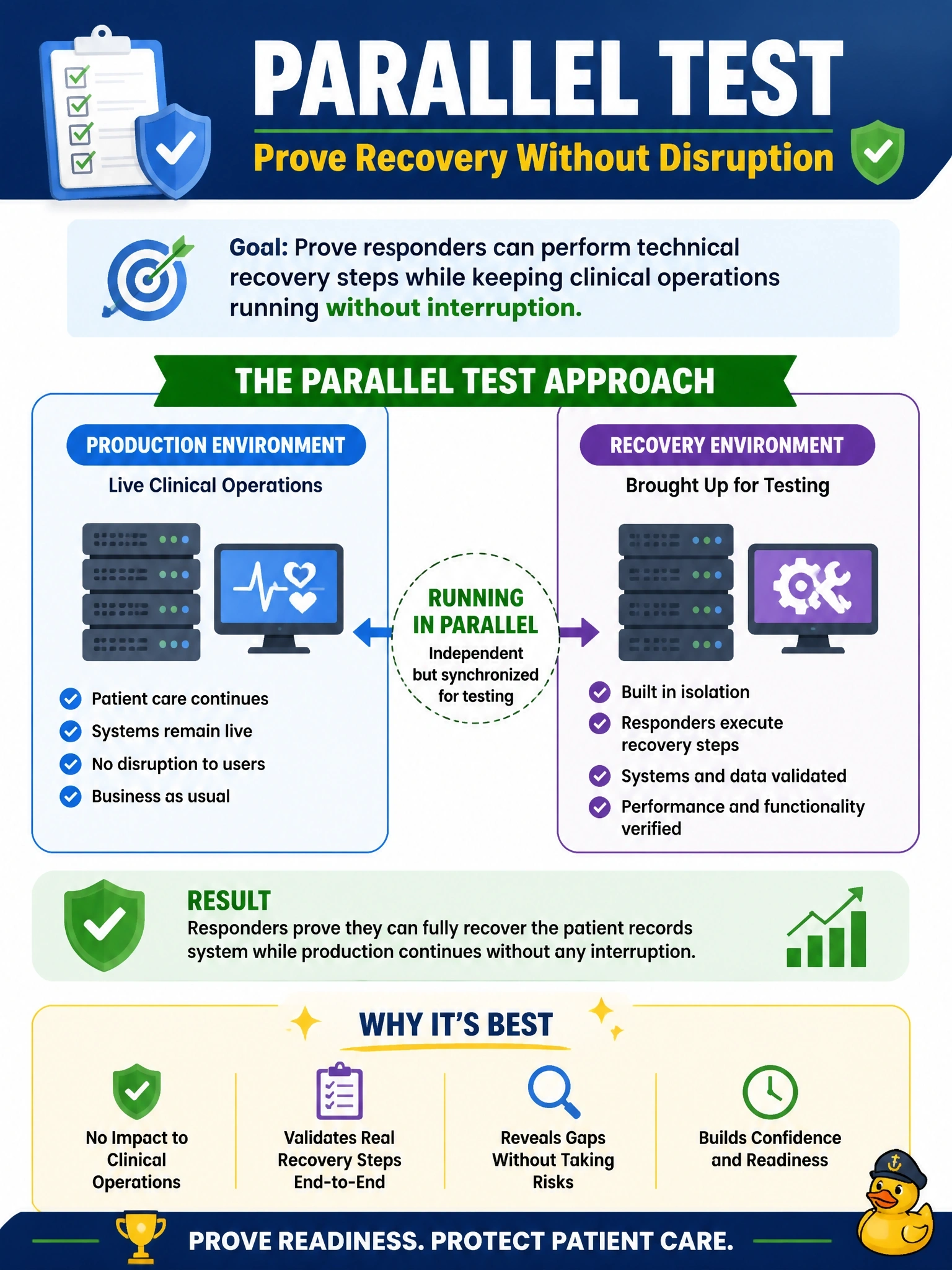
Think of it like a fire drill where the backup kitchen actually cooks a meal while the main kitchen keeps serving. You need real execution and zero disruption, and only a parallel test gives you both. The trap is grabbing the most realistic test, full interruption, when the business owner has already said no.
Full Explanation
Test selection is driven by the objectives the test must prove, the risk the organization is willing to take during the test, and the disruption the business will tolerate. Here the objective is demonstrated execution of technical recovery, and the constraint set by the business owner is no interruption to clinical services. A parallel test satisfies both: the recovery environment is activated and processing is performed there, while the production system continues to serve users, so execution is evidenced without putting patient care at risk. A tabletop walkthrough builds shared understanding of roles and sequence, but participants only describe actions, so it cannot show that the technical steps work. A full interruption test gives the highest realism, yet it deliberately stops production, which directly violates the stated constraint and carries real patient-safety risk. A checklist review confirms that procedures and contacts exist and are current, which is a documentation check rather than evidence of execution. Exam caveat: when a stem states a disruption limit set by the business, treat it as binding; the most realistic test is not the best one if the owner has excluded it. Operational check: confirm the test plan names its objectives, the business owner's approval, the parallel environment's scope and the success criteria before scheduling.