
After the loss of the primary data center, the recovery team is planning the order in which systems will be restored at the recovery site. Which systems should generally be restored FIRST?
Select an answer to reveal the explanation.
Short Explanation
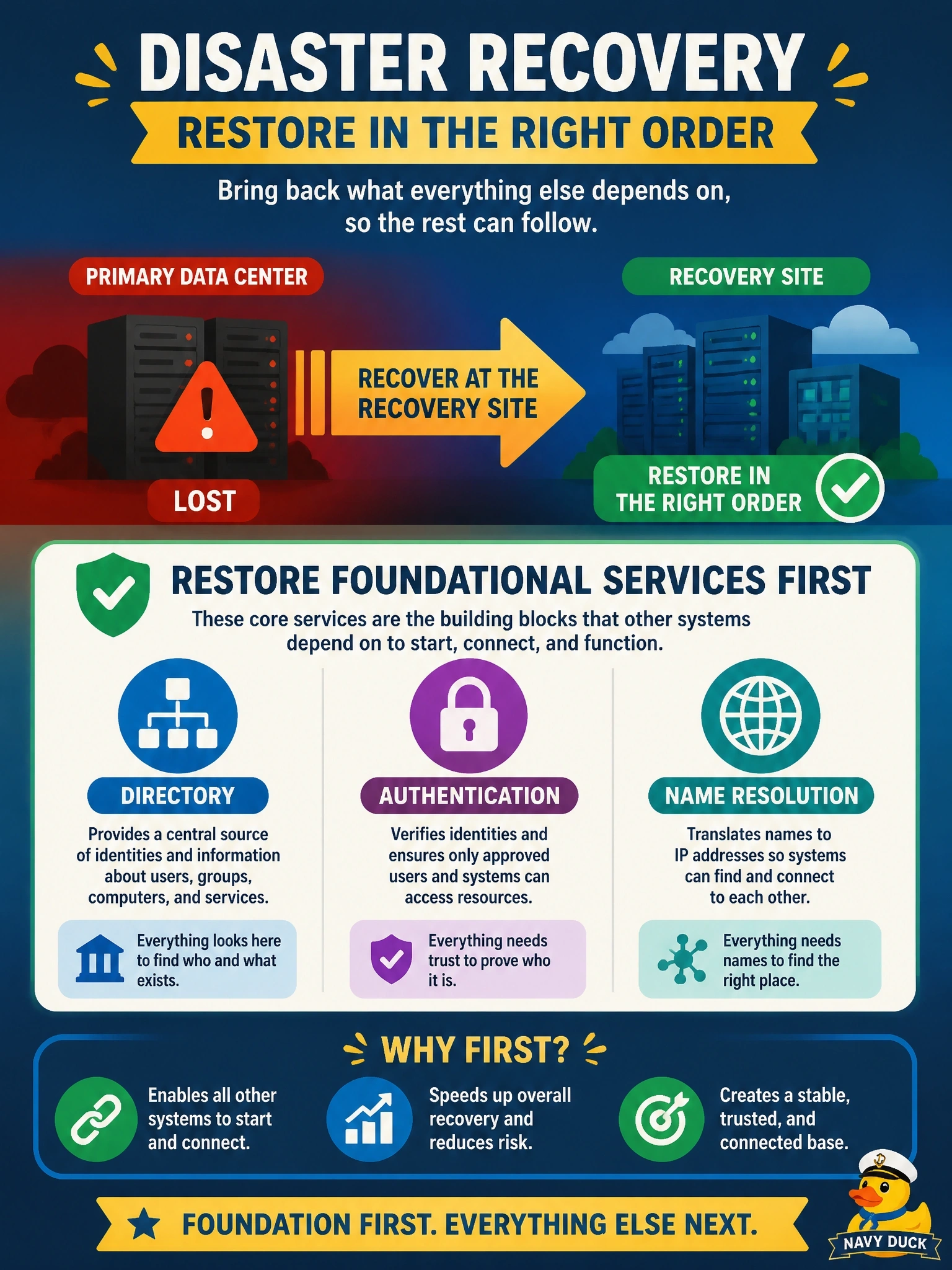
You can't open the doors of the shop before you've turned on the lights. Directory, authentication and name resolution are the lights; almost everything else needs them to run. Rushing the most important app first is the trap; it won't start without the services underneath it.
Full Explanation
Restoration sequence is driven by business priority and by technical dependency. Business priority, from the BIA, determines which applications matter most, but those applications cannot function until the infrastructure they depend on is available. Foundational services such as directory and authentication, name resolution and core networking are therefore restored first, followed by critical applications in priority order. Restoring systems with the most users first uses headcount as a proxy for importance, and those systems would still fail without the foundational services. Restoring the customer-facing application with the shortest recovery time objective ahead of its dependencies misunderstands the sequence; its priority is real, but it is achieved by restoring its dependencies first, quickly, not by skipping them. Choosing systems because they were recently patched applies a security consideration in place of a recovery sequence and has no connection to business need or dependency. Exam caveat: dependency mapping must be done before a disaster, as part of the BIA and recovery planning, because discovering dependencies during recovery causes delay. Operational check: confirm the disaster recovery plan contains a documented restoration order showing each critical application's dependencies and that a recovery test followed it successfully.