
A major incident begins at 2 a.m. on a holiday weekend. The on-call engineer cannot reach anyone with authority to activate the business continuity plan. Which weakness does this reveal?
Select an answer to reveal the explanation.
Short Explanation
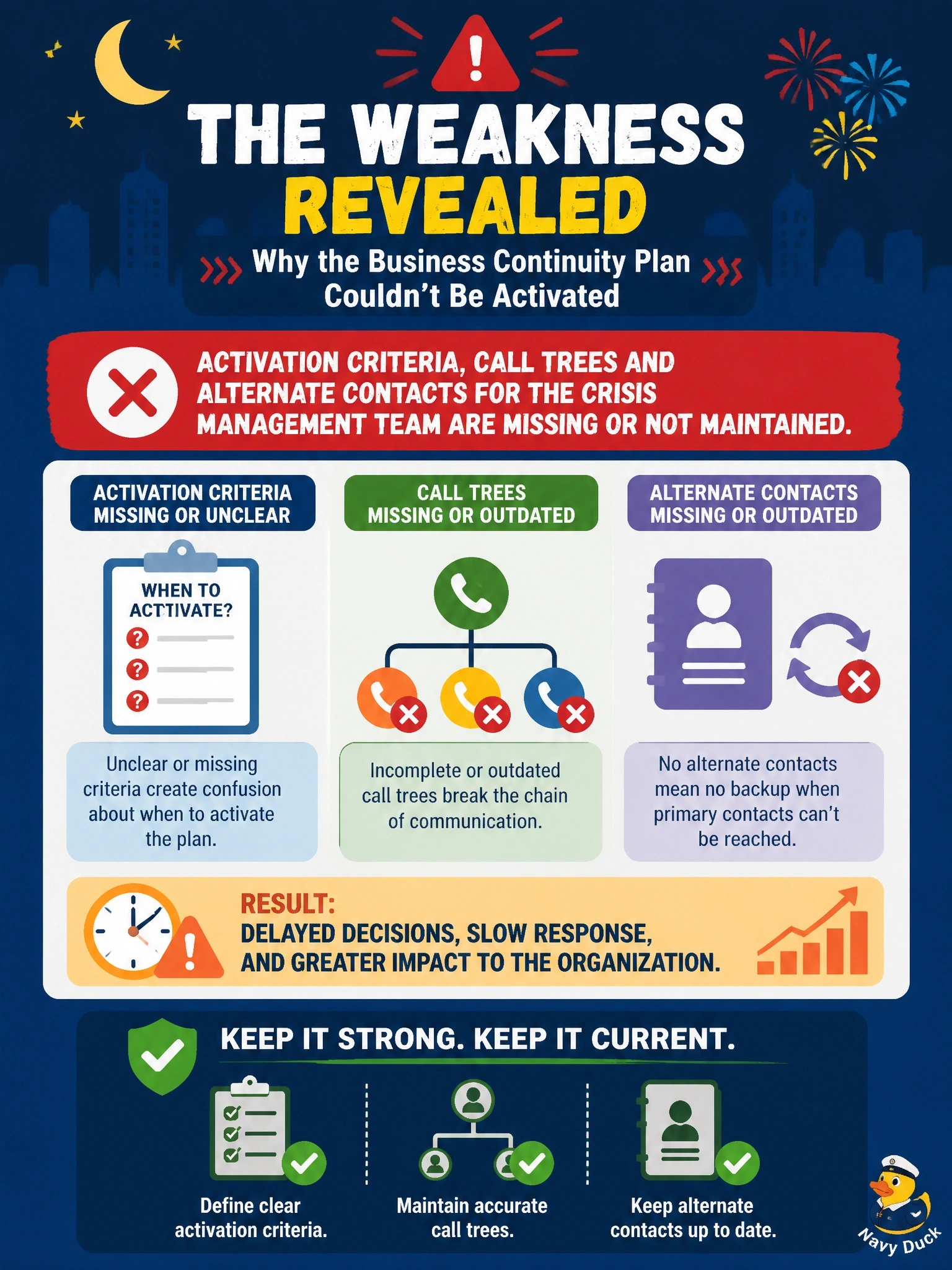
A crisis doesn't check your calendar before it shows up. If your engineer can't reach anyone who can pull the trigger, the gap is in activation: who to call, in what order and who's next if they don't answer. More staff or a bigger recovery site won't help if nobody can say go.
Full Explanation
Plan activation is a defined procedure. A continuity plan should specify the criteria for activation, the roles authorized to declare it, a call tree with primary and alternate contacts for the crisis management team, and how contact details are kept current. Because crises can begin at any hour, the procedure must work outside business hours and should not depend on a single person being reachable. An engineer unable to reach anyone with authority shows these elements are absent, incomplete or out of date. Recovery site capacity concerns whether systems can run after failover, which has no bearing on whether someone can authorize activation. The number of technical staff on shift affects technical response capacity, but the engineer was present; the gap is decision authority, not headcount. Recovery time objectives are set per process and apply regardless of the day of the week, so the BIA is not where the failure lies. Exam caveat: delegations of authority should be documented so that a deputy can activate the plan without waiting for the primary decision maker. Operational check: run an unannounced out-of-hours call-tree test and measure the time taken to reach someone with activation authority.