
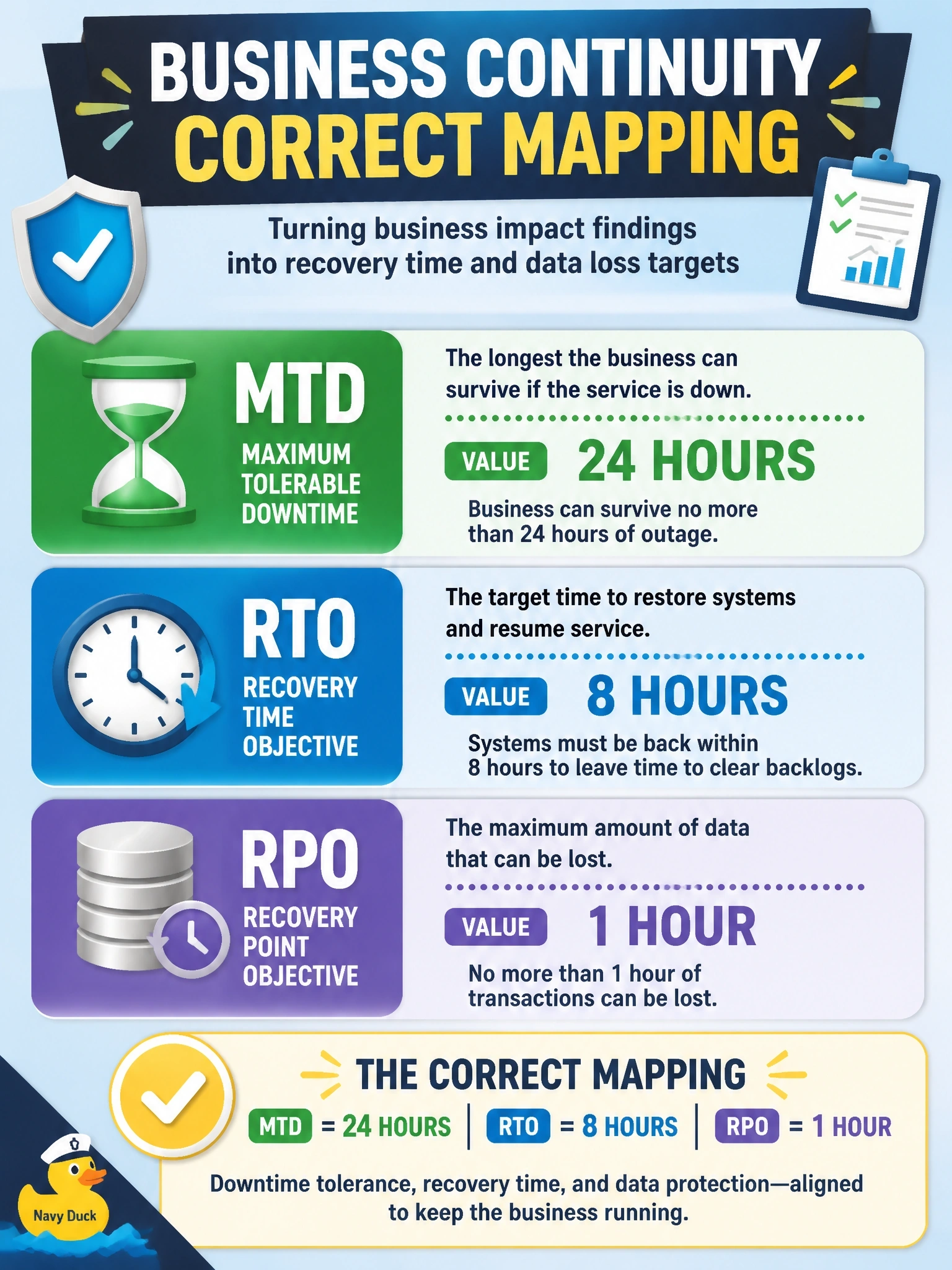
A BIA for the order-processing service finds that the business can survive an outage of no more than 24 hours, systems must be back within 8 hours to leave time to clear backlogs, and no more than 1 hour of transactions can be lost. Which mapping is correct?
Select an answer to reveal the explanation.
Short Explanation
Here's the memory hook: MTD is the cliff edge, RTO is where you plan to stop well before it, and RPO looks backward at how much data you can afford to lose. So 24 hours is the cliff, 8 hours is your target, and 1 hour is your data loss limit. Mixing RTO and RPO is the classic trap.
Full Explanation
Maximum tolerable downtime is the longest the business can survive without the process before impact becomes unacceptable; here it is 24 hours. The recovery time objective is the target time to restore systems after disruption and must be shorter than the MTD to leave room for the remaining recovery work, such as clearing backlogs and validating data; here it is 8 hours. The recovery point objective is the maximum acceptable data loss measured backward from the disruption, which drives backup and replication frequency; here it is 1 hour. Swapping RTO and MTD would set the systems target at the business survival limit and the survival limit below the target, which is internally inconsistent because RTO must not exceed MTD. Swapping RPO and RTO confuses time to restore with acceptable data loss; an 8-hour RPO would allow eight hours of transactions to be lost, contradicting the stated tolerance. Reversing RPO and MTD makes the survival limit 1 hour and the data loss tolerance 24 hours, which matches nothing in the analysis. Exam caveat: RTO plus the time needed to resume work must fit within MTD. Operational check: confirm the backup or replication interval is no longer than the RPO and that tested restoration time is within the RTO.