
A payment platform must check that every transaction respects the customer's account limits, and it processes several thousand transactions each day. Which type of control is MOST appropriate for this requirement?
Select an answer to reveal the explanation.
Short Explanation
Checking thousands of transactions a day by hand is like asking you to count raindrops: you'll miss some and you'll get tired. High-volume, rule-based checks are exactly what automation is good at. The trap is the sample review: it's useful assurance, but it doesn't enforce the rule on every transaction.
Full Explanation
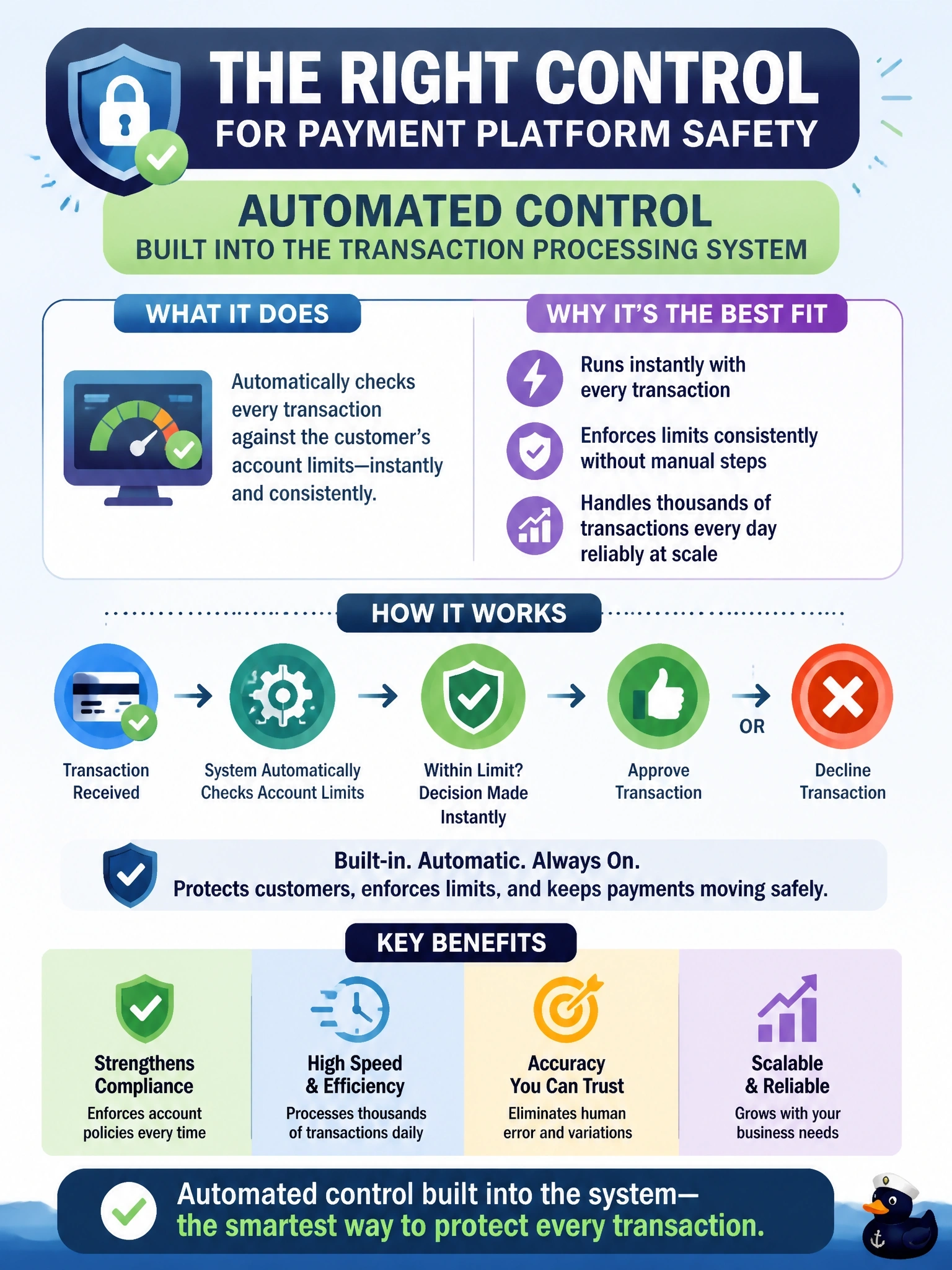
When a check is rule-based, applies to every item and must run thousands of times a day, an automated control embedded in the processing system is the most reliable and cost-effective choice. It applies the same logic consistently to each transaction, operates in real time before posting and generates evidence that it ran, which also simplifies later testing. A manual review of every transaction by a supervisor is slow, expensive and error-prone at this volume; fatigue and inconsistency would make the control unreliable and could delay customer payments. A monthly sample review by internal audit is an assurance activity that may detect some violations after the fact, but it does not enforce the limit on each transaction and is not designed to be the primary control. A policy statement reminding staff about limits is an administrative control that cannot enforce anything in an automated payment flow and relies entirely on behavior. Exam caveat: automated controls still need change management and periodic testing, because a faulty rule fails consistently on every transaction. Operational check: confirm that the limit logic is documented, tested before release, protected from unauthorized change and covered by exception reporting reviewed by the process owner.