
A review finds that the organization owns many security tools with overlapping capabilities, and licence and support costs are rising. What should the information security manager do to BEST address this?
Select an answer to reveal the explanation.
Short Explanation
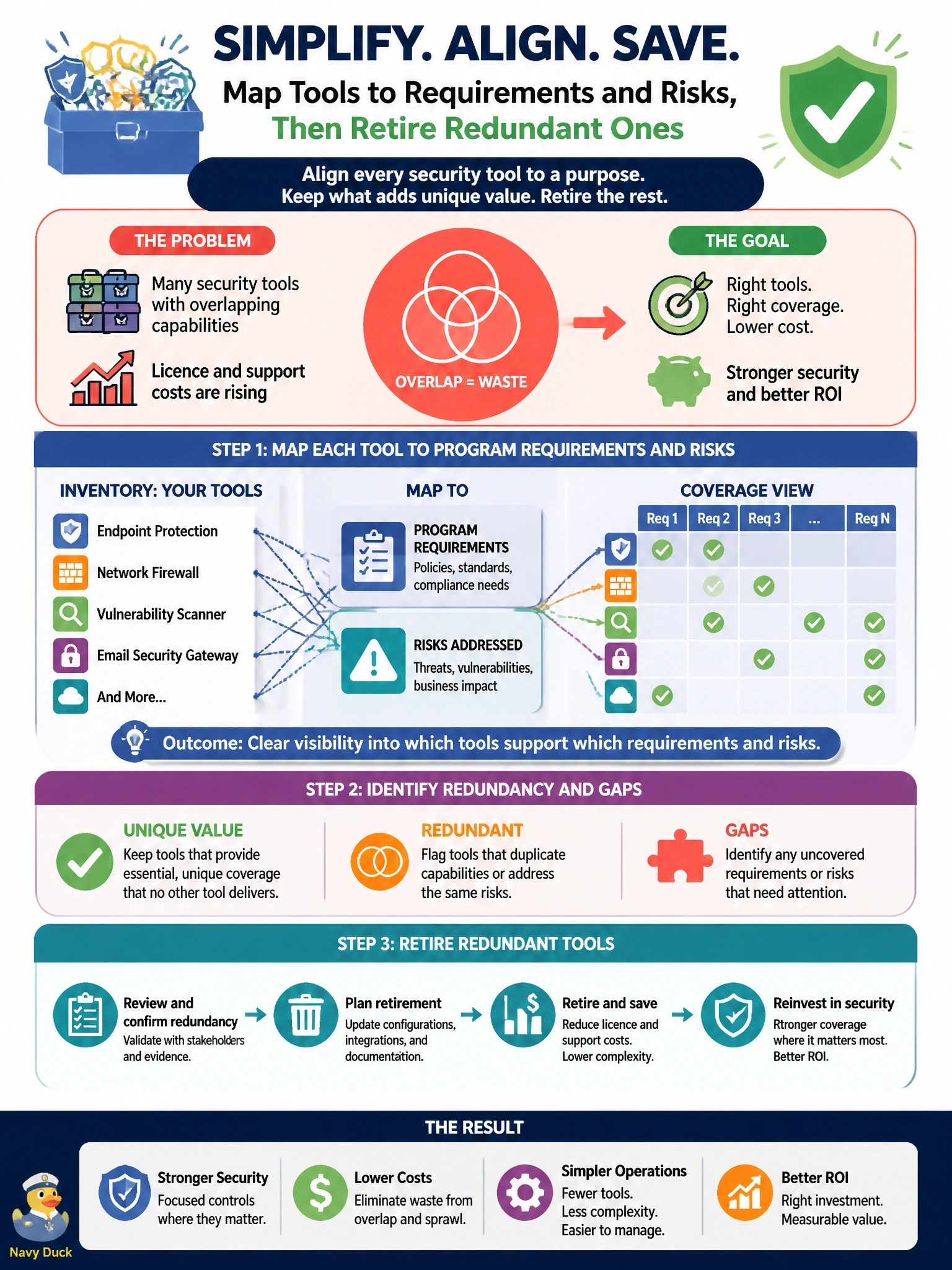
A toolbox with five hammers and no screwdriver isn't defense in depth; it's clutter. You line each tool up against what the program actually needs and the risks it covers, then retire the duplicates, and you don't just cut whatever's priciest.
Full Explanation
Tool rationalization should start from the program's requirements rather than from vendors or prices. Mapping each tool to the control requirements and risks it addresses shows where capabilities genuinely overlap, where gaps remain and which tools deliver the most value relative to cost. Redundant tools can then be retired in a planned way, freeing budget and staff time for gaps. Standardizing on the vendor with the broadest suite is a technology-driven decision; breadth of features does not guarantee the suite meets the organization's specific requirements, and it may introduce concentration risk and lock-in. Keeping every tool on the grounds of defense in depth misunderstands the principle, which calls for layered, complementary controls, not duplicate products performing the same function, each needing support, tuning and skilled operators. Cancelling the most expensive tools could remove the most valuable capabilities and leave real gaps, since cost alone says nothing about a tool's contribution to risk reduction. Exam caveat: some deliberate overlap may be justified for critical risks, which the mapping makes visible and defensible. Operational check: confirm every retained tool is linked to at least one requirement and risk, and that each retirement has an approved transition plan.