
After the company purchases a cyber insurance policy that covers data breach costs, a business executive proposes cutting the security budget because the breach risk now belongs to the insurer. How should the information security manager respond?
Select an answer to reveal the explanation.
Short Explanation
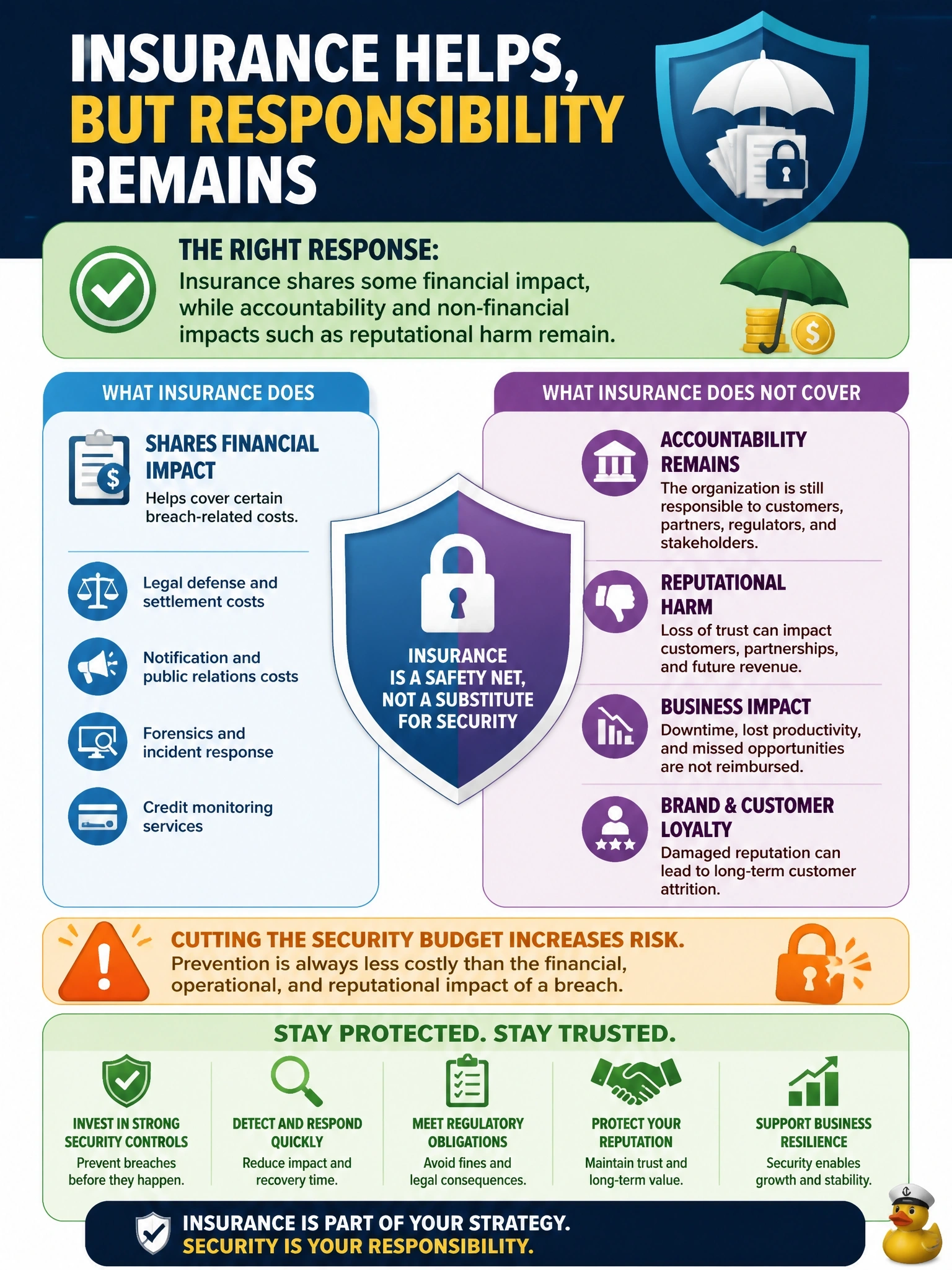
Insurance pays some bills after the fire, but it won't rebuild your customers' trust or take the blame for you. You can transfer part of the financial hit, never the accountability. Watch for answers that treat a policy like a substitute for security.
Full Explanation
Risk transfer, more precisely risk sharing, moves some financial consequences of an event to another party, typically through insurance or contracts. It does not transfer accountability: the organization remains responsible to customers, regulators and shareholders for protecting the data, and many impacts, such as reputational damage, customer loss, operational disruption and regulatory action, are not fully compensated by any policy. Policies also carry exclusions, limits and conditions that often require reasonable security controls to be maintained. Cutting the security budget could therefore increase uninsured losses and even jeopardize coverage. Agreeing that accountability has moved to the insurer misunderstands transfer entirely. Making agreement conditional on the insurer approving current controls still treats insurance as a replacement for security; an underwriting review is not an assurance that risk is acceptable. Claiming that insurance is valid only for risks outside appetite is incorrect; it is a legitimate treatment option for many risks and is commonly combined with mitigation. Exam caveat: transfer is often part of a combined treatment, not a standalone answer. Operational check: review the policy's exclusions and control conditions with legal and finance, and map them to the security program before any budget change.