
A risk assessment is complete, and the security manager must sequence a three-year roadmap. Proposed initiatives are a behavioral analytics platform, data loss prevention that relies on data labels, a policy refresh with a data classification scheme, and an automated response tool. Which initiative should be scheduled FIRST?
Select an answer to reveal the explanation.
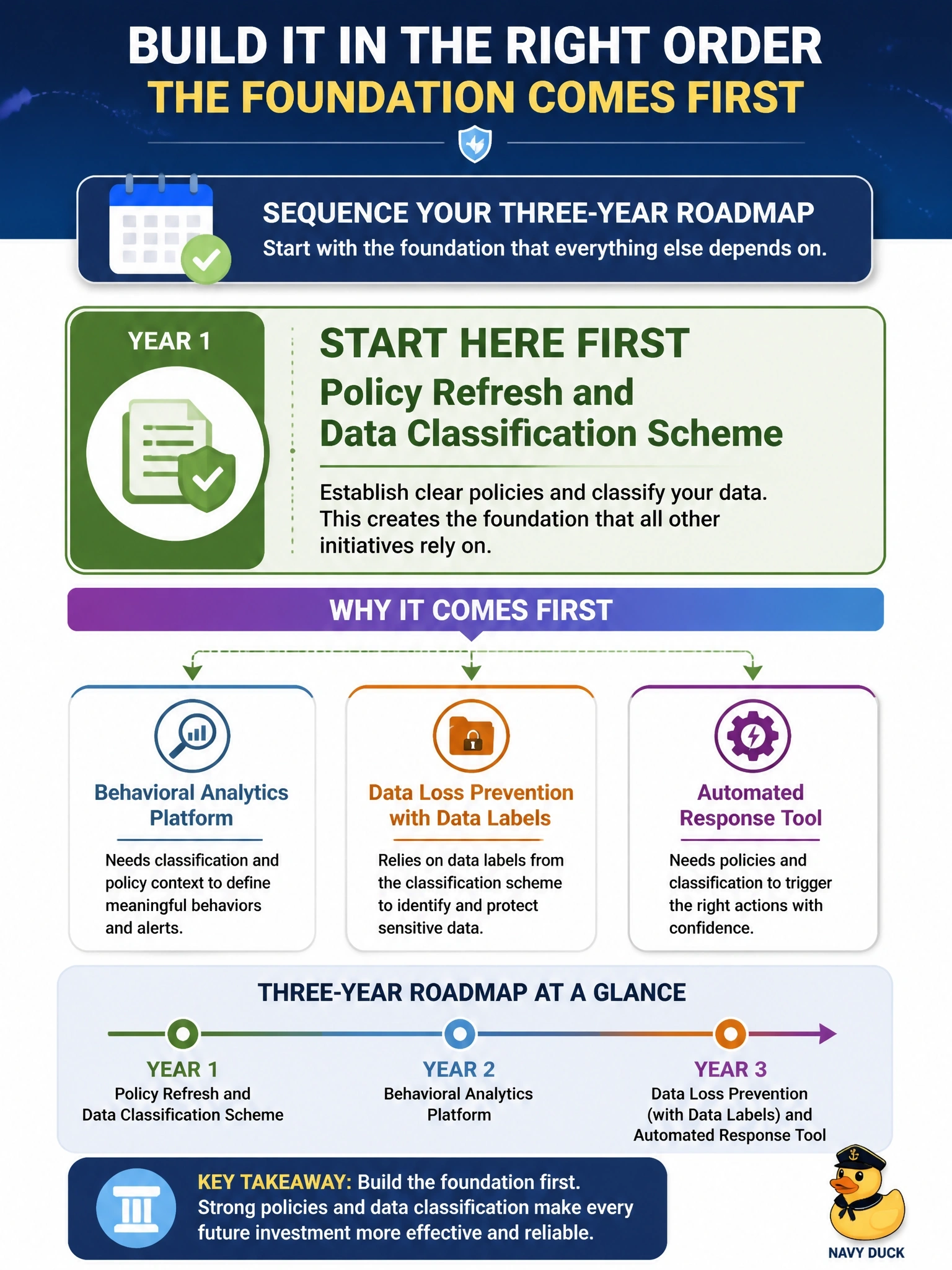
Short Explanation
You can't hang pictures before the walls are up. Data loss prevention needs labels, labels need a classification scheme, and tools need policies telling them what 'wrong' looks like. The trap is chasing the flashiest tool first and then discovering it has nothing to enforce.
Full Explanation
Roadmap sequencing should respect dependencies and risk, and foundational governance usually comes before advanced tooling. In this scenario, data loss prevention explicitly relies on data labels, which in turn require a data classification scheme supported by current policy; analytics and automated response also need policy to define what is acceptable and what action is authorized. Scheduling the policy refresh and classification scheme first enables every later initiative to deliver value. Starting with the behavioral analytics platform invests in detection before the organization has defined what data matters most or what behavior is permitted, producing alerts that are hard to prioritize. Launching data loss prevention first would deploy a tool whose rules depend on labels that do not yet exist, leading to either excessive false positives or rules so broad they are ignored. Prioritizing automated response before governance risks automated actions without clear authority or agreed playbooks. Exam caveat: if the risk assessment had identified an urgent, specific exposure, a targeted interim control might be justified ahead of the foundations; the stem gives no such urgency. Operational check: build the roadmap as a dependency map, confirm each initiative's prerequisites are scheduled earlier, and have the sponsor approve the sequence.