
Emergency management tracks AI alert-draft quality. Which monitoring approach best treats integrity as security-relevant?
Select an answer to reveal the explanation.
Short Explanation
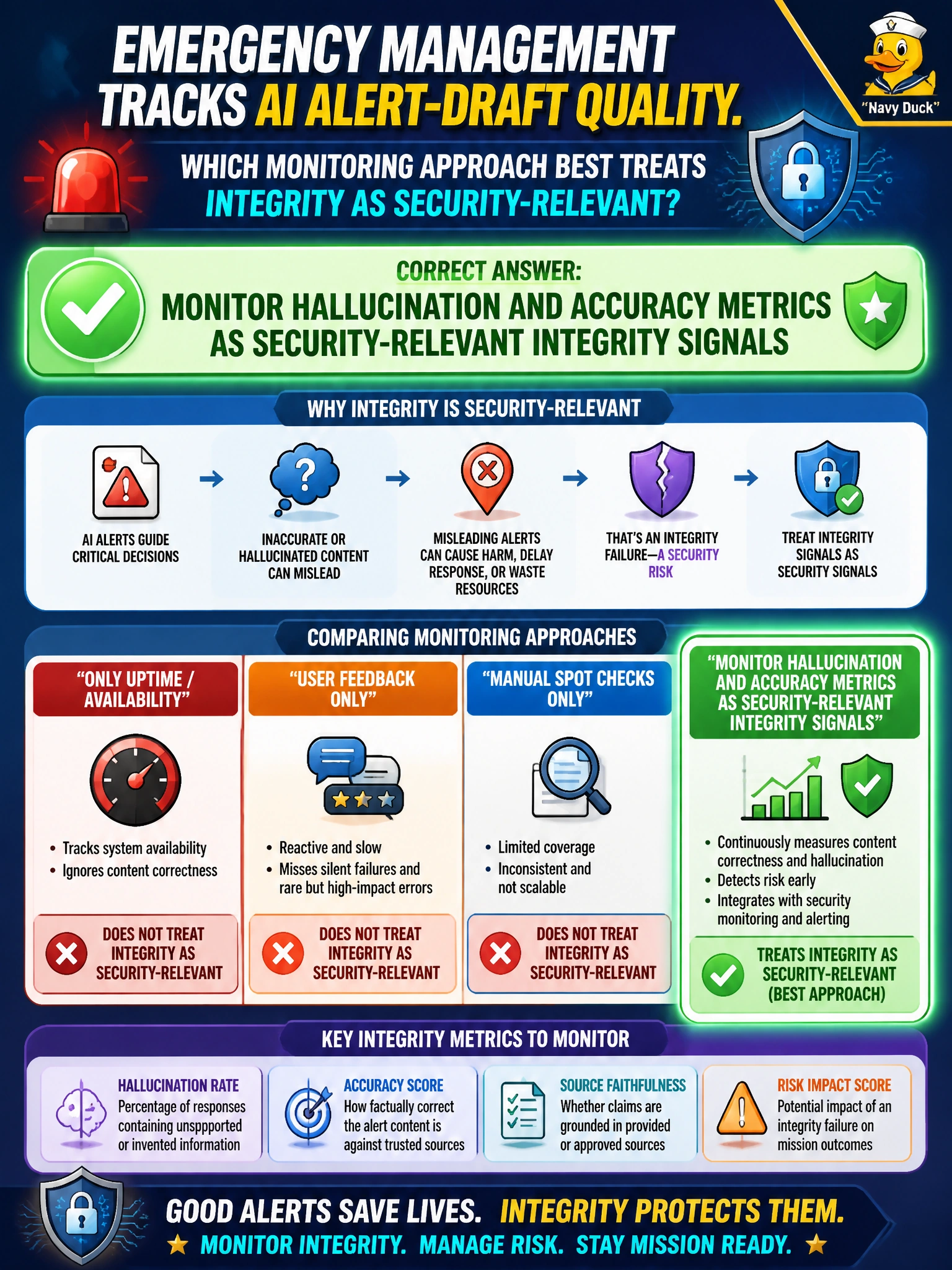
A made-up emergency fact is an integrity failure, not a grammar nit. Treat hallucination and accuracy metrics as security signals for those AI drafts.
Full Explanation
Monitoring hallucination and accuracy metrics as security-relevant integrity signals is the approach that fits emergency-management AI alert drafts: fabricated or wrong hazard facts are integrity failures that can drive harmful public action. The correct practice works by folding quality metrics into security operations so spikes in hallucination rate, factual error rate, or citation failure trigger the same seriousness as other integrity alarms—not a separate "content team only" dashboard. Monitoring access logs and authentication rates as security-relevant integrity signals fails because it tracks who enters the system, not whether the alert drafts themselves contain fabricated or inaccurate hazard information. Tracking network latency and service uptime as security-relevant integrity signals fails because availability and speed do not verify that the generated alert content is factually correct or free of hallucinations. Reviewing operator clarity and tone feedback as security-relevant integrity signals fails because subjective impressions of clarity and tone do not detect hallucinated facts or verify accuracy against trusted hazard sources. Exam caveat: not every stylistic oddity is a security incident; define thresholds and human review for suspected factual hallucinations in alert drafts before mass distribution. Operational check: instrument draft-time hallucination and accuracy checks against trusted hazard sources, feed metrics and alerts into the security monitoring stack, block or quarantine drafts that fail integrity gates, and review metric trends after model or prompt changes affecting emergency messaging.
Prefer to study offline? Printable PDF study book + test engine ($7.50, unofficial). These questions stay free here.