
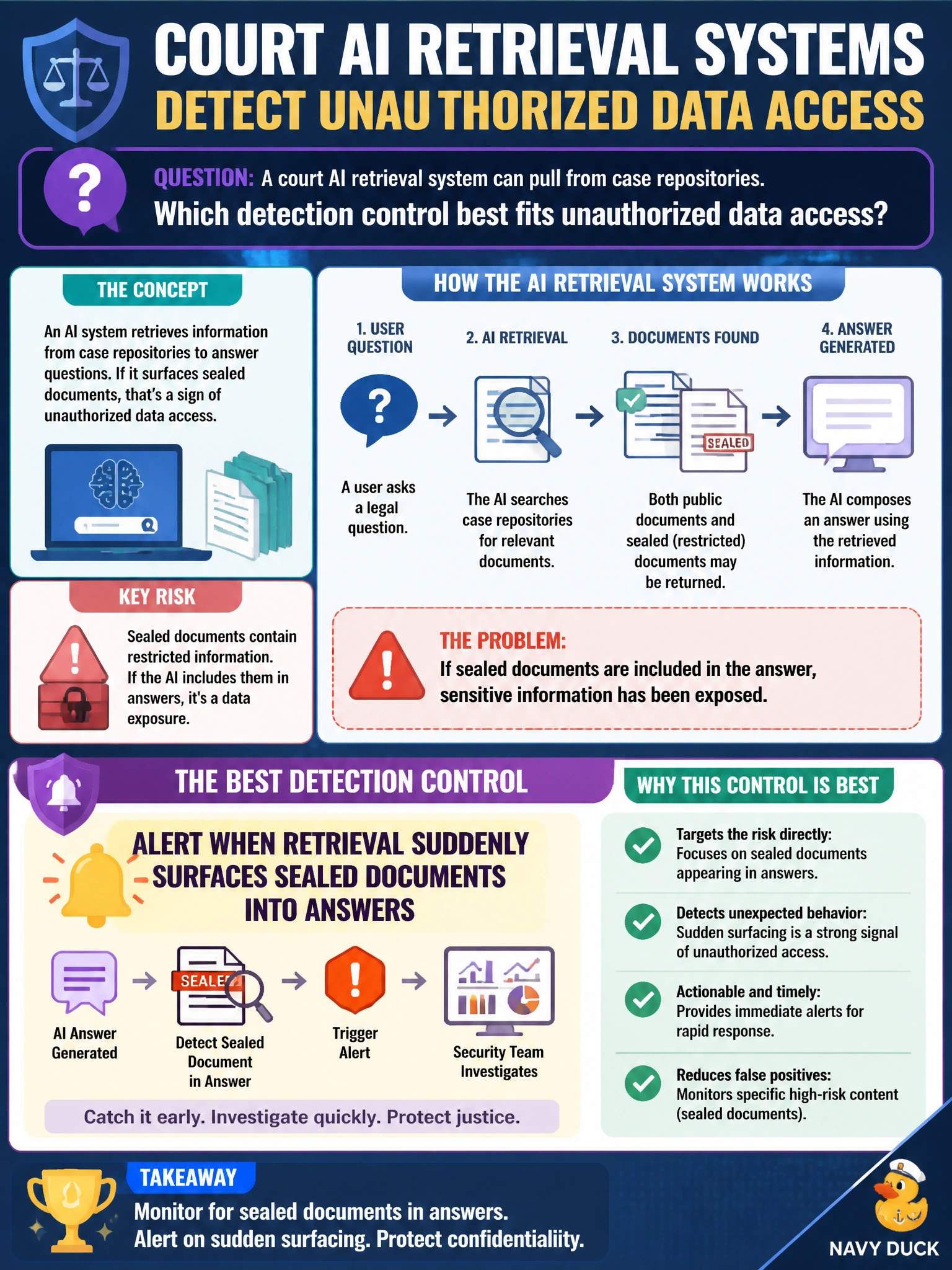
A court AI retrieval system can pull from case repositories. Which detection control best fits unauthorized data access?
Select an answer to reveal the explanation.
Short Explanation
If sealed docs start showing up in AI answers, that is a siren—not a footnote. Alerting on that retrieval failure is how courts catch unauthorized access fast.
Full Explanation
Alerting when retrieval suddenly surfaces sealed documents into answers is the detection control that fits unauthorized data access in a court AI retrieval system: sealed material appearing in generated answers is a confidentiality failure, not a quality nit. The correct control works because retrieval monitoring can catch policy-bypass, mis-indexed corpora, compromised credentials, or broken access filters as soon as sealed content leaks into responses. Alerting when repository permission changes suddenly bypass approval checks fails as the best fit because it detects administrative governance bypass at the permission layer rather than detecting when sealed documents are actually retrieved and surfaced into answers; it flags unauthorized configuration changes, not unauthorized data access in retrieval output. Flagging when failed attorney logins suddenly spike across portals fails because it targets authentication attacks rather than detecting when sealed case material is retrieved and surfaced in answers; it does not address unauthorized data access from repositories. Monitoring when service accounts suddenly access sealed repositories nightly fails because it tracks backend service-account activity timing rather than detecting when sealed repository documents are retrieved and surfaced in answers; it does not address the confidentiality failure in generated responses. Exam caveat: alerts must be tuned to known legitimate sealed-access workflows for authorized chambers staff so detection targets unauthorized surfacing, not every sealed touch by cleared users. Operational check: tag sealed corpora, monitor retrieval and answer traces for sealed document IDs, page security and court IT on unexpected surfacing, quarantine the offending index path, and run periodic sealed-document canary queries that must never appear in unauthorized sessions.
Prefer to study offline? Printable PDF study book + test engine ($7.50, unofficial). These questions stay free here.