
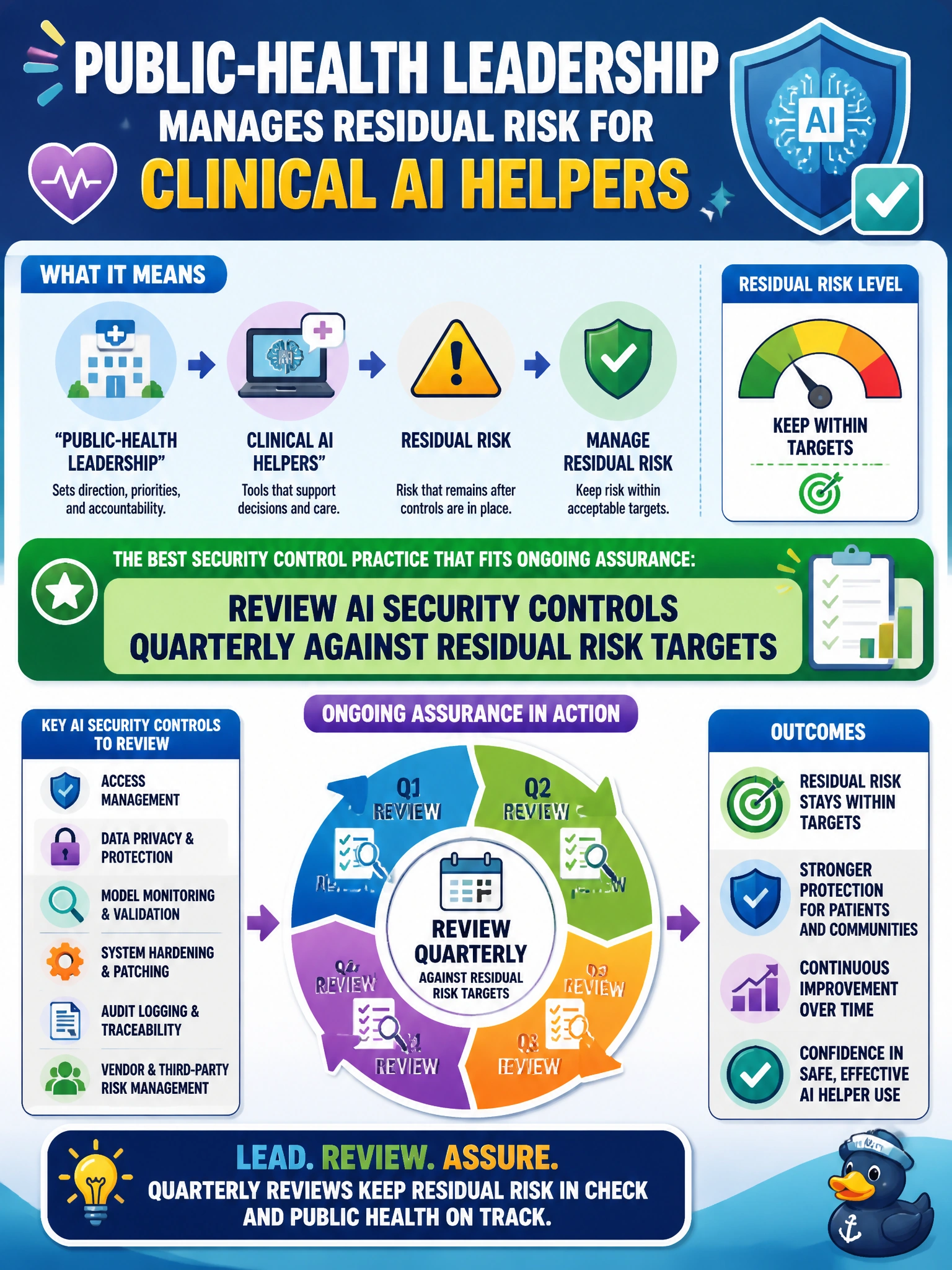
Public-health leadership manages residual risk for clinical AI helpers. Which security control practice best fits ongoing assurance?
Select an answer to reveal the explanation.
Short Explanation
Risk targets drift, so you'll want a calendar covering all your AI controls because a vendor security controls audit misses the rest. Quarterly reviews against residual risk keep the program honest.
Full Explanation
Reviewing AI security controls quarterly against residual risk targets is the ongoing assurance practice that fits public-health clinical AI helpers: residual risk changes as models, data, threats, and clinical workflows evolve. The correct control works because periodic review compares current control effectiveness and residual risk to approved targets, then drives remediation or risk acceptance with dates—not a quarterly vendor security controls audit that checks only vendor-owned controls but ignores internal, data, model, and workflow controls that also shape residual risk. Auditing vendor security controls quarterly against residual risk targets fails conceptually because it assures only the vendor subset rather than testing whether the full set of AI security controls actually keeps residual risk within approved targets in a clinical context. Monitoring model accuracy controls quarterly against residual risk targets fails because accuracy is only one control domain and not comprehensive security control assurance; it does not measure whether the full set of controls keeps residual risk within approved targets. Reviewing privileged access controls quarterly against residual risk targets fails as ongoing assurance because it is a single access-control domain, not a comprehensive review of AI security controls against residual risk targets. Exam caveat: quarterly is a common municipal cadence, not a universal law; higher-risk clinical AI may need faster review triggers after incidents, model changes, or new data sources, while low-risk helpers might combine quarterly paperwork with continuous monitoring. Operational check: calendar quarterly AI control reviews owned by public-health risk and security leads, compare residual risk to documented targets, record findings and actions, and require out-of-cycle review when models, vendors, or clinical indications change.
Prefer to study offline? Printable PDF study book + test engine ($7.50, unofficial). These questions stay free here.