
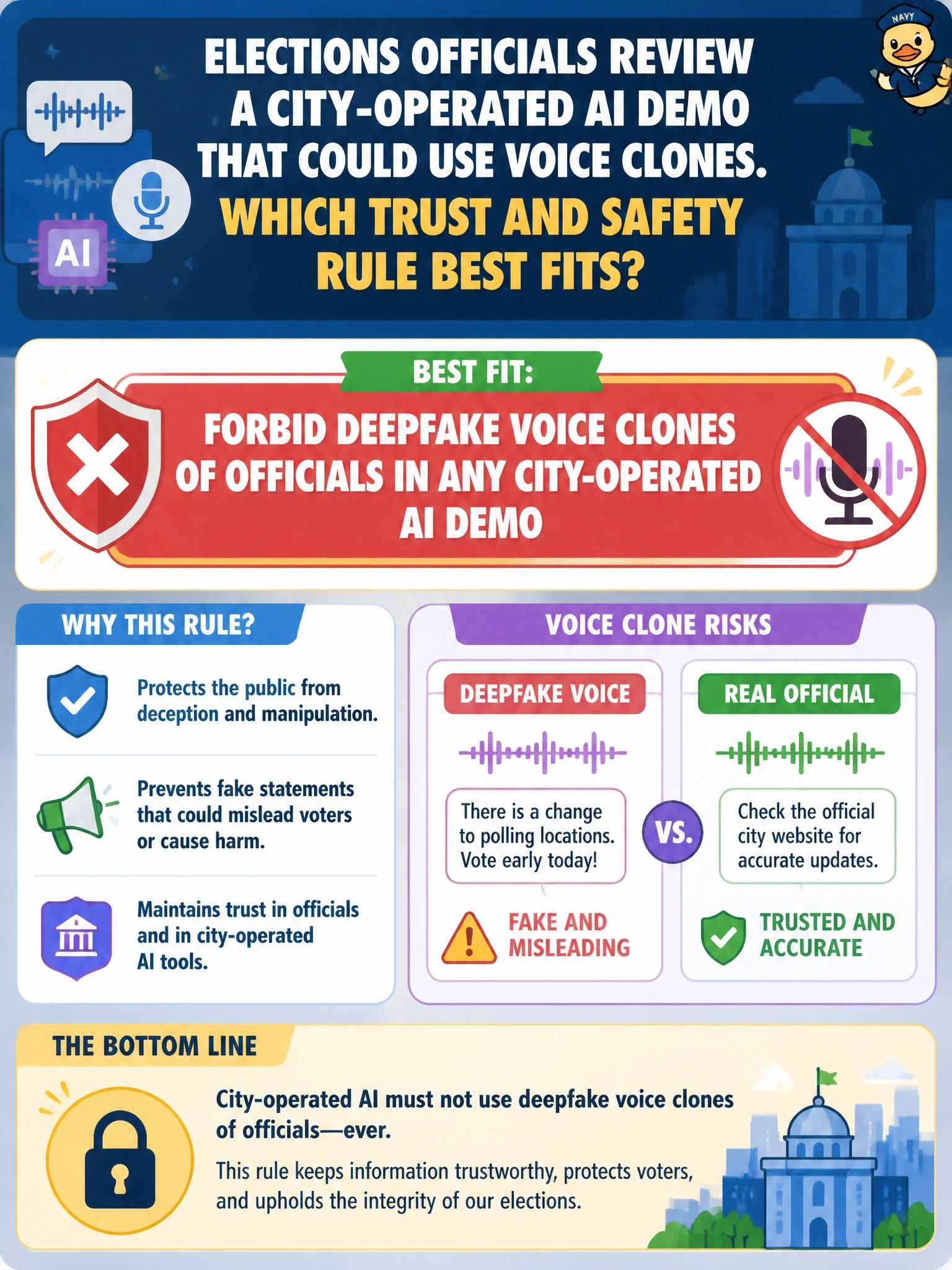
Elections officials review a city-operated AI demo that could use voice clones. Which trust and safety rule best fits?
Select an answer to reveal the explanation.
Short Explanation
City demos are not a playground for deepfake mayor voices. Forbid those clones outright—trust and safety in elections-adjacent contexts does not do “just this once.”
Full Explanation
Forbidding deepfake voice clones of officials in any city-operated AI demo is the trust-and-safety rule that fits elections-adjacent civic risk: cloned official voices can seed confusion, phishing, or false authority even when labeled a demo. The correct rule works by establishing a bright-line prohibition—city systems should not manufacture official vocal likenesses that the public might later confuse with authentic communications. Requiring documented consent from officials before cloning voices for demos fails conceptually because consent does not remove the risk that cloned official voices leak, get recorded, and normalize a capability elections officials have strong reason to keep out of municipal tooling. Permitting official voice clones in demos with visible synthetic content labels fails by relying on visible notice against a strong authenticity attack; labels do not reliably prevent misattribution of cloned speech. Allowing synthetic official voices in demos following election risk review fails as a review-over-trust tradeoff that still manufactures official vocal likenesses and increases deepfake familiarity and misuse pathways. Exam caveat: banning official voice clones in city-operated demos is distinct from detecting third-party deepfakes in the wild; both matter, but this control addresses what the city itself will not create. Operational check: put an explicit deepfake-likeness ban in the AI demo policy, block voice-clone features in approved tools, require legal and elections review for any biometric likeness request, and treat violations as security incidents rather than creative exceptions.
Prefer to study offline? Printable PDF study book + test engine ($7.50, unofficial). These questions stay free here.