
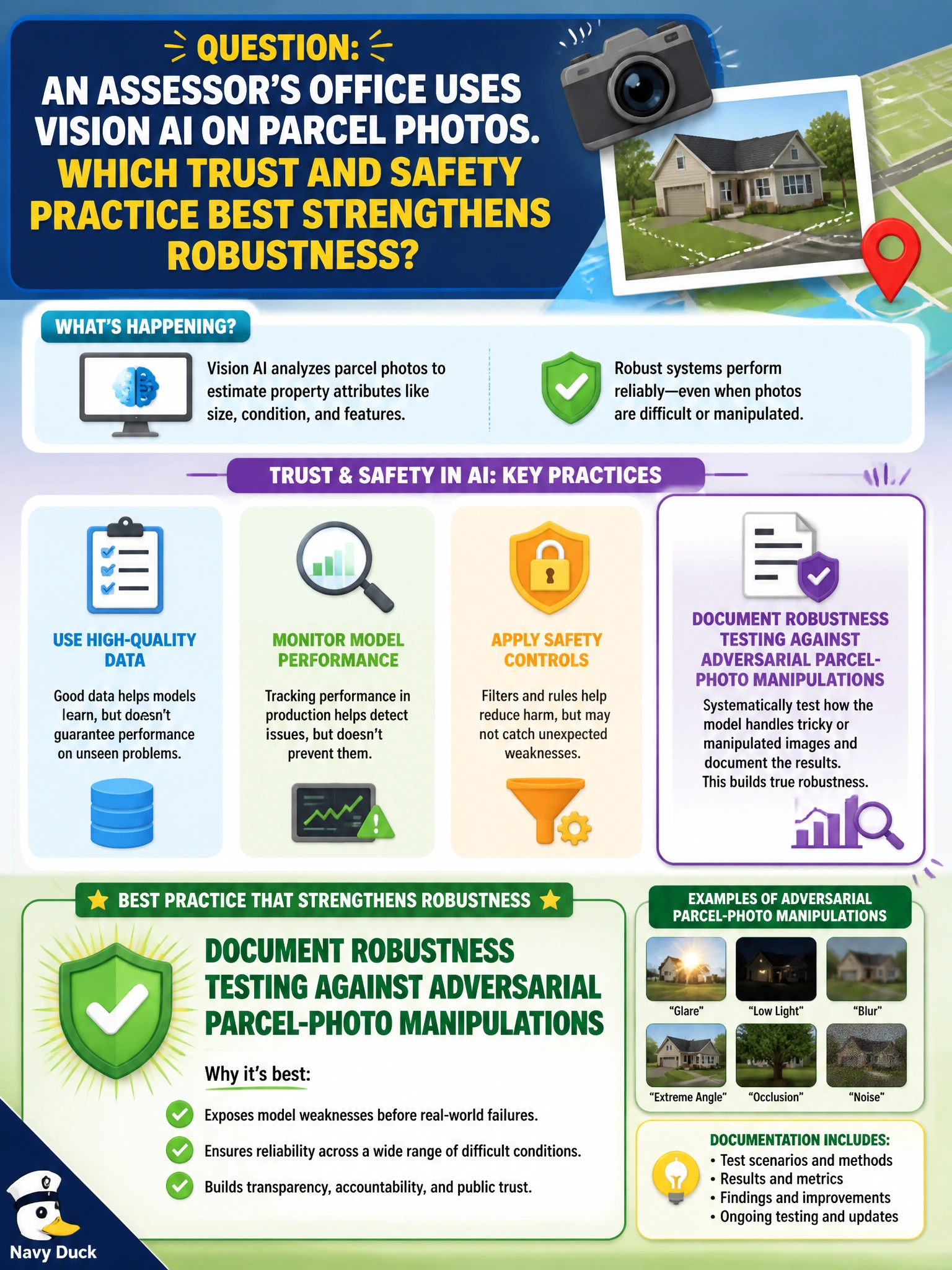
An assessor’s office uses vision AI on parcel photos. Which trust and safety practice best strengthens robustness?
Select an answer to reveal the explanation.
Short Explanation
Parcel photos can be gamed—so prove the vision helper can take a punch. Documented robustness testing against adversarial manipulations is how assessors keep trust real.
Full Explanation
Documenting robustness testing against adversarial parcel-photo manipulations strengthens trust and safety for assessor vision AI because property imagery can be altered to hide improvements, exaggerate damage, or spoof conditions that affect valuation and enforcement. The correct practice works by treating robustness as an evidence-backed property: teams define attack classes such as cropping, overlays, lighting tricks, and synthetic edits, measure degradation, and record results so risk owners know residual exposure rather than assuming clean-lab accuracy transfers to the field. Documenting robustness testing on clean parcel-photo validation collections fails as a robustness practice—clean-collection testing only shows baseline accuracy and does not reveal how the model performs under adversarial manipulations or field distribution shifts, and it cannot substitute for documented adversarial testing. Documenting robustness testing for parcel-photo audit log completeness checks fails as a robustness practice because audit-log completeness checks support traceability but do not test or improve the model's resilience to manipulated or shifted parcel photos. Documenting robustness testing of parcel assessment use-case descriptions fails as a robustness practice because use-case descriptions document intended use and limitations but do not measure or harden the model against adversarial parcel-photo manipulations. Exam caveat: documented adversarial tests are not infinite; scope them to plausible assessor threats and refresh when model or capture pipelines change. Operational check: maintain a parcel-photo robustness test set with known manipulations, run it before model promotion, threshold alerts for anomalous image traits, and keep a signed test report with the model release package for audit.
Prefer to study offline? Printable PDF study book + test engine ($7.50, unofficial). These questions stay free here.