
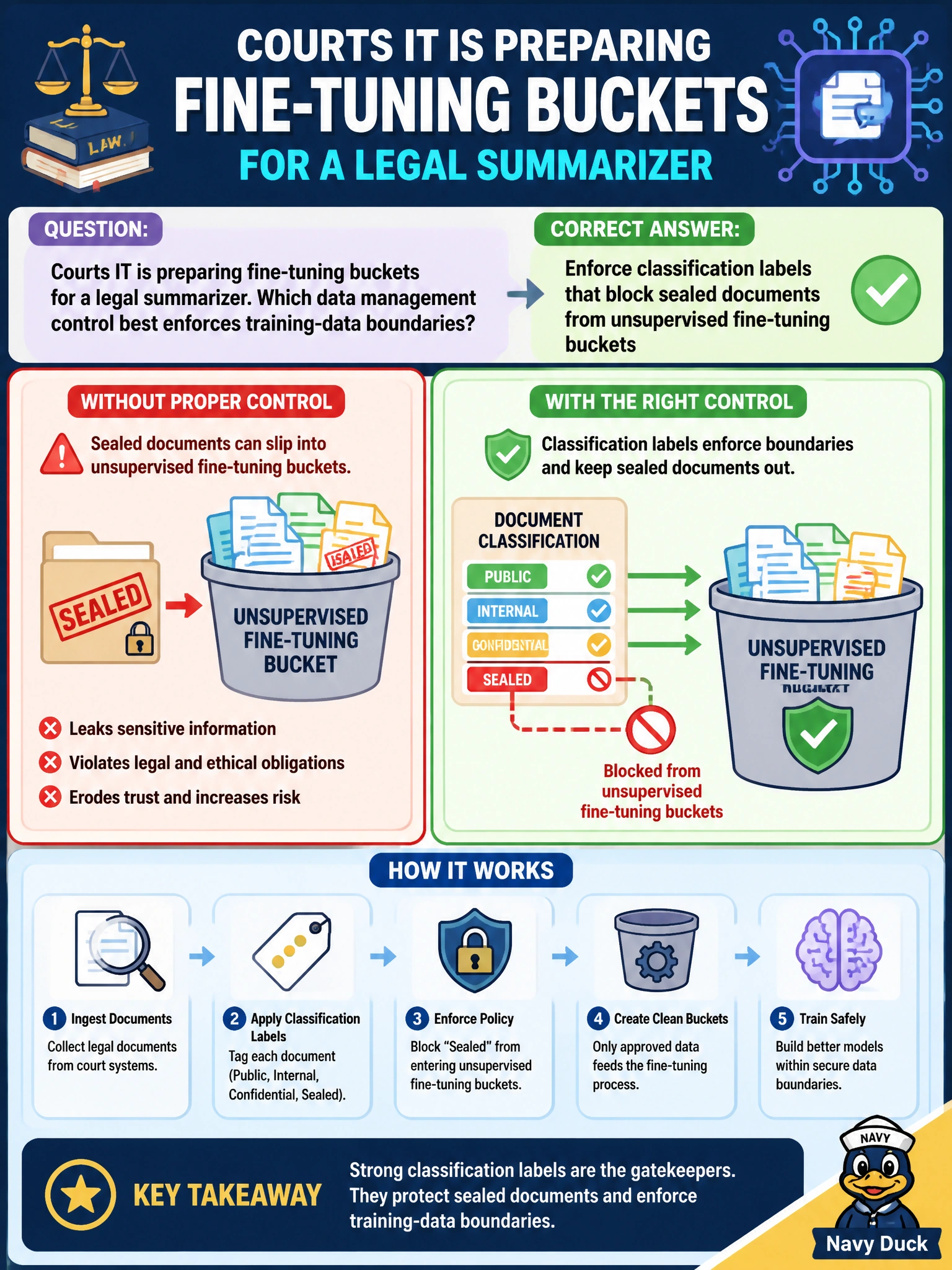
Courts IT is preparing fine-tuning buckets for a legal summarizer. Which data management control best enforces training-data boundaries?
Select an answer to reveal the explanation.
Short Explanation
Sealed isn’t a suggestion—it’s a hard line. Classification that blocks sealed docs from unsupervised fine-tuning buckets keeps the summarizer from learning what it should never see.
Full Explanation
Courts fine-tuning data for a legal summarizer must respect sealed-matter boundaries. Classification labels that technically block sealed documents from unsupervised fine-tuning buckets enforce training-data boundaries at the control plane, where urgency and convenience cannot casually override them. Enable detailed audit logging of fine-tuning bucket access for extended post-training review activities only watches access after the fact and cannot stop sealed documents from entering unsupervised fine-tuning buckets in the first place. Require bucket-level encryption at rest for existing sealed court summarizer training dataset archives secures stored archives but does not prevent sealed records from mixing with public evidence during fine-tuning or enforce boundaries at the control plane. Apply automated retention policies that version curated fine-tuning datasets for future regulated reuse governs how long datasets are kept but is not a technical gate that blocks sealed documents from unsupervised fine-tuning buckets. Exam caveat: AAISM data management for restricted civic records favors automated, label-enforced exclusion over policy slogans or awareness-only controls. Operational check: tag sealed versus public court records, bind fine-tuning bucket policies to those labels, scan staging areas for sealed markers before training, and retain deny/allow logs for audit when Courts IT prepares summarizer datasets.
Prefer to study offline? Printable PDF study book + test engine ($7.50, unofficial). These questions stay free here.