
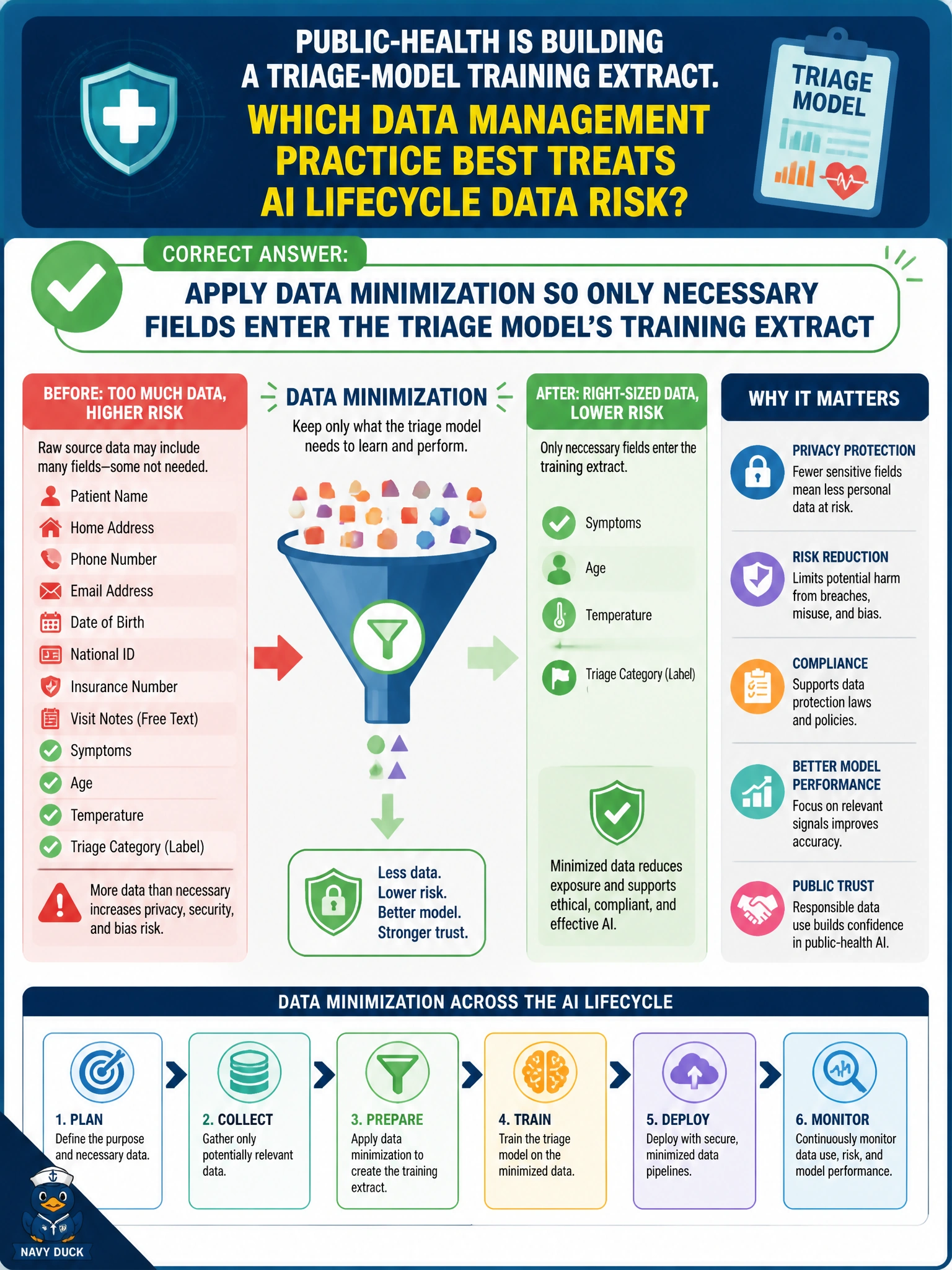
Public-health is building a triage-model training extract. Which data management practice best treats AI lifecycle data risk?
Select an answer to reveal the explanation.
Short Explanation
Pseudonymizing full records with separate key storage still leaves you holding more data than you'll need for training. Keep only the fields the triage model actually needs—less data in means less privacy and integrity risk to babysit.
Full Explanation
Public-health triage-model training extracts should follow data minimization: only fields necessary for the defined modeling purpose enter the sandbox. Minimization shrinks privacy exposure, reduces integrity attack surface, and clarifies lawful basis and retention for protected health-related attributes used in civic triage analytics. Pseudonymizing full triage records with separate key storage to support training use still places full records in the training workflow, preserves reversible identifiable data that remains re-identifiable if keys and records are combined, and violates minimization by retaining all fields rather than limiting the extract to what the triage model needs. Maintaining versioned copies of full extracts with restricted access for reproducibility still over-collects by preserving full extracts rather than minimized fields, retains excess data across versions even with tighter access controls, and treats reproducibility as a substitute for purpose-limited retention. Retaining training extracts in governed archive to enable longitudinal performance review keeps training data beyond the modeling purpose, increases long-term privacy and integrity exposure despite archive governance, and substitutes a monitoring justification for disciplined retention limits on the extract. Exam caveat: AI lifecycle data management expects purposeful collection and least-data training extracts, especially for public-health use cases with elevated sensitivity. Operational check: document the triage feature list against a data inventory, exclude non-essential PHI and HR fields, apply retention to the extract, and require approval before expanding the field set for any subsequent training run.
Prefer to study offline? Printable PDF study book + test engine ($7.50, unofficial). These questions stay free here.