
A library evaluates quantizing an on-prem summarizer to run on smaller hardware. What lifecycle consideration matters most for security posture?
Select an answer to reveal the explanation.
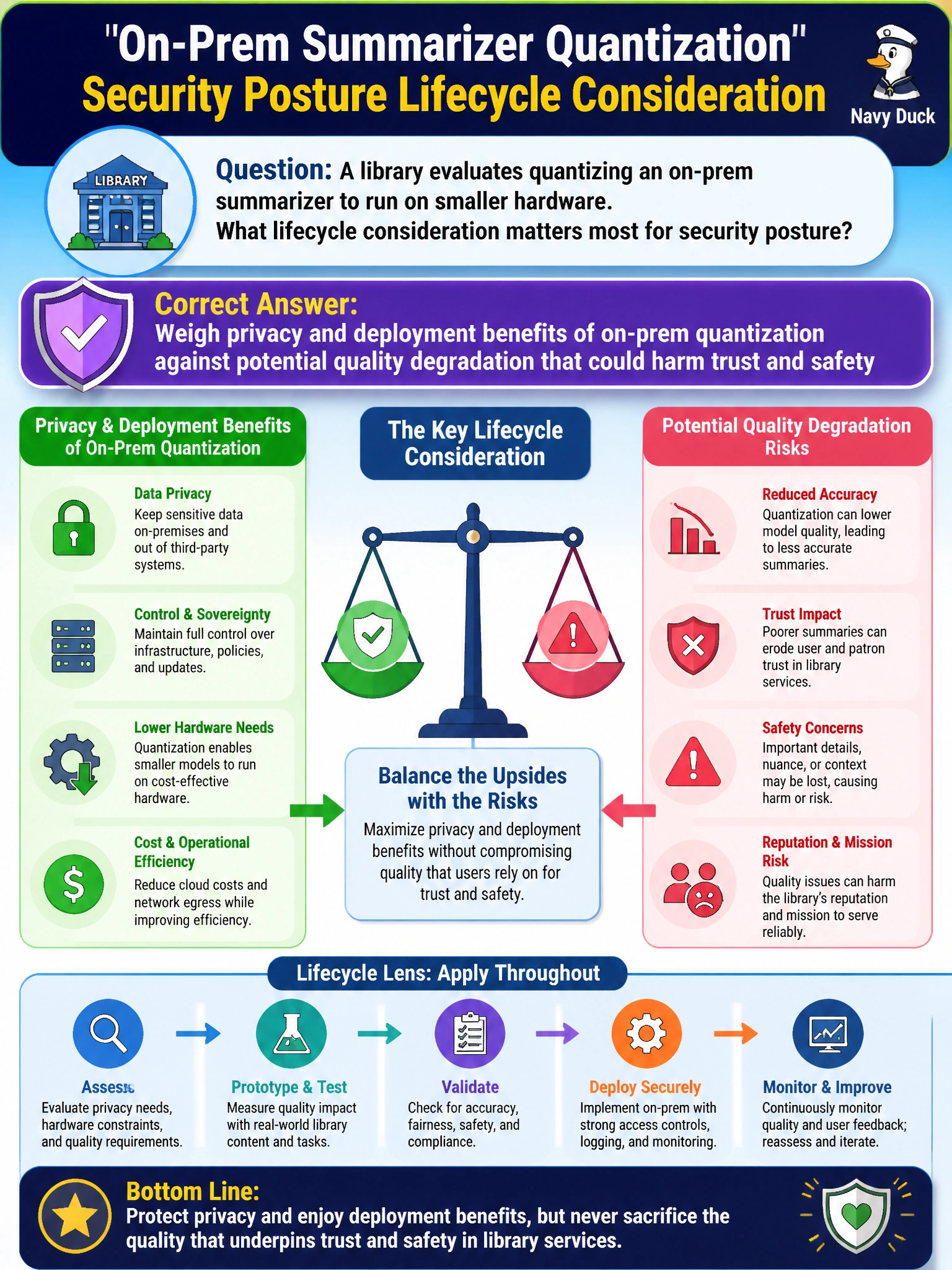
Short Explanation
Smaller on-prem models can keep patron text closer to home, but check that answers don’t get sloppy. Blind quantization—or fleeing to a public API just to dodge the decision—misses the real trade-off.
Full Explanation
Libraries considering quantization of an on-prem summarizer to fit smaller hardware are making a lifecycle trade-off, not a pure performance tweak. The consideration that matters most for security posture is weighing privacy and deployment benefits of on-prem quantization against potential quality degradation that could harm trust and safety. On-prem quantized models can keep patron queries local and reduce third-party exposure, but degraded answers may misstate policies or reduce reliability; both sides must be evaluated.
Quantizing blindly without measuring quality impact on library answers fails because unmeasured degradation can produce unsafe or misleading guidance to patrons. Moving the summarizer to a public consumer API to avoid hardware decisions fails by trading an on-prem privacy posture for external processing of library queries. Ignoring privacy benefits of on-prem hosting when comparing options fails conceptually—it omits a core security/privacy factor in the deployment choice.
Exam caveat: Quantization decisions for civic on-prem AI are dual evaluations of confidentiality benefit and quality/safety impact—not blind compress-or-outsource moves.
Operational check: Benchmark quantized vs full-precision answer quality on library FAQ tasks, document residual privacy gains of on-prem hosting, set minimum quality thresholds before hardware cutover, and reject 'move to public API' as a way to dodge the trade-off analysis.
Prefer to study offline? Printable PDF study book + test engine ($7.50, unofficial). These questions stay free here.