
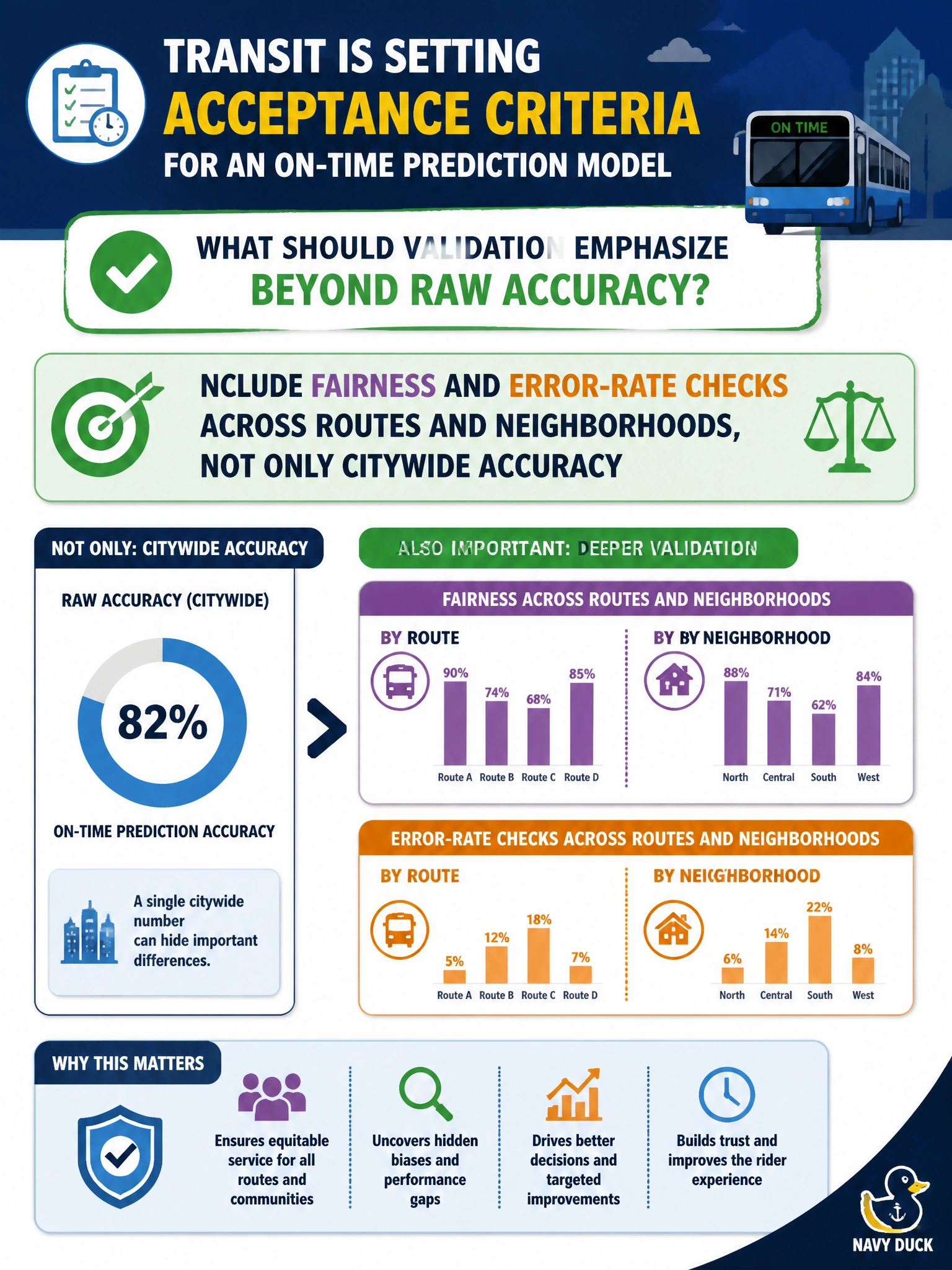
Transit is setting acceptance criteria for an on-time prediction model. What should validation emphasize beyond raw accuracy?
Select an answer to reveal the explanation.
Short Explanation
A citywide average can hide a route that always loses. Check fairness across neighborhoods, not just the shiny overall score. One corridor’s success isn’t proof for the whole system.
Full Explanation
Transit on-time prediction models serve riders unevenly across routes and neighborhoods, so acceptance criteria must look beyond a single citywide accuracy number. Validation should include fairness and error-rate checks across routes and neighborhoods, not only aggregate accuracy, so systematic underperformance against some communities is visible before the model is accepted. Equity-aware validation supports trustworthy municipal service and catches dashboard averages that hide concentrated harm.
Including fairness and uptime checks for arrival displays across routes and stops fails as acceptance criteria because it validates display availability rather than prediction error rates, so even equitable uptime can hide systematically worse on-time predictions for some neighborhoods. Including fairness and latency checks across routes and time periods fails as validation because it measures equitable response speed rather than equitable prediction accuracy, so fast responses can still carry systematically larger errors for some routes and neighborhoods. Including fairness reviews of monthly board-report narratives across districts fails because it reviews reporting language rather than model performance, so balanced narratives cannot serve as an acceptance gate that catches systematic prediction errors before deployment.
Exam caveat: Civic AI lifecycle validation emphasizes disaggregated performance (routes/neighborhoods), not only citywide accuracy.
Operational check: Slice error rates by route and neighborhood, set acceptance gates that reject large disparities even when citywide accuracy is high, and document equity review with transit operations before production acceptance.
Prefer to study offline? Printable PDF study book + test engine ($7.50, unofficial). These questions stay free here.