
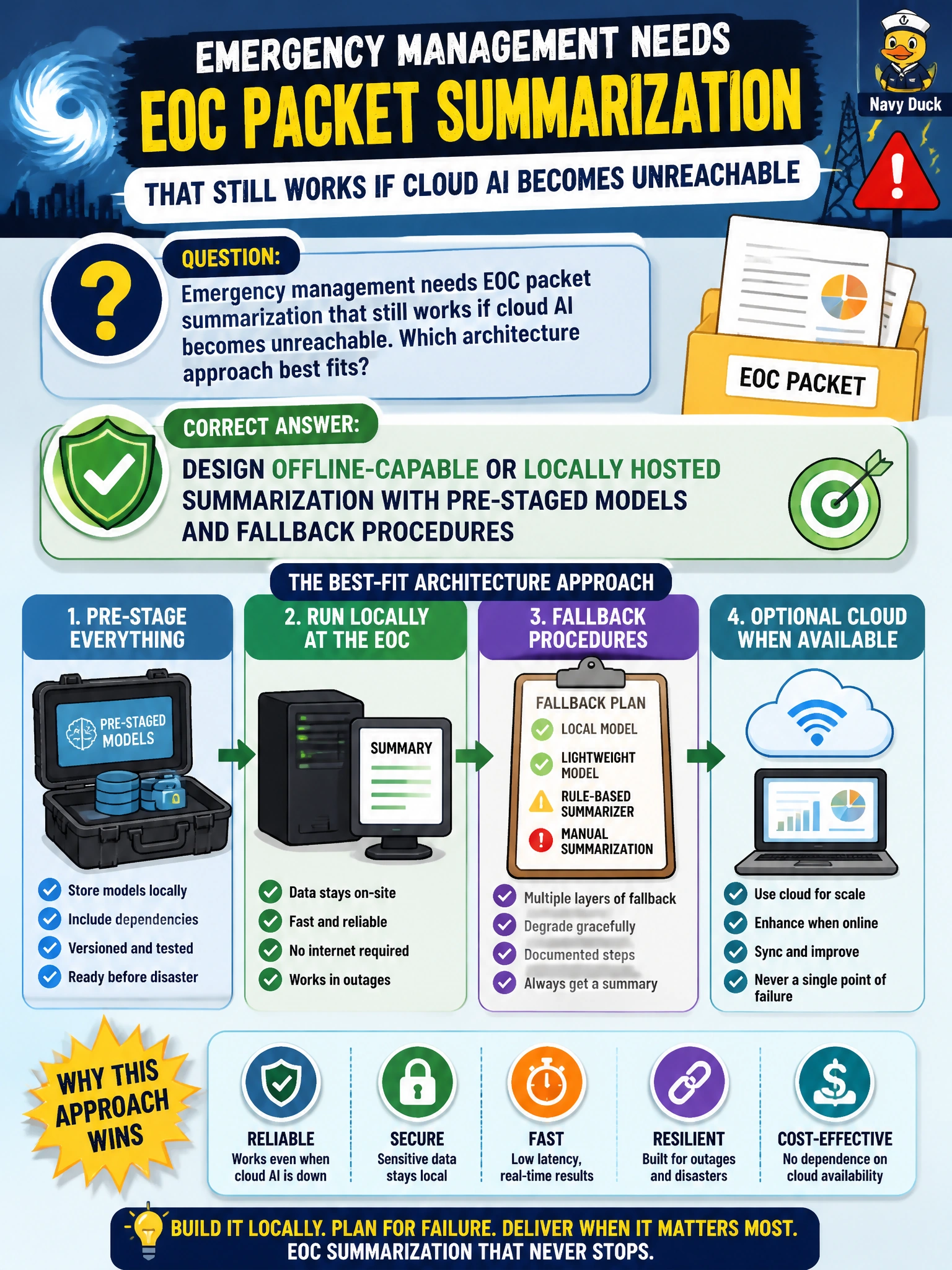
Emergency management needs EOC packet summarization that still works if cloud AI becomes unreachable. Which architecture approach best fits?
Select an answer to reveal the explanation.
Short Explanation
When the cloud goes dark mid-incident, you still need summaries. Pre-stage a local option and a playbook—don’t freeze the EOC or ship packets to someone’s consumer chatbot. Resilience is part of the design, not a hope.
Full Explanation
Emergency operations centers cannot pause documentation because a vendor cloud AI endpoint is unreachable during an incident. The architecture approach that fits is offline-capable or locally hosted summarization with pre-staged models and documented fallback procedures so EOC packet summarization continues under degraded connectivity. Resilience here is part of AI security architecture for continuity of municipal emergency functions, not an afterthought once the outage starts.
Depending solely on a single public cloud AI endpoint with no local fallback fails because a connectivity, outage, or provider incident becomes a single point of failure for EOC workflows. Halting all EOC documentation whenever internet AI is down fails operationally and conceptually—it couples mission documentation to an external dependency instead of designing for continuity. Emailing classified packet text to personal consumer chatbots as a backup fails because it exfiltrates sensitive emergency content into unmanaged consumer services outside municipal controls, retention, and classification handling.
Exam caveat: For emergency AI, AAISM favors resilience designs (local/pre-staged models and fallbacks) over cloud-only dependence or unsafe consumer-chat workarounds.
Operational check: Pre-stage approved local summarizer weights and runbooks, test failover during exercises, prohibit consumer chatbot use for packet text, and document who activates the offline path when cloud AI is unreachable.
Prefer to study offline? Printable PDF study book + test engine ($7.50, unofficial). These questions stay free here.