
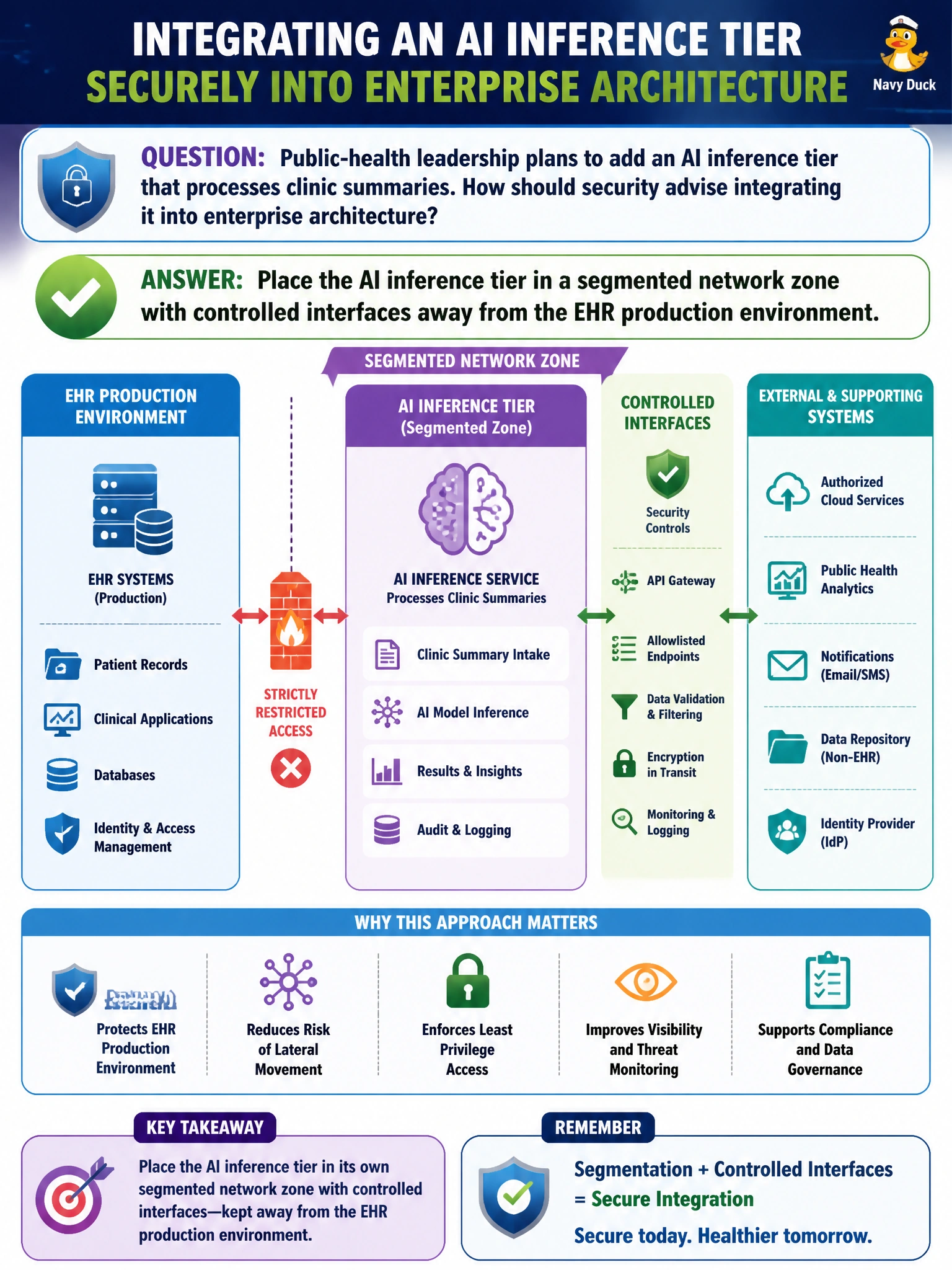
Public-health leadership plans to add an AI inference tier that processes clinic summaries. How should security advise integrating it into enterprise architecture?
Select an answer to reveal the explanation.
Short Explanation
Think of the AI inference box like a guest wing—not the same hallway as the EHR vault. Segment it, put doors on the interfaces, and don’t hand it full production keys. Temporary or not, it still sits inside the enterprise.
Full Explanation
Public-health clinic summaries sit next to some of the municipality’s most sensitive systems, so enterprise-architecture placement of an AI inference tier is a security decision, not a convenience detail. The correct approach is to put the inference tier in a segmented network zone with controlled interfaces that keep it away from the EHR production environment. Segmentation limits lateral movement if the model stack is compromised, constrains which identities and protocols can reach clinical data, and forces any EHR interaction through reviewed gateways rather than flat adjacency. Temporary project language does not change the fact that inference still processes clinic content inside the enterprise trust fabric.
Collocating the inference tier on the same flat VLAN as EHR databases with unrestricted lateral access fails because it collapses trust boundaries: a prompt-injection, dependency, or credential flaw in the AI path becomes an EHR lateral-move opportunity. Skipping enterprise-architecture review because inference is 'only temporary' fails conceptually—temporary workloads still expand the attack surface and often become permanent without the controls that a review would require. Mirroring full EHR production credentials into unmanaged public cloud notebooks fails because it exports highly privileged clinical secrets into environments outside municipal key management, logging, and retention controls.
Exam caveat: AAISM architecture items reward deliberate zoning and interface control for AI components adjacent to sensitive civic systems; temporary status is not an exemption from enterprise placement rules.
Operational check: Confirm the inference zone has documented allow-lists to EHR interfaces, no flat VLAN adjacency to clinical databases, credentials scoped and rotated under enterprise KMS/IAM, and an architecture review ticket closed before production clinic summaries flow through the tier.
Prefer to study offline? Printable PDF study book + test engine ($7.50, unofficial). These questions stay free here.