
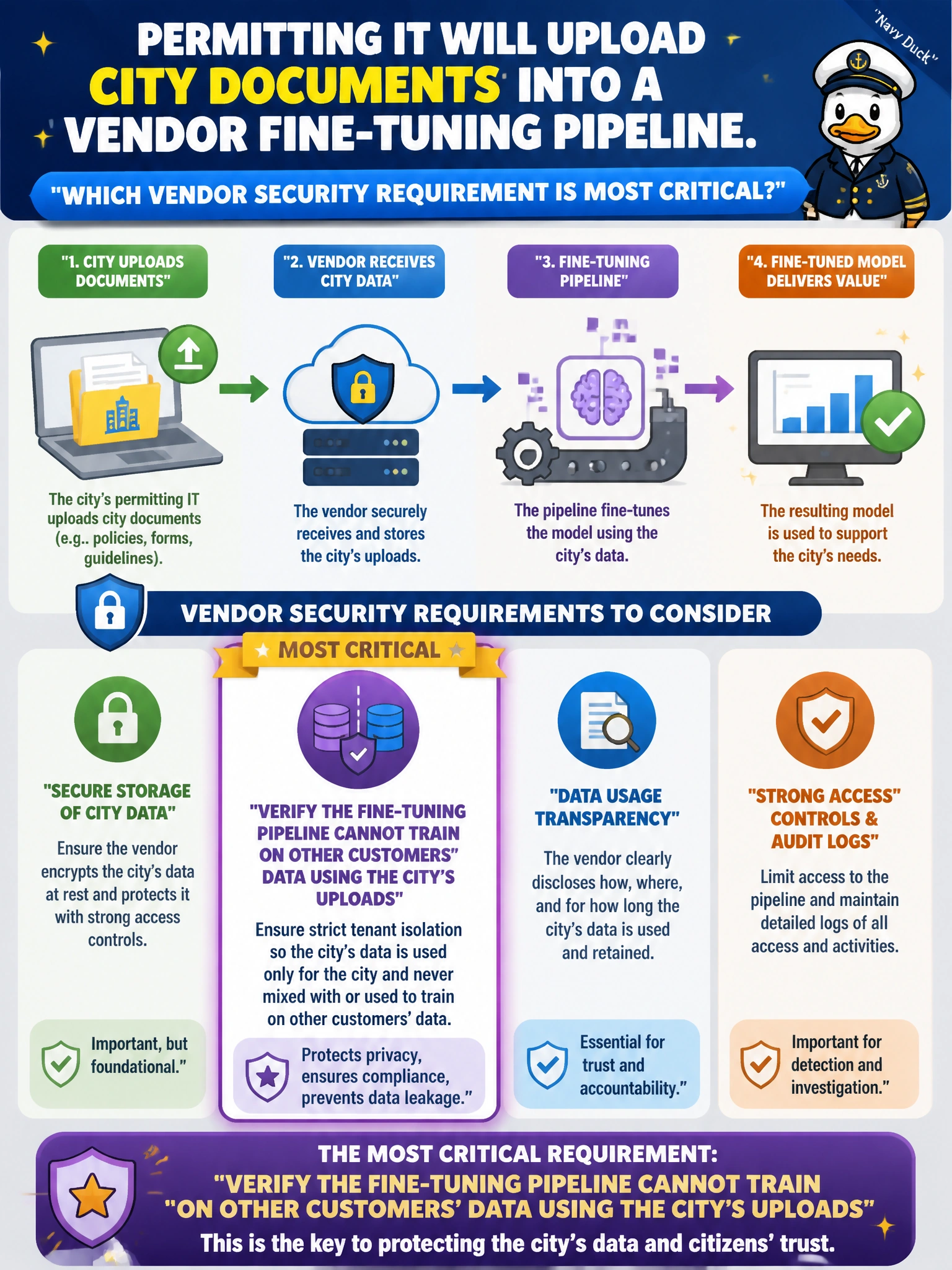
Permitting IT will upload city documents into a vendor fine-tuning pipeline. Which vendor security requirement is most critical?
Select an answer to reveal the explanation.
Short Explanation
Your city's permit files shouldn't become free training fuel for someone else's tenant. You demand proof the pipeline can't bleed your uploads into other customers' models—encryption and access logs don't cover that. Shared pools by default are a red flag.
Full Explanation
Permitting IT uploading city documents into a vendor fine-tuning pipeline should critically verify that the fine-tuning pipeline cannot train on other customers’ data using the city’s uploads—and symmetrically cannot leak city uploads into other tenants’ models. That vendor security requirement is most critical because fine-tuning concentrates proprietary permit content; cross-tenant training or shared pools create confidentiality, integrity, and competitive exposure failures for municipal permitting.
Requiring the vendor to encrypt fine-tuning datasets at rest with AES-256 and in transit fails conceptually because encryption guards the uploads from outside interception, not from the vendor's own pipeline: once the data is decrypted to train, encryption says nothing about whether that run stays walled off from other customers' models. Requiring role-based access controls for vendor staff accessing the fine-tuning environment fails because RBAC governs which people can touch the environment, not what the pipeline does with the data once access is granted; staff can be correctly scoped by role while the pipeline still pools the city's uploads into other customers' runs. Requiring tamper-evident audit logging of fine-tuning jobs and city dataset access with retention fails because a log is a detective control recording what happened after the fact; it does not prevent the pipeline from training on the city's uploads alongside other customers' data, which is the preventive guarantee this scenario needs.
Exam caveat: contractual isolation language must match technical reality—logical tenant IDs alone may not prevent shared fine-tune corpora unless the pipeline enforces hard separation. Operational check: require written and technical evidence of per-tenant fine-tune isolation, prohibit shared training pools for city uploads, and sample vendor attestations plus configuration before any bulk permitting corpus is sent.
Prefer to study offline? Printable PDF study book + test engine ($7.50, unofficial). These questions stay free here.