
Housing chatbot capacity collapses after scrapers flood token-heavy requests. Which vulnerability-management response best addresses this AI threat?
Select an answer to reveal the explanation.
Short Explanation
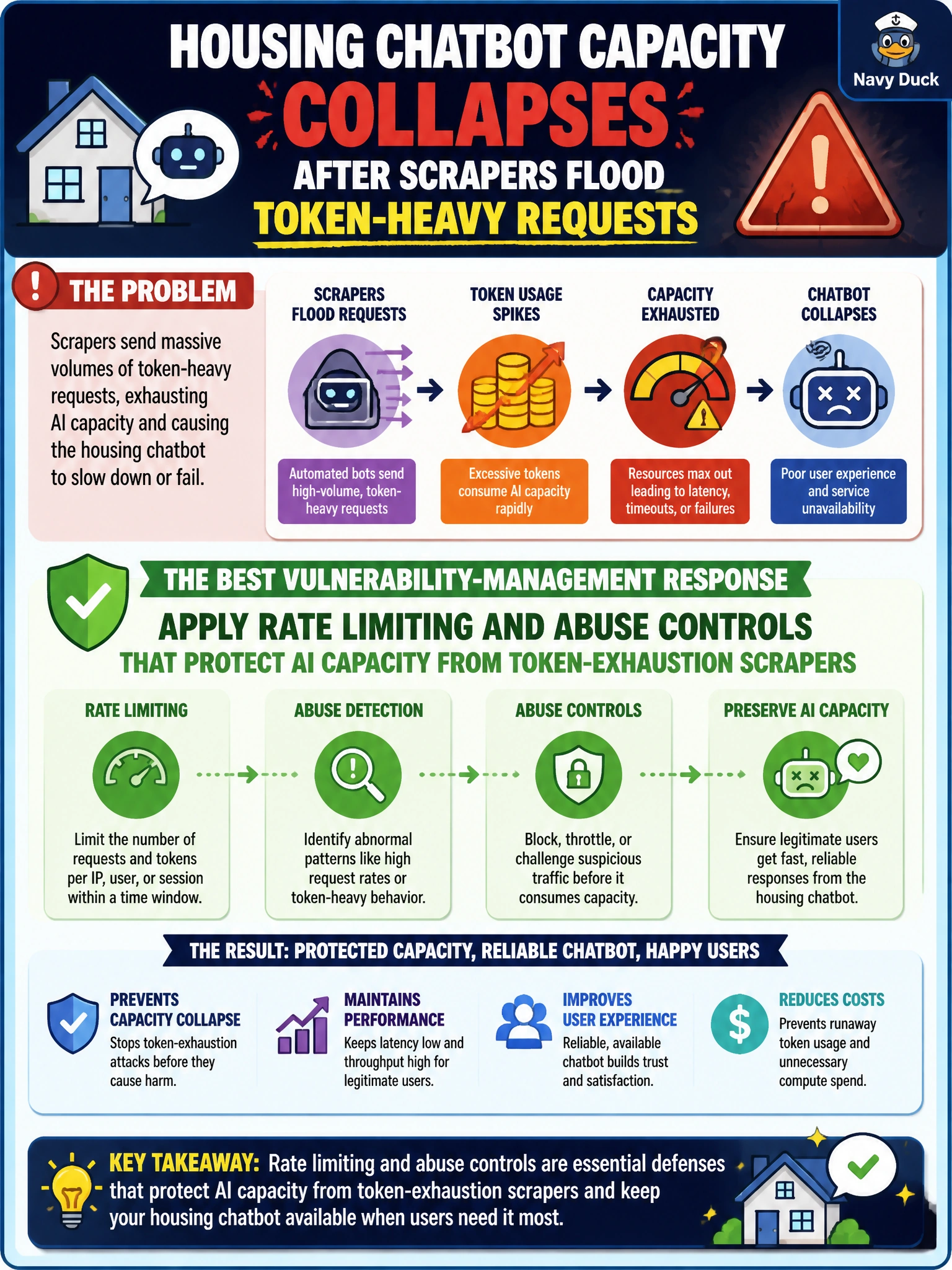
Scrapers can burn through tokens until the housing bot goes dark for real residents. Cap the flood with rate limits and abuse controls so capacity stays for people who need help. Watching token-usage logs and dashboards shows you the burn, but it won’t stop a scraper from draining your token budget.
Full Explanation
Housing chatbot capacity collapsing after scrapers flood token-heavy requests is best addressed by applying rate limiting and abuse controls that protect AI capacity from token-exhaustion scrapers. That response works because generative assistants meter cost and availability in tokens and concurrent inference; without quotas, per-identity limits, anomaly thresholds, and bot challenges, scrapers can deny service to residents seeking housing assistance while inflating municipal spend. Deploying input validation and prompt filters that screen token-heavy scraper queries for injection fails because those controls only inspect content for injection, but they still allow high-volume benign queries through and do not throttle volumetric token-exhaustion scrapers or enforce quotas, per-identity limits, and anomaly thresholds needed to protect AI capacity. Requiring mutual TLS authentication between clients and servers to block token-exhaustion scraper traffic fails because it only verifies client identity at connection setup; it does not throttle token consumption, enforce quotas, or stop authenticated scrapers from flooding volumetric requests at the public chatbot edge. Enabling token-usage audit logging and capacity dashboards that track token-exhaustion scraper consumption patterns fails because it only provides visibility into consumption after it occurs; it does not throttle scrapers, enforce token budgets, or prevent capacity collapse in real time. Exam caveat: rate limits must spare legitimate high-need residents (for example, emergency housing triage) through tiered policies rather than blunt global caps that create inequitable denial. Operational check: define per-user and per-IP token budgets for the housing chatbot, alert when burn rate exceeds baseline, and document exception paths for authorized bulk civic workflows before enforcing blocks.
Prefer to study offline? Printable PDF study book + test engine ($7.50, unofficial). These questions stay free here.