
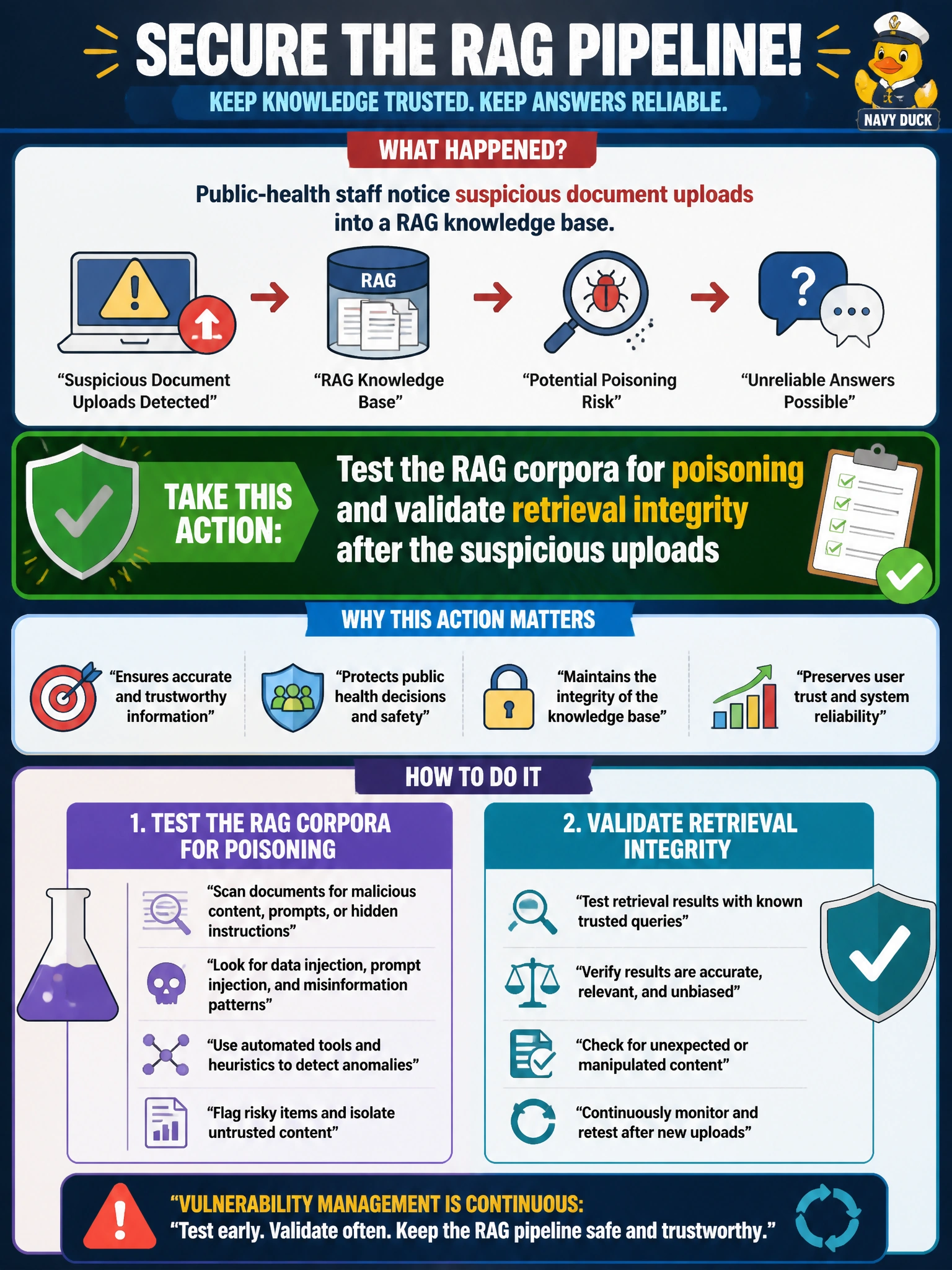
Public-health staff notice suspicious document uploads into a RAG knowledge base. What vulnerability-management action should security take?
Select an answer to reveal the explanation.
Short Explanation
Weird uploads into the knowledge base are a poisoning alarm, not a filing chore. Test the corpus and check what the retriever pulls before clinicians trust it. Rebuilding embeddings from the current corpora and redeploying the retriever to refresh index shards won’t tell you if the uploads are poisoned or validate retrieval integrity.
Full Explanation
Suspicious uploads into a public-health RAG knowledge base are a classic data-poisoning vulnerability signal. Security should test the corpora for poisoning and validate retrieval integrity after those uploads so clinicians do not receive manipulated guidance. Testing works because retrieval systems amplify whatever documents they index; integrity validation of chunks, citations, and top-k results detects whether malicious or low-quality content is now steering answers. Vulnerability management treats the knowledge path as a security surface equal to the model endpoint.
Scanning the upload bucket for malware signatures and validating clean parse logs for uploaded PDFs fails because file-level malware checks do not detect data poisoning or validate retrieval integrity; a PDF can parse cleanly and still contain manipulated clinical guidance that steers answers. Rebuilding vector embeddings from current corpora and redeploying the retriever to refresh index shards fails because reindexing does not test for poison already present or validate that chunks, citations, and top-k results are trustworthy; it merely refreshes index shards without determining whether malicious content is shaping answers. Tuning retrieval top-k and reranking thresholds to improve answer relevance for uploaded passages fails because relevance tuning does not test for poisoning or validate retrieval integrity; it optimizes answers around untrusted uploads rather than determining whether malicious content is shaping answers.
Exam caveat: not every suspicious file is intentional poison—quality failures and misfiles also demand quarantine—but both warrant corpus testing before clinical reliance. Operational check: quarantine new uploads, run poison/integrity tests and retrieval spot-checks against known clinical queries, restore from clean snapshots if needed, and only then re-enable the documents with provenance and access controls recorded.
Prefer to study offline? Printable PDF study book + test engine ($7.50, unofficial). These questions stay free here.