
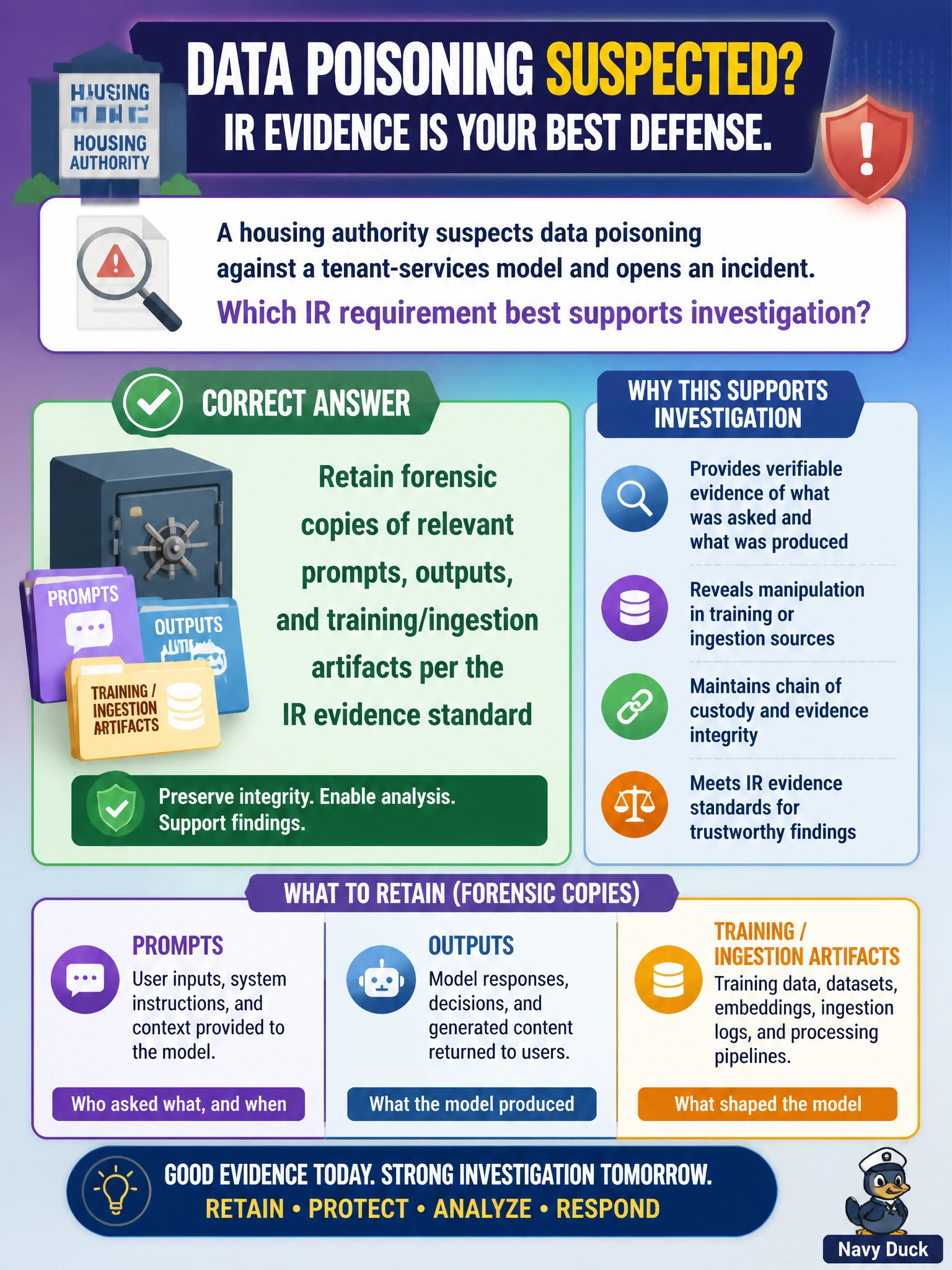
A housing authority suspects data poisoning against a tenant-services model and opens an incident. Which IR requirement best supports investigation?
Select an answer to reveal the explanation.
Short Explanation
Poisoning hunts need receipts—prompts, outputs, and what got ingested. You'll want forensic copies under IR, since anonymized summaries won't prove poisoning, release versions won't show the attack trail, and audit archiving won't lock evidence for your investigation. No AI trail means no real investigation.
Full Explanation
Suspected data poisoning against a tenant-services model is an AI integrity incident whose investigation depends on evidence: relevant prompts, outputs, and training or ingestion artifacts that show what entered the learning or retrieval pipeline. Retaining forensic copies per the IR evidence standard preserves the ability to attribute poisoning, scope affected tenant decisions, and support eradication without destroying the trail investigators need.
Retaining only anonymized copies of relevant prompts, outputs, and training/ingestion summaries per the privacy guideline fails because anonymization and summarization strip the exact payloads investigators need to attribute poisoning and scope affected tenant decisions. Retaining versioned copies of relevant model weights, configs, and evaluation reports per the release standard fails because release versioning tracks what was shipped, not the forensic prompt, output, and ingestion trail that proves what poisoned the model path. Retaining audit copies of relevant prompts, outputs, and ingestion approvals per the compliance archiving standard fails because routine compliance retention lacks the IR evidence hold with forensic integrity, restricted access, and closure-tied retention that keeps poisoning evidence available for investigation.
Exam caveat: forensic retention must still respect tenant privacy and legal hold rules—preserve what IR requires, restrict access, and avoid indefinite uncontrolled copies of sensitive tenant data. Operational check: confirm the IR evidence standard names which AI logs and ingestion batches are snapshotted on incident open, who can access them, and the retention period tied to investigation closure.
Prefer to study offline? Printable PDF study book + test engine ($7.50, unofficial). These questions stay free here.