
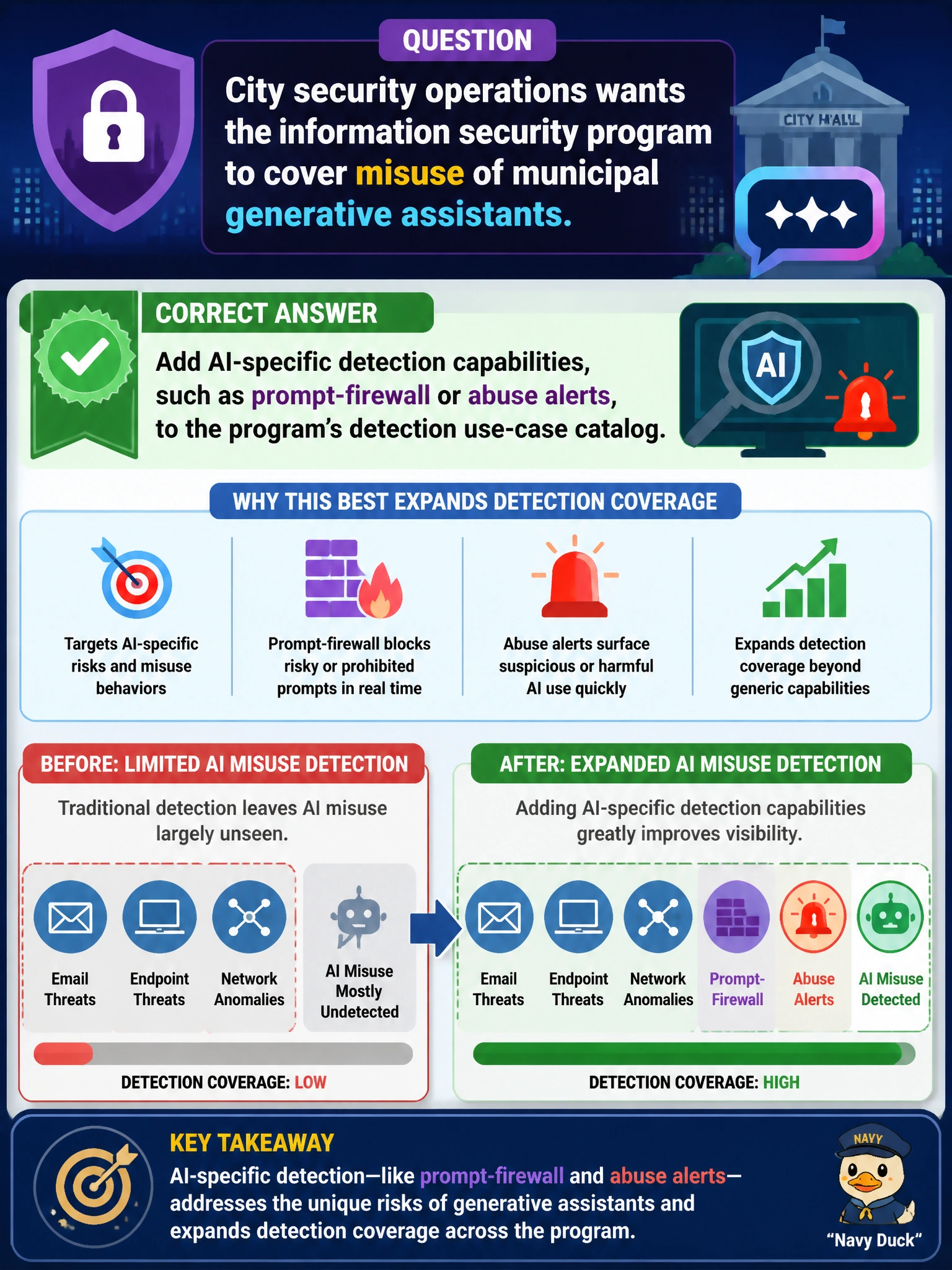
City security operations wants the information security program to cover misuse of municipal generative assistants. Which program action best expands detection coverage?
Select an answer to reveal the explanation.
Short Explanation
If the city runs generative assistants, the SOC catalog needs AI-shaped tripwires. Add prompt-firewall or abuse alerts alongside the usual detections. Expanding the catalog is how the security program keeps up with new civic tech.
Full Explanation
City security operations expands coverage of municipal generative-assistant misuse by adding AI-specific detection capabilities—such as prompt-firewall or abuse alerts—to the program’s detection use-case catalog. Generative misuse (sensitive data exfiltration via prompts, jailbreaks, toxic or fraudulent outputs) will not reliably surface in traditional malware or perimeter detections; cataloged AI use cases make monitoring intentional and testable. Removing generative assistants from monitoring scope to reduce alert volume shrinks visibility where new abuse is likely. Relying solely on end-user honor systems without detection use cases abandons SOC assurance. Documenting detections only after a public scandal forces retrospective logging is reactive program management. Exam caveat: AI detections need tuned baselines and privacy-aware log handling so prompt monitoring itself does not become an uncontrolled sensitive-data store. Operational check: add prompt-abuse and sensitive-entity-in-prompt detections to the use-case catalog with owners and runbooks, enable alerts in the municipal assistant logging pipeline, and conduct a tabletop that exercises escalation from an AI abuse alert to incident response.
Prefer to study offline? Printable PDF study book + test engine ($7.50, unofficial). These questions stay free here.