
A county CIO wants AI security risk visible alongside other cyber risk. How should the AI security program be structured for reporting?
Select an answer to reveal the explanation.
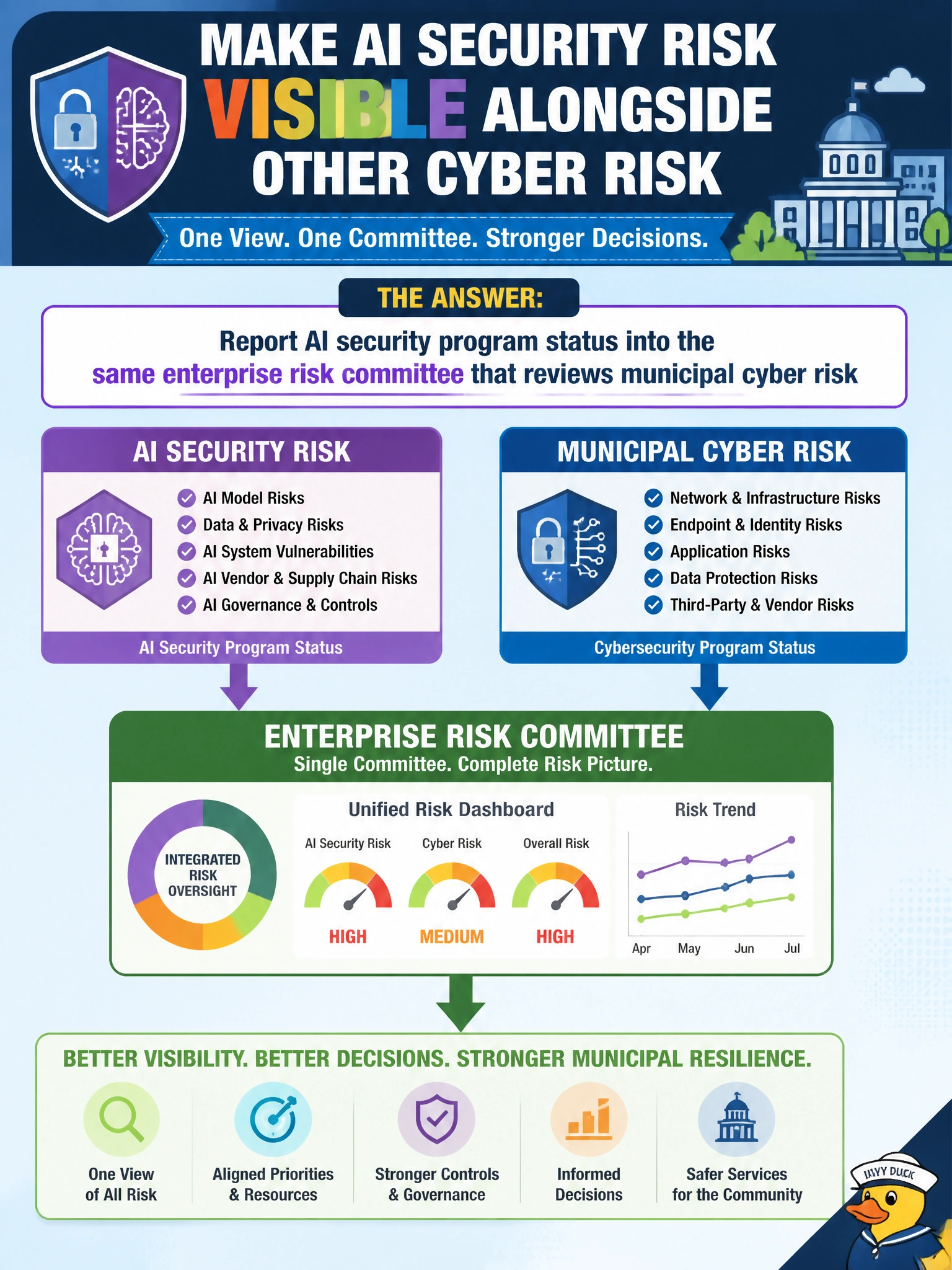
Short Explanation
AI security risks belong in the same enterprise risk committee that already reviews cyber risk—don't bury them in the IT operations review where you only track municipal system performance. Route status anywhere else and you let AI risks hide while everything else gets governed. You'll do the same if you use the separate AI steering group for innovation or the procurement risk register for third-party contracts.
Full Explanation
Reporting AI security program status into the same enterprise risk committee that reviews municipal cyber risk is the governance action that embeds AI risk into institutional decision-making. The enterprise risk committee reviews threats, mitigations, and residual risk for all major IT and operational systems; AI security risks must be presented there so the committee can prioritize them against other cyber risks, allocate resources, and escalate to the board if necessary. AI risks are organizational risks, not CISO-only concerns. This integration ensures AI security governance is seen as part of broader risk management, not a siloed technology issue.
Reporting AI security program status into the IT operations review that tracks municipal system performance hides risk from the body that actually prioritizes resources and escalates to the board: the operations review focuses on system performance and uptime, so the enterprise risk committee remains unaware of AI security gaps, incidents accumulate without escalation, and resource requests for AI security tooling or staffing go unheard. Reporting AI security program status into the separate AI steering group that aligns municipal innovation initiatives keeps AI risk outside the enterprise risk committee; alignment on innovation is not the same as the committee prioritizing AI security alongside other cyber risks. Reporting AI security program status into the procurement risk register that monitors municipal third-party contracts is a false substitute: the procurement register tracks third-party contract risk and does not give the enterprise risk committee a complete view of AI security gaps, and risk decisions can be buried in procurement workflows instead of prioritized against other cyber risks.
Operational check: ensure the next enterprise risk committee meeting includes a standing agenda item for AI security program status (incident rate, control attestations, vendor risks, staffing), presented by the CISO or AI security lead alongside cyber updates. After the meeting, confirm AI risks are reflected in the organization's quarterly risk dashboard.
Prefer to study offline? Printable PDF study book + test engine ($7.50, unofficial). These questions stay free here.