
A city permitting office discovers multiple generative assistants and vector stores with no single owner list. What should security establish first for AI asset lifecycle management?
Select an answer to reveal the explanation.
Short Explanation
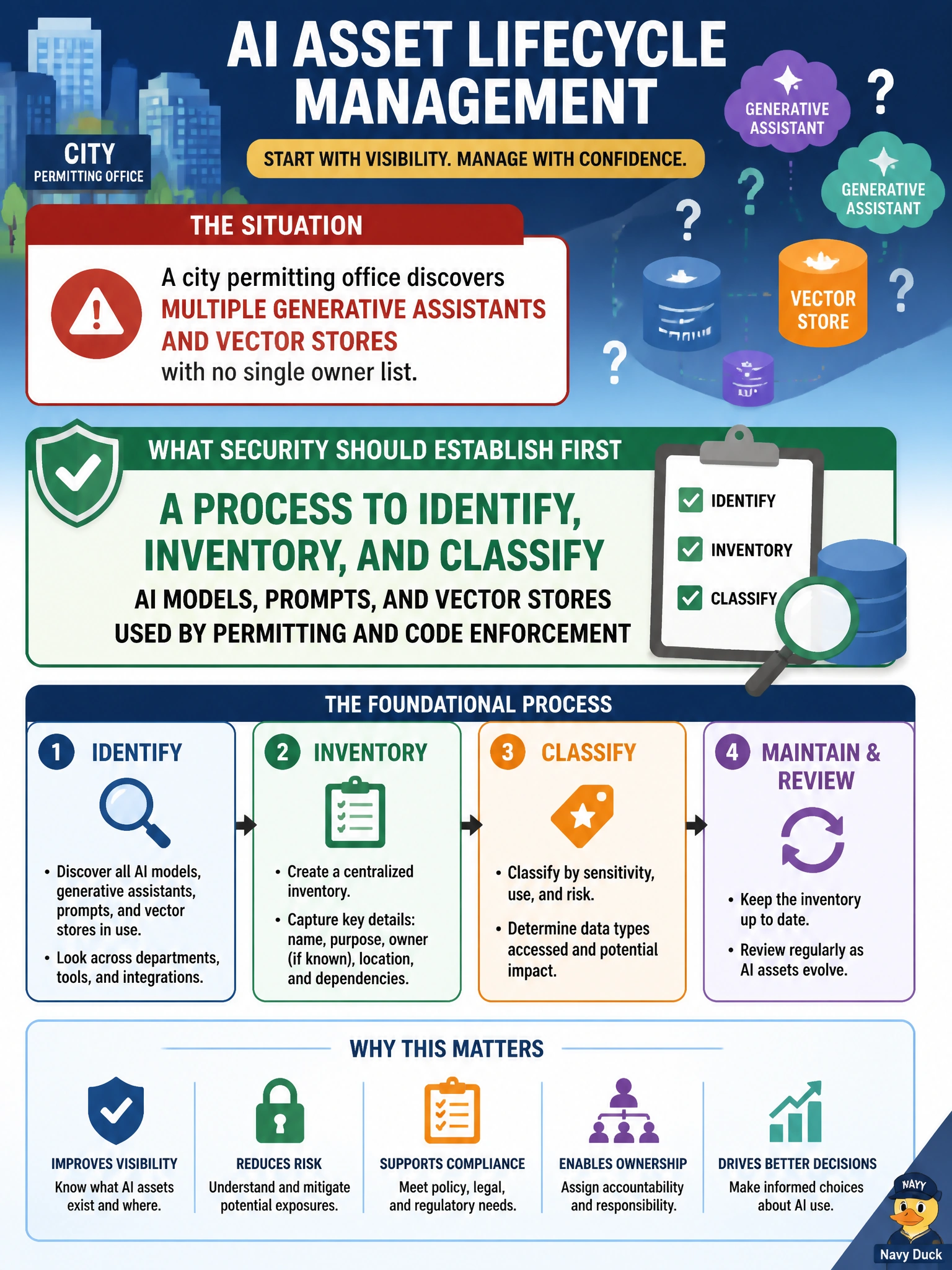
You can't govern what you don't know about. First, find all the AI systems running in the city, catalog them, sort them by risk. Then build rules.
Full Explanation
Establishing an ongoing process to identify, inventory, and classify AI models, prompts, and vector stores used by permitting and code enforcement is the foundational action that gives the city visibility and a governance starting point. A permitting office likely has multiple models running—official chatbots, fine-tuned models for specific workflows, prompt templates, and vector stores from past projects. Some may be approved; others may be shadow IT left from pilots. Without a continuing process (not a one-off list), new assistants and data stores added next quarter go untracked, and governance is impossible. Classification allows the city to apply proportionate controls: high-risk uses get tighter oversight; low-risk uses can move quickly.
A centralized logging pipeline to capture prompts and outputs for detailed audit and incident review is useful, but it is not the foundational governance step; it records activity from systems you already know about, and it does not identify shadow AI, inventory vector stores, or classify assets by risk across permitting and code enforcement. A detailed access review for vector store permissions and assistant sharing settings used by permitting and enforcement teams is a useful control, but it presumes you already know which assistants and stores exist; it does not create the initial inventory, identify unregistered AI, or classify assets by risk. A targeted red-team exercise to test permitting assistants for prompt injection and sensitive data disclosure in enforcement workflows is valuable for finding those risks, but it is not the first step; you cannot effectively test systems you have not yet identified, inventoried, and classified. Red-teaming assumes an existing inventory and does not create the asset baseline the city needs before governance can begin.
Operational check: within 60 days, publish an AI inventory form (one page) that all departments complete listing: (1) model name/purpose, (2) vendor or source, (3) data inputs (personally identifiable, confidential, public), (4) approval date, and (5) estimated monthly usage, with a standing intake step for anything added afterward. Departments with inventory gaps must investigate within 30 days.
Prefer to study offline? Printable PDF study book + test engine ($7.50, unofficial). These questions stay free here.