
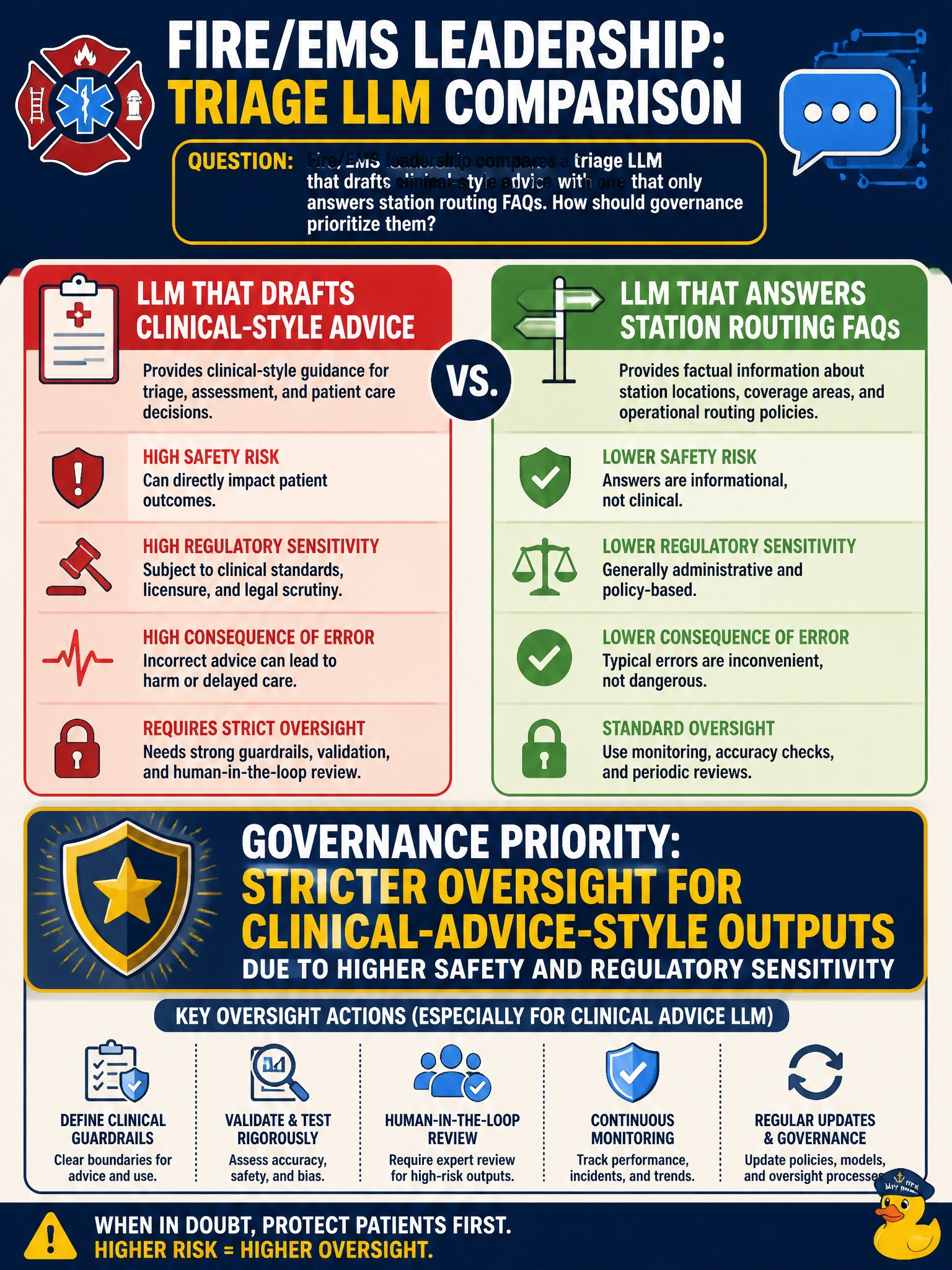
Fire/EMS leadership compares a triage LLM that drafts clinical-style advice with one that only answers station routing FAQs. How should governance prioritize them?
Select an answer to reveal the explanation.
Short Explanation
A triage LLM telling EMS to bypass a heart-attack patient is a different threat than a FAQ bot giving wrong building-hours. Clinical outputs need tighter leashes.
Full Explanation
Prioritizing stricter oversight for clinical-advice-style outputs due to direct impact on care decisions and patient outcomes is the governance principle that reflects their differential risk. Fire/EMS triage output influences care routing and urgency; mistakes can delay treatment or misallocate resources. FAQ chatbots answer publicly available information with lower stakes. Stricter oversight for clinical AI means real-time monitoring, human review on exceptions, and model monitoring for accuracy drift in high-risk decision branches—not just quarterly audits like FAQ systems need.
Prioritizing stricter oversight for FAQ outputs due to higher public visibility and reputational sensitivity confuses exposure with severity; public visibility does not outweigh direct impact on care decisions and patient safety that demands tighter governance for clinical-advice outputs. Applying clinical validation and human-in-the-loop review to triage and FAQ outputs for audit consistency imposes equal burden without equal risk; audit consistency does not justify spending scarce clinical review on low-stakes FAQs while diluting oversight where errors delay treatment. The time cost of a human-in-the-loop review on triage is small compared to the harm of a missed critical condition. Prioritizing pre-deployment validation for FAQ workflows while monitoring triage outputs through user feedback channels is backwards: FAQ systems are lower-stakes and can tolerate lighter validation, while triage requires rigorous pre-deployment validation plus real-time monitoring because user feedback is too slow and unreliable to catch harm from delayed or misrouted care.
Exam caveat: 'stricter oversight' does not mean physicians must individually approve every triage recommendation; it means real-time performance monitoring, well-tuned alerting for output anomalies, and human escalation on exceptions—tooling can make this efficient without becoming a bottleneck.
Operational check: confirm fire/EMS clinical AI systems have real-time monitoring dashboards tracking accuracy on critical decision branches (cardiac, respiratory, trauma), human escalation rules, and weekly review of exceptions by clinical staff.
Prefer to study offline? Printable PDF study book + test engine ($7.50, unofficial). These questions stay free here.