
Which of the following BEST describes the risk introduced when an organization uses an AI model's output as a feature input to a second AI model in a pipeline?
Select an answer to reveal the explanation.
Short Explanation
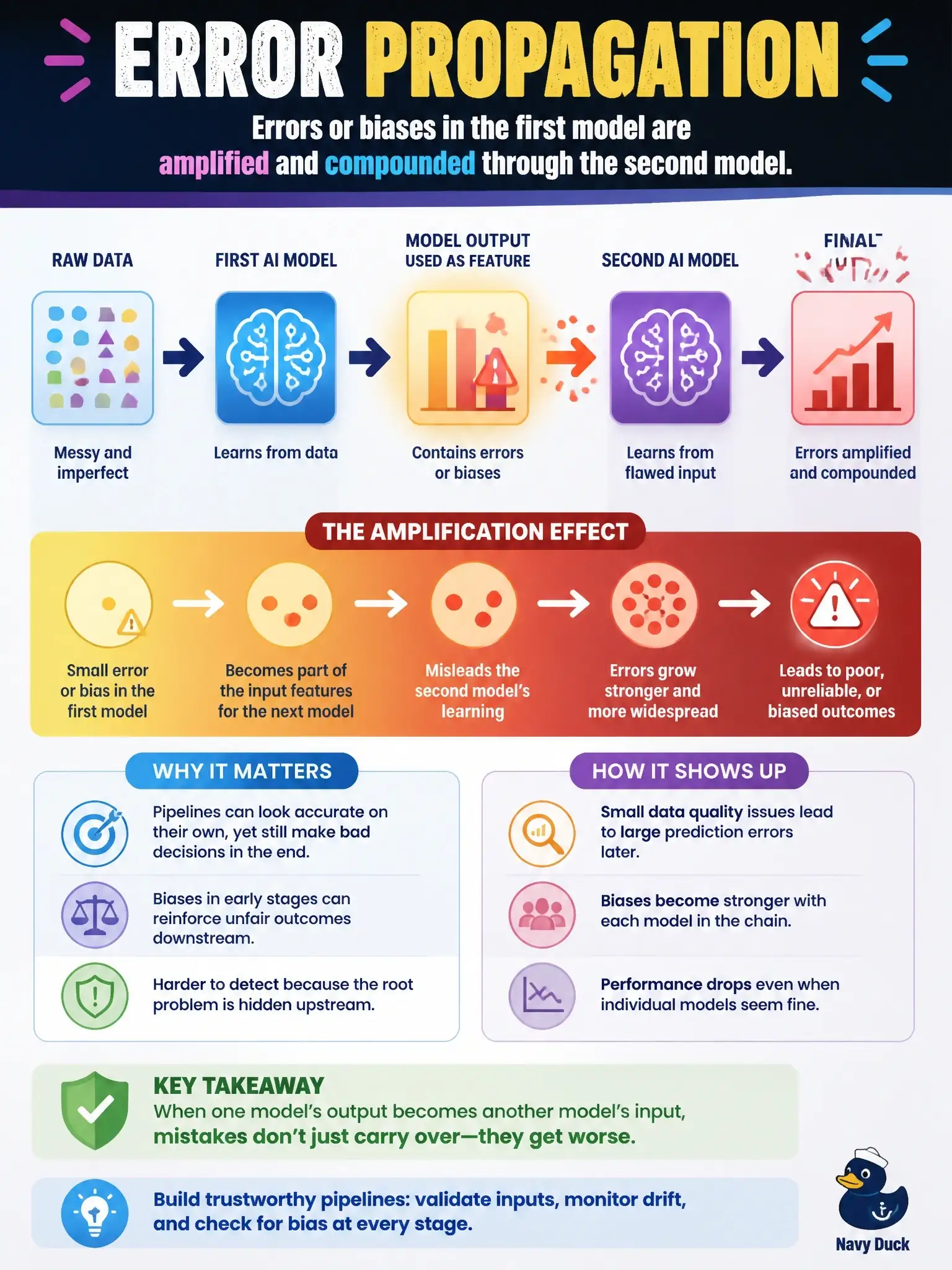
Picture a game of telephone: if the first person mishears the message, everyone down the line repeats the mistake with more confidence. That's what happens when one model's output feeds another. The first model's errors and biases don't wash out; they get baked in and compounded downstream.
Full Explanation
Error propagation is the defining risk of chaining AI models. When the second model treats the first model's output as a trusted feature, any error, drift or bias in that upstream output becomes part of the downstream model's input distribution, and the second model has no independent way to tell a wrong value from a right one. Small upstream inaccuracies can therefore be amplified and compounded, and the combined pipeline can be less reliable than either model evaluated alone. The overfitting option describes a model-training concern, not the characteristic risk of a pipeline; a second model can be well regularized and still inherit bad inputs. The adversarial option rests on an unsupported premise, because receiving processed inputs does not by itself make a model more attackable. The vendor lock-in option is simply false: models from different providers are chained routinely through ordinary data interfaces. On an exam, a BEST question with one precise, defining risk expects that risk rather than a side issue. Operationally, an auditor should confirm that each model in the chain is validated separately and end to end, that upstream outputs carry confidence or quality signals, that bias testing covers the combined pipeline, and that monitoring can trace a downstream failure back to the stage that introduced it.